
2026 California Mortgage Guide for DACA Recipients
Can you qualify for a California home loan as a DACA recipient, even if one lender says no? The answer may depend on more than a program’s published guidelines. A search for “mortgage for DACA recipients california” can turn up broad claims, but lenders may assess applications differently, including how they review work authorization and financial documents.
It’s understandable to want a clear answer before planning a purchase. Mortgage options may be worth exploring, but general guidelines can’t guarantee a particular lender’s approval. A useful next step is a prepared conversation with the lender that will underwrite your application.
This guide explains how to compare potential loan paths, prepare questions about Social Security and Employment Authorization documents, and clarify which requirements come from a loan program versus an individual lender. You’ll also learn how to consider financing as part of a California homebuying plan, from setting a working budget to coordinating mortgage guidance with residential purchase representation. With specific questions and current lender information, you can make informed decisions without assuming every lender uses the same criteria.
Key Takeaways
- For a mortgage for DACA recipients california, treat program guidelines as a starting point and confirm how the lender reviewing your application evaluates eligibility.
- Compare FHA and conventional pathways by asking about documentation, down payment, credit, occupancy, and underwriting requirements.
- Request written, case-specific requirements and clarify which identity, work-authorization, income, and tax records the lender needs.
- Build a step-by-step application plan, compare written loan terms, and share sensitive records only through lender-approved secure channels.
- Align verified financing information, a realistic budget, and your property search before making an offer.
Can DACA Recipients Get a Mortgage in California? Start with the Lender
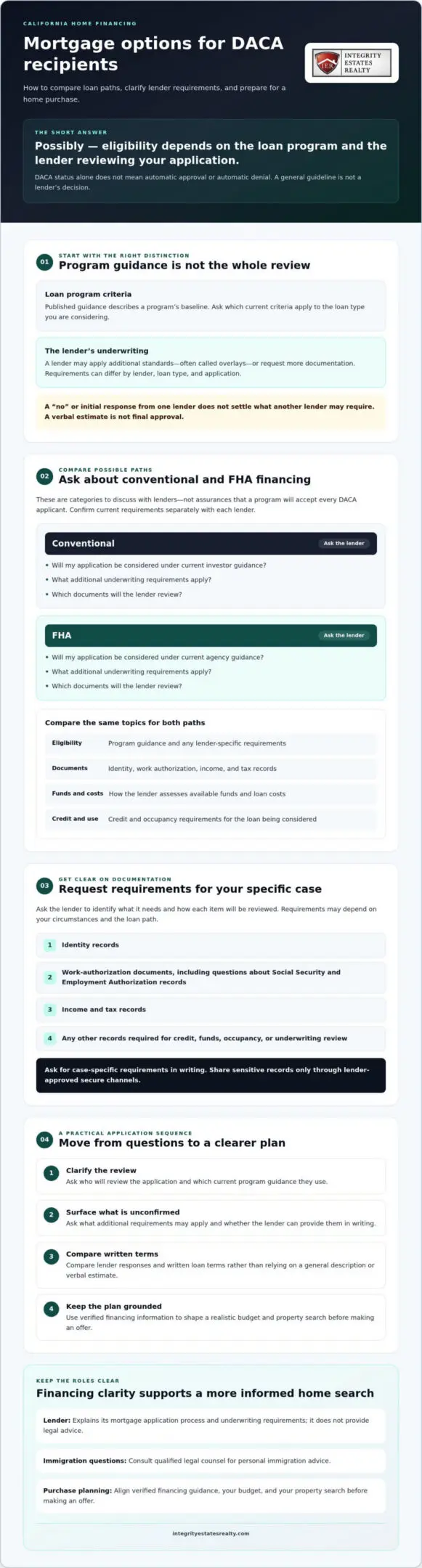
Possibly, but eligibility depends on the current rules for a loan program and the lender reviewing the application. DACA status alone shouldn’t be treated as automatic approval or automatic denial. A lender assesses the full application, and requirements may vary by loan type, lender, and underwriting review. Because guidance and interpretations can change, confirm current requirements directly with the lender before relying on a general answer about a mortgage for DACA recipients california.
Program criteria and lender requirements aren’t always identical. Published criteria describe a program’s baseline; a lender may also apply additional underwriting standards, often called overlays, or request more documentation. For DACA borrowers, lender-specific confirmation means asking the institution reviewing the application how current program criteria and its own requirements apply to your documents and circumstances.
For background on the program itself, see this overview of Deferred Action for Childhood Arrivals (DACA). It provides context, but it doesn’t determine whether a lender will approve a mortgage application.
What should a DACA borrower understand before applying?
Keep separate questions separate. Immigration status, current work authorization, credit history, income, and the property being purchased may each factor into a lender’s review. Ask which criteria apply to the loan type you’re considering, which documents the lender needs, and whether requirements depend on the details of your application. Don’t assume a requirement described for one loan or lender applies everywhere. For personal immigration questions, consult qualified legal counsel; a mortgage lender can explain its application process, not provide legal advice.
Why do lender answers sometimes differ?
Lenders may interpret program guidance through different underwriting standards and use different documentation processes. One lender’s initial response doesn’t settle what another lender will require, and a verbal estimate isn’t final approval. Ask whether the lender has reviewed applications with circumstances similar to yours, what additional requirements may apply, and whether it can provide those requirements in writing. This gives you a clearer basis for comparing responses before making plans around a particular loan path.
Make the first conversation about process, not promises: who will review the application, what current guidance they use, and what remains unconfirmed. That clarity helps you decide what to prepare next without mistaking a general program description for a lender’s decision.
Compare Mortgage Options for DACA Recipients in California Carefully
Conventional and FHA financing are two categories to discuss with lenders, not assurances that a particular program will accept every DACA applicant. Compare the specifics: what rules apply to the loan, which documents the lender will review, and whether its underwriting adds requirements beyond published program or investor guidance. For broader background on FHA financing, see this FHA home loans guide.
How should borrowers compare conventional and FHA financing?
Use the questions below to structure a lender conversation. DACA-specific eligibility requires current confirmation for each loan category and lender. A general program description can’t decide an individual application.
| What to compare | Conventional | FHA |
|---|---|---|
| Eligibility | Will the lender consider my application under current investor guidance? What additional underwriting requirements apply? | Will the lender consider my application under current agency guidance? What additional underwriting requirements apply? |
| Documentation | Which identity, work-authorization, income, and tax records are required? | Which identity, work-authorization, income, and tax records are required? |
| Down payment and costs | How will the lender assess my funds and the costs associated with this loan? | How will the lender assess my funds and the costs associated with this loan? |
| Credit and occupancy | What credit factors and intended property use will be reviewed? | What credit factors and intended property use will be reviewed? |
| Underwriting | Who reviews the file, and what lender-specific conditions may apply? | Who reviews the file, and what lender-specific conditions may apply? |
Don’t compare options using assumed minimum scores, down payments, rates, or loan limits. Ask each lender for current figures and terms that apply to your circumstances, then compare the written responses. This makes a search for a mortgage for DACA recipients california more useful than relying on broad online claims.
What should you ask about lender overlays?
An overlay is an additional lender requirement beyond the baseline criteria the lender says apply. Ask whether the lender accepts your specific documents for the loan program under consideration, and which current agency, investor, and lender requirements govern its review. You can also ask whether it has reviewed similar applications, without assuming that experience guarantees an outcome.
- Record the representative’s name, date, and answer.
- Ask for written clarification of eligibility, documentation, and any additional conditions.
- Confirm whether the answer is preliminary or based on a review of your application.
Because Integrity Estates Realty works through lender relationships and offers FHA loan origination and conventional loan processing, a financing conversation may help you identify questions to take to a lender. For broader broker-selection criteria, see this mortgage broker guide for California homebuyers. Confirm DACA-specific requirements directly with the lender reviewing your application.
Evaluate Lenders by Their DACA Documentation and Underwriting Process
A useful lender conversation should leave you with more than a general yes or no. Find out whether the lender can review your circumstances and intended loan type, what documents it expects, and which requirements still need confirmation. These details help you compare lenders based on the clarity of their process, not just an early estimate.
Questions to ask during an initial lender conversation
Ask how the lender will review your application and who is responsible for evaluating it. Document requests can differ, so don’t assume there’s one standard file for every DACA borrower or loan program. Ask whether the lender needs records related to:
- Identity and immigration status
- Current work authorization
- Income and employment
- Tax history
Then clarify how the lender confirms its current requirements, who makes the final underwriting decision, and when you can expect written feedback. If the response is preliminary, ask what additional review is needed before you can rely on it.
Before paying application-related costs, verify the current program requirements and the lender’s own requirements for your specific application. This is a practical safeguard when exploring a mortgage for DACA recipients california, because a broad description of a loan program may not reflect the lender’s complete process.
How to recognize a reliable, transparent response
A helpful representative distinguishes confirmed information from details that still need review. Be cautious if someone promises approval before reviewing your complete application or can’t explain which requirements apply to the loan type you’re considering. A careful answer may include questions for you, a request for documents, or a clear explanation of what the lender hasn’t yet confirmed.
Keep a record of who you spoke with, when you spoke, and what requirements they described. If a later request differs from what you understood, ask the lender to explain the change and provide updated details in writing before proceeding. Written clarification is a more reliable basis for comparing lenders than memory or verbal estimates alone.
For broader criteria to consider when assessing a mortgage professional, read the Santa Clara County mortgage broker guide. Integrity Estates Realty works through lender relationships, so a financing conversation can help you organize questions while the lender underwriting your application confirms its requirements. Explore mortgage and homebuying guidance as you plan your next steps.
Prepare Your California Mortgage Application Step by Step
A steady preparation process can make lender conversations more productive and connect financing research to your home search. Requirements vary, so use these steps as a framework and let the lender identify what applies to your application.
- Define a working budget. Consider the payment and other homeownership expenses that fit your finances. Treat this as a planning range, not a loan approval.
- Contact lenders. Ask whether they can review your intended loan type and circumstances, and how they handle a preliminary assessment.
- Confirm current requirements. Find out which program and lender criteria will guide the review and what remains subject to verification.
- Gather requested records. Follow the lender’s instructions rather than assembling documents based on another borrower’s checklist.
- Compare written terms. Review each lender’s written information, questions, and conditions before deciding how to proceed.
As you explore a mortgage for DACA recipients california, discuss income, employment history, credit, debts, and available funds with the lender. Share sensitive records only through channels the lender has approved for secure document submission. If you’re unsure whether a message or upload method is legitimate, confirm the process with the lender before sending anything.
Which records might a lender ask you to discuss?
Depending on the lender and application, the conversation may involve identity, work-authorization or immigration-related records, income and employment information, asset records, and tax documents. These are examples, not a universal checklist. Ask which items are needed, how the lender wants them submitted, and what to do if a document is missing, expired, or updated. Confirm whether an alternative or newer record is acceptable before assuming it is.
How does preapproval fit into the buying timeline?
A lender may review information about your finances and the proposed loan before issuing a preapproval, but the scope and outcome depend on that lender’s process. Preapproval isn’t a final loan commitment or a guarantee that financing will close. Ask what has been reviewed, what remains outstanding, and whether any stated parameters could change after further underwriting.
Use confirmed financing parameters to shape a realistic property search and discuss an offer strategy with your real estate professional. For related local context, consult this Gilroy homebuyer’s financing guide. Integrity Estates Realty brings mortgage guidance and California residential purchase representation together; discuss your homebuying and mortgage options as you plan your next steps.
Plan Your California Home Purchase with Verified Financing Guidance
A sound purchase plan brings three pieces together before you make an offer: lender-confirmed requirements, a budget that fits your finances, and a property search shaped by verified financing parameters. For anyone assessing a mortgage for DACA recipients california, keep the lender’s review separate from the decision about which home to pursue. A preliminary estimate can help frame questions, but it isn’t a substitute for current, case-specific confirmation from the lender.
How can a mortgage broker and real estate agent support different parts of the process?
The lender reviews and underwrites the mortgage application, determines what documentation is needed, and makes financing decisions through its process. A real estate professional can help you identify properties, prepare offers, and coordinate purchase milestones. These roles can work alongside one another, but a real estate professional doesn’t decide loan eligibility. Neither role replaces immigration or legal advice from a qualified professional.
Integrity Estates Realty represents residential buyers in California and provides mortgage services through lender relationships. That can connect purchase planning with a financing conversation, but it isn’t a DACA-specific approval promise. Confirm eligibility and underwriting requirements with the lender responsible for reviewing your application.
What should you do if a lender cannot confirm eligibility?
Ask what remains unresolved. Is the lender waiting to verify a program requirement, review a particular document, or clarify its own underwriting policy? Request a clear explanation of what information could resolve the question and whether the lender can provide its response in writing. If uncertainty remains, you can seek another lender’s review rather than assuming every lender follows identical criteria.
Keep your plans measured. Don’t make a purchase commitment based on eligibility the lender hasn’t verified. Once you have clearer financing parameters, you and your real estate professional can align the property search and offer strategy with your budget and purchase timeline. If requirements change, revisit the plan before proceeding.
Buying a home is a significant decision. A careful sequence can help you move forward with greater clarity: confirm financing, establish a realistic search range, then evaluate homes and offers with the relevant professionals. To discuss your California homebuying plans and financing questions with Integrity Estates Realty, Discuss your California homebuying plans.
Take Your Next California Homebuying Step with Clarity
A thoughtful plan starts with a lender’s current, written requirements, a budget grounded in your finances, and a home search that reflects confirmed financing parameters. For a mortgage for DACA recipients california, program descriptions are only a starting point: the lender reviewing your application must confirm how its current criteria apply to your circumstances.
Keep the roles clear. Lenders assess and underwrite mortgage applications; real estate professionals help with property search, offers, and purchase milestones. Integrity Estates Realty provides California residential real estate representation and mortgage loan services through lender relationships. Its Gilroy-based team serves buyers in communities including San Jose, Hollister, Salinas, Seaside, Soledad, Prunedale, San Francisco, Hayward, San Leandro, Livermore, Merced, Los Banos, Delhi, Gustine, Stockton, Tracy, Modesto, Turlock, Sacramento, Madera, Fresno, and Clovis. DACA-specific eligibility should always be confirmed directly with the lender.
If you’re ready to discuss your homebuying plans and financing questions, connect with Integrity Estates Realty. A conversation can help you identify useful next steps as you work toward a home purchase with greater confidence.
Frequently Asked Questions
Can DACA recipients get a mortgage in California?
Possibly, but approval depends on current loan-program guidance, the lender’s requirements, and the details of the application. DACA status alone doesn’t guarantee approval or mean automatic denial. Ask the lender reviewing your file how it evaluates your intended loan type, work authorization, finances, and property plans. For a mortgage for DACA recipients california, confirm current requirements directly with the lender rather than relying on general program descriptions.
Can DACA recipients qualify for an FHA loan in California?
Current 2026 guidance reported for FHA-insured mortgages indicates DACA recipients may be eligible, subject to applicable program requirements and lender underwriting. Confirm the latest guidance and ask the lender whether it will review your specific application. Discuss which identity and work-authorization documents it requires, along with credit, income, occupancy, and down-payment criteria. A general FHA description can help you prepare questions, but it can’t determine your individual approval outcome.
What documents might a DACA recipient need for a mortgage application?
A lender may ask to review identity and work-authorization records, income and employment information, asset records, and tax documents. The exact file depends on the loan type, lender, and application, so don’t assume another borrower’s checklist applies to you. Ask which records are needed, whether they must be current, and how to handle missing, expired, or updated documents. Submit sensitive information only through lender-approved secure channels.
Do DACA recipients need a Social Security number to apply for a mortgage?
Current guidance for FHA and conventional loan pathways specifies a valid Social Security number, but confirm the requirement for the specific program and lender reviewing your application. Ask how the lender will assess your number alongside work-authorization documents and other application records. Requirements and underwriting can vary, so don’t treat a general answer as a decision on your eligibility. For personal immigration questions, consult qualified legal counsel.
Can a DACA recipient get a conventional mortgage in California?
Conventional financing may be a pathway to investigate. Current 2026 guidance indicates DACA borrowers with a valid Social Security number and Employment Authorization Document may be considered, but individual lenders can apply additional requirements. Ask which investor guidance and lender standards apply, what documentation is needed, and how credit, income, occupancy, and down payment will be reviewed. Confirm current criteria with the lender underwriting your application before relying on an estimate.
Does mortgage preapproval guarantee a DACA recipient will get a home loan?
No. Preapproval is not a final loan commitment or a guarantee that financing will close. A lender may review financial information before issuing it, but further underwriting and confirmation of application details may still be required. Ask what the lender has reviewed, what remains outstanding, and whether the terms or conditions could change. Use confirmed financing information to guide your home search, and avoid making a purchase commitment based on an unverified assumption.
Should DACA recipients speak with a mortgage broker before looking at homes?
Yes, an early financing conversation can help you frame a realistic home search and prepare lender questions, though it can’t confirm eligibility. Integrity Estates Realty is based in Gilroy and serves buyers in San Jose, Hollister, Salinas, Seaside, Soledad, Prunedale, San Francisco, Hayward, San Leandro, Livermore, Merced, Los Banos, Delhi, Gustine, Stockton, Tracy, Modesto, Turlock, Sacramento, Madera, Fresno, and Clovis. The lender makes financing decisions.