
Cost of Living in Tracy, CA: A Comprehensive 2026 Lifestyle & Real Estate Guide
Can a $665,000 investment truly buy you a sanctuary that balances professional ambition with a peaceful community lifestyle? As of March 2026, Tracy stands as a strategic middle ground for those weary of the Bay Area’s price tags, yet the reality of the cost of living in tracy ca being 24% higher than the national average requires a steady, expert hand to navigate. We understand that you’re likely feeling the pressure of rising interest rates and the uncertainty of utility costs, especially with electricity rates sitting at $0.29 per kilowatt-hour. You want more than just a house; you want a legacy built on a foundation of financial logic and transparency.
In this comprehensive guide, we’ll demystify your future expenses by breaking down essential data, from the 8.25% local sales tax to the nuances of property taxes under Proposition 13. You’ll gain a clear understanding of your potential monthly budget and discover how our partnership, rooted in integrity, can help you secure a mortgage with confidence. We’ll preview the current real estate landscape, evaluate the true price of the commute, and provide the actionable steps needed to transition from a cautious observer to a proud homeowner in this thriving California community.
Key Takeaways
- Understand why Tracy functions as a strategic value play for those seeking a sanctuary outside the expensive Bay Area core as of May 2026.
- Analyze the comprehensive cost of living in Tracy, CA; including the $665,000 median home price and the specific impact of interest rates on family residences.
- Identify the hidden costs of Central Valley summers, such as the $0.29 per kWh electricity rate, and how local grocery expenses compare to the national average.
- Calculate the commuter’s math for San Jose and San Francisco routes to evaluate the true financial and lifestyle trade-offs of your daily travel.
- Gain professional advice on timing the market and selecting specialized loan products to maximize your long-term equity and peace of mind.
Understanding the Tracy Cost of Living Index in 2026
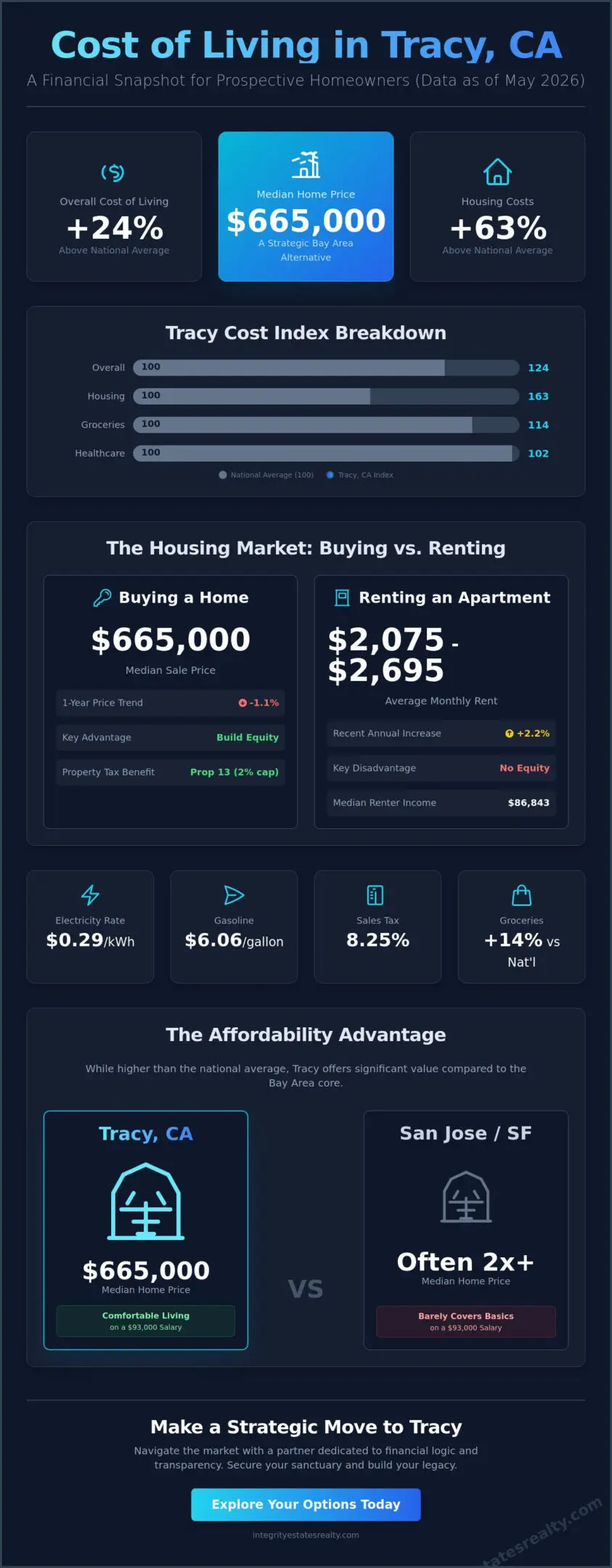
A cost of living index acts as a vital financial barometer, measuring how far your dollar stretches compared to a national baseline of 100. As of May 2026, the cost of living in tracy ca sits approximately 24% above that national mark. While this premium might seem high at first glance, the city remains a strategic value play for those migrating from the expensive Bay Area core. We view Tracy as a middle ground where professional ambition meets a sustainable lifestyle. The primary drivers of local expenses include housing, which remains 63% higher than the national average, and energy rates that reached $0.29 per kilowatt-hour this month. These costs are balanced by a robust local economy and a median household income for renters that stays steady at $86,843.
The 2026 economic landscape in the Central Valley is defined by a careful dance between cooling home prices and persistent service inflation. While the median home sale price in Tracy decreased by 1.1% in March 2026, daily logistics like gasoline reached an average of $6.06 per gallon. Navigating these numbers requires a partner who values transparency over a quick sale. We focus on helping you understand these variables so your move feels like a seamless transition rather than a financial shock.
Tracy vs. The National Average: The Reality of California Pricing
Comparing Tracy to the national average often feels like comparing apples to oranges because the California market operates under unique regulatory and economic constraints. National data doesn’t account for the specific benefits of living in Tracy, California, such as the protections offered by Proposition 13 which limits property tax increases to 2% annually. The 2026 Tracy cost of living index serves as a refined metric that accounts for these persistent assessed value limits against the backdrop of current inflationary pressures. Groceries and healthcare also trend higher than the national baseline, sitting at 14% and 2% above average respectively, reflecting the higher cost of labor and logistics in the Golden State.
Relative Affordability: Comparing Tracy to San Jose and San Francisco
The true appeal of Tracy becomes clear when you look west toward Silicon Valley. With a median home price of $665,000 as of March 2026, Tracy offers a significant delta in price-per-square-foot compared to San Jose or San Francisco, where similar properties often command double the price. A salary of $93,000 allows a single adult to live comfortably here, a figure that would barely cover basic necessities in the city. This financial breathing room allows for true lifestyle curation. You aren’t just buying a house; you’re investing in a sanctuary where your equity can grow while you enjoy a community rooted in local pride and reliability.
The Housing Market: Real Estate and Mortgage Costs in Tracy
Securing a home in the Central Valley requires a blend of financial precision and local insight. As of March 2026, the median home price in Tracy settled at $665,000, reflecting a slight 1.1% decrease from the previous year. This cooling trend offers a window of opportunity for families seeking a sanctuary without the aggressive bidding wars common in the Silicon Valley core. While housing remains 63% higher than the national average, the value per square foot continues to favor those willing to trade a commute for a legacy property. Understanding Tracy, CA economic data helps reveal how these prices align with a median household income that supports long term equity growth.
The rental landscape serves as a flexible entry point, though it lacks the wealth building potential of ownership. Average monthly rents in May 2026 range from $2,075 to $2,695. For many, the transition from renter to owner is driven by the desire for stability and the tax advantages inherent in California real estate. Working with a dedicated partner ensures you don’t just find a house, but a sound financial asset tailored to your family’s future.
Buying vs. Renting in the Tracy Triangle
Choosing between a lease and a deed involves more than just a monthly check. Homeownership allows you to lock in housing costs, protecting you from the annual rent increases that have averaged up to 2.2% recently. Leveraging the expertise of mortgage brokers in Santa Clara County can help you navigate the current interest rate environment to find a monthly payment that rivals local rents.
| Metric (3-Bedroom Home) | Renting (Monthly) | Buying (Estimated Monthly) |
|---|---|---|
| Base Payment | $2,488 (Average) | Varies by Rate/Down Payment |
| Property Tax & Insurance | Included | ~0.77% to 1.23% (Tax) |
| Equity Accumulation | 0% | 100% of Principal Paid |
| Maintenance Control | Landlord Dependent | Full Autonomy |
Financing Your Tracy Dream: FHA, VA, and Conventional Loans
The path to ownership is paved with diverse financing options. For first time buyers, FHA home loans in Gilroy and Tracy offer accessible down payment requirements. Veterans can utilize VA loans to secure a home with zero down payment, honoring their service with a path to stability. If you’re eyeing the executive estates in south Tracy, our Jumbo loan origination services provide the capital necessary for higher value acquisitions. Our team at Integrity Estates Realty is here to guide you through these complex calculations with total transparency.
To navigate the 2026 market with confidence, follow this pre-approval checklist:
- Gather two years of tax returns and W-2 statements.
- Verify your debt to income ratio is below 43% for most conventional products.
- Ensure your credit report is accurate and reflects a history of reliability.
- Document all sources of your down payment, including gift funds if applicable.
Securing these details early allows us to act swiftly when your ideal property hits the market, ensuring a seamless closing process.
Daily Essentials: Utilities, Groceries, and Healthcare Expenses
Operating a home in the Central Valley involves more than just the mortgage payment; it’s about managing the daily “burn rate” of a sophisticated lifestyle. The cost of living in tracy ca is uniquely influenced by the regional climate and the logistical demands of Northern California. While residents benefit from the Ava Community Energy program’s cleaner options, electricity rates remain a significant consideration at $0.29 per kilowatt-hour as of May 2026. This rate is 46% higher than the national average, reflecting the premium paid for California’s energy infrastructure. Natural gas costs for standard residential customers are approximately $2.792 per therm, requiring a methodical approach to monthly budgeting to ensure your sanctuary remains both comfortable and cost-effective.
Managing Utility Costs in a High-Heat Climate
Summer in Tracy brings a vibrant energy, but it also brings high temperatures that test any household budget. PG&E rates in 2026 continue to trend upward, making energy-efficient upgrades a wise investment for long-term equity. Homeowners who prioritize high-ROI improvements, such as radiant barrier insulation or smart HVAC systems, often see a seamless stabilization of their monthly expenses. A typical 2,000 square foot residence in Tracy can expect summer utility bills to surge by $200 to $300 monthly when temperatures consistently exceed 90 degrees. Investing in solar panels or participating in local energy discount programs can help mitigate these seasonal spikes and provide peace of mind throughout the year.
Food and Healthcare: Budgeting for the Basics
Grocery costs in Tracy sit approximately 14% higher than the national average, a reflection of the state’s higher labor and transportation costs. However, the city’s proximity to the nation’s most productive farmland offers a unique advantage. Local farmers’ markets provide access to fresh, seasonal produce that often bypasses the retail markups of traditional supermarkets. A family of four in 2026 typically allocates $1,250 per month for groceries to maintain a balanced, healthy kitchen. This investment in quality is a cornerstone of the community lifestyle that many former city dwellers find so appealing.
Healthcare accessibility is another pillar of the Tracy experience, with costs trending just 2% above the national average. Major providers like Kaiser Permanente and Sutter Health have a strong presence, offering comprehensive care for growing families and seniors alike. According to the U.S. Census Bureau QuickFacts, the city’s growing population has supported a steady expansion of local medical facilities. Pet owners should also account for veterinary care, which mirrors the regional healthcare trend. Annual wellness exams and preventative care for a medium-sized dog in Tracy generally range from $250 to $400, ensuring every member of your family is well-tended in your new home.
The Commuter’s Math: Transportation and Opportunity Costs
For many professionals, the decision to call Tracy home is a calculated trade-off between hours on the road and the quality of their personal sanctuary. While the cost of living in tracy ca remains attractive compared to Silicon Valley, the transportation budget is where the “hidden tax” of the Central Valley resides. You aren’t just paying for gas; you’re investing time to secure a piece of community and equity that’s increasingly rare in the Bay Area core. We believe in looking at these numbers with total transparency so your move feels like a strategic advancement rather than a compromise.
The Altamont Pass: Fuel, Tolls, and Maintenance
As of May 1, 2026, the average price for regular gasoline in California reached $6.06 per gallon. For a commuter traveling from Tracy to San Jose five days a week, fuel expenses alone can exceed $520 monthly. When you add the cost of I-580 express lane tolls and the accelerated maintenance schedule required for high-mileage vehicles, the financial burden is clear. Tires and oil changes come faster when you’re adding 25,000 miles to your odometer annually. Insurance providers also adjust premiums based on these long distances, reflecting the increased risk of a daily Altamont Pass crossing. To mitigate these costs, many residents utilize carpooling programs to access HOV lanes, which can save up to 45 minutes of travel time and significantly reduce wear on personal vehicles.
Public Transit: Is the ACE Train Worth It?
The Altamont Corridor Express (ACE) train offers a sophisticated alternative to the grind of the daily drive. With 2026 schedules tailored for the professional workday, the train transforms a stressful commute into a productive workspace or a period of quiet reflection. Monthly passes offer a predictable expense that shields you from the volatility of gas prices. Proximity to the Tracy station has a direct impact on local property values; homes within a three-mile radius often command a premium due to this seamless connectivity. Choosing the train isn’t just a financial decision; it’s a commitment to your mental health and long-term well-being.
The opportunity cost of commuting is often weighed against the $665,000 median home price found in Tracy. While you may spend more time in transit, you’re building equity in a stable market rather than paying off a landlord’s mortgage in an overpriced city center. If you’re ready to balance your career goals with a smart real estate investment, consult with Integrity Estates Realty to explore properties that align with your specific commuting needs.
Strategic Living: Navigating the Tracy Market with Integrity
Choosing to call Tracy home is more than a simple relocation; it’s a strategic decision to prioritize your family’s future and long-term stability. While the cost of living in tracy ca is 24% higher than the national average, the community offers a sophisticated balance of professional opportunity and residential peace that is increasingly rare. We view the current 1.1% dip in median home prices as a distinct window for buyers to secure a sanctuary at $665,000 before the next market cycle begins. Success in this environment requires an ethical anchor, a partner who values your peace of mind as much as the transaction itself.
Timing the market isn’t about chasing the lowest price, but about finding the highest value. By analyzing local data and 2026 economic trends, we help you identify properties with the strongest potential for equity growth. Our collaborative approach ensures that every detail, from the 8.25% sales tax to the nuances of local school districts, is factored into your financial legacy. We believe that transparency is the foundation of every successful move, turning a complex process into a seamless journey toward your new front door.
Expert Guidance for Your Move
At Integrity Estates Realty, we don’t just sell houses; we curate lifestyles. Our team integrates professional real estate representation with in-house expertise in FHA, VA, and conventional loan processing. This holistic view allows us to spot opportunities that others might miss, ensuring your financing is as solid as the home you choose. For those seeking a broader perspective on the region, reviewing Gilroy real estate market trends can provide valuable context on how the Central Valley and South Bay markets interact. This regional insight is crucial for professionals who work in Silicon Valley but seek the community-centric atmosphere Tracy provides.
Maximizing Your Investment
Protecting your investment requires a deep understanding of local tax structures. In many of Tracy’s newer developments, you’ll encounter Mello-Roos assessments alongside the standard San Joaquin County property tax rates of 0.77% to 1.23%. We help you navigate these costs so there are no surprises at closing. If you’re a first-time buyer, our strategy focuses on leveraging low down-payment options to help you transition from the $2,488 average rent into a home that builds your personal wealth. We’re here to show you that with the right guidance, the dream of California homeownership is still within reach.
Your 2026 Moving to Tracy Checklist:
- Secure a 2026 mortgage pre-approval to understand your true buying power.
- Audit the utility history of potential homes to project summer PG&E costs.
- Map your daily commute, whether via the Altamont Pass or the ACE Train.
- Review the specific property tax and Mello-Roos obligations for your target neighborhood.
- Partner with a local expert who prioritizes transparency and ethical conduct.
Every home has a story, and we’re dedicated to helping you write yours with confidence and clarity. Contact Integrity Estates Realty today for a personalized Tracy market analysis and take the first step toward your new sanctuary.
Your Future in the Central Valley Starts Here
Deciding to relocate is a significant life milestone that requires more than just a moving truck; it demands a strategic vision for your family’s legacy. We’ve explored how Tracy serves as a vital bridge between the professional intensity of the Bay Area and a more balanced, community focused lifestyle. Understanding the total cost of living in tracy ca is the first step toward a successful transition, allowing you to weigh the $665,000 median home price against your long term financial goals. With over 20 years of California real estate expertise, our team at Integrity Estates Realty provides the authoritative guidance you need to navigate this journey with peace of mind.
Our integrated mortgage and brokerage services ensure your path to homeownership is efficient and transparent. We believe in ethical conduct and lifestyle curation, treating your home search as a collaborative partnership rather than a simple transaction. By choosing a partner who values your story as much as the data, you can secure a sanctuary that offers both financial stability and personal fulfillment. Ready to find your sanctuary in Tracy? Connect with our local experts today. We look forward to helping you build your future in a community you’ll be proud to call home.
Frequently Asked Questions
Is Tracy, CA more expensive than Stockton or Modesto?
Yes, Tracy commands a price premium over Stockton and Modesto due to its strategic position as a gateway to the Bay Area. While those cities offer lower housing costs, Tracy provides a unique balance of community and professional accessibility. As of March 2026, the median home price here is $665,000, reflecting its status as a premier choice for those who work in Silicon Valley but seek a suburban sanctuary.
How much income do you need to live comfortably in Tracy in 2026?
To live comfortably as a single adult in Tracy, we recommend a pre-tax salary of approximately $93,000. This figure accounts for the fact that the cost of living in tracy ca is 24% higher than the national average. For families, the required income scales upward to accommodate housing costs that sit 63% above national marks. This ensures enough breathing room for utilities, groceries, and long-term equity building.
What are the average property taxes in Tracy, California?
Property owners in Tracy can expect an effective tax rate between 0.77% and 1.23% of the assessed property value. This includes the 1% base rate established by California law, along with specific local levies for schools and emergency services. Thanks to Proposition 13, your property’s assessed value won’t increase by more than 2% annually unless the home is sold, providing long-term financial predictability for your household budget.
Are there Mello-Roos taxes in Tracy neighborhoods?
Yes, Mello-Roos assessments are common in many of Tracy’s newer residential communities. These special tax districts fund essential local infrastructure like parks, roads, and schools that make these neighborhoods so desirable. When exploring newer developments, it’s vital to review the specific tax disclosures. We prioritize transparency in every transaction, ensuring you understand these monthly obligations before you commit to your new home and lifestyle.
How does the cost of living in Tracy compare to Livermore?
Tracy is significantly more affordable than Livermore, which typically sees higher price-per-square-foot metrics due to its closer proximity to the Tri-Valley tech hubs. While Livermore offers a shorter commute, Tracy’s $665,000 median home price allows buyers to secure larger residences and more land for their investment. This delta makes Tracy the preferred choice for growing families who want to maximize their purchasing power without sacrificing a sophisticated lifestyle.
Can I find FHA-approved homes in Tracy?
You can certainly find FHA-approved homes in Tracy, as many properties fall within the current loan limits for San Joaquin County. These homes offer a seamless entry point for first-time buyers or those with limited down payment funds. Our team specializes in FHA loan origination, providing a collaborative partnership to guide you through the approval process. We focus on finding homes that meet both your aesthetic dreams and strict FHA safety standards.
What is the average monthly utility bill for a home in Tracy?
Residential utility bills in Tracy vary by season, but a 2,000 square foot home often averages between $250 and $450 monthly. Electricity rates sit at $0.29 per kWh as of May 2026, while natural gas costs approximately $2.792 per therm. During the peak of Central Valley summers, air conditioning usage can cause these figures to rise. Investing in energy-efficient upgrades is a smart way to stabilize these monthly expenses and protect your comfort.
Is the ACE train a viable way to save on transportation costs?
The ACE train is a strategic choice for commuters looking to bypass the stress of the Altamont Pass while saving on vehicle maintenance. With gasoline averaging $6.06 per gallon as of May 2026, the cost of a daily drive adds up quickly. The train offers a predictable monthly expense and restores valuable time to your day. It allows you to focus on work or relaxation, turning a standard commute into a productive part of your life.