
1031 Exchange Properties in Madera County: The 2026 Investor’s Guide
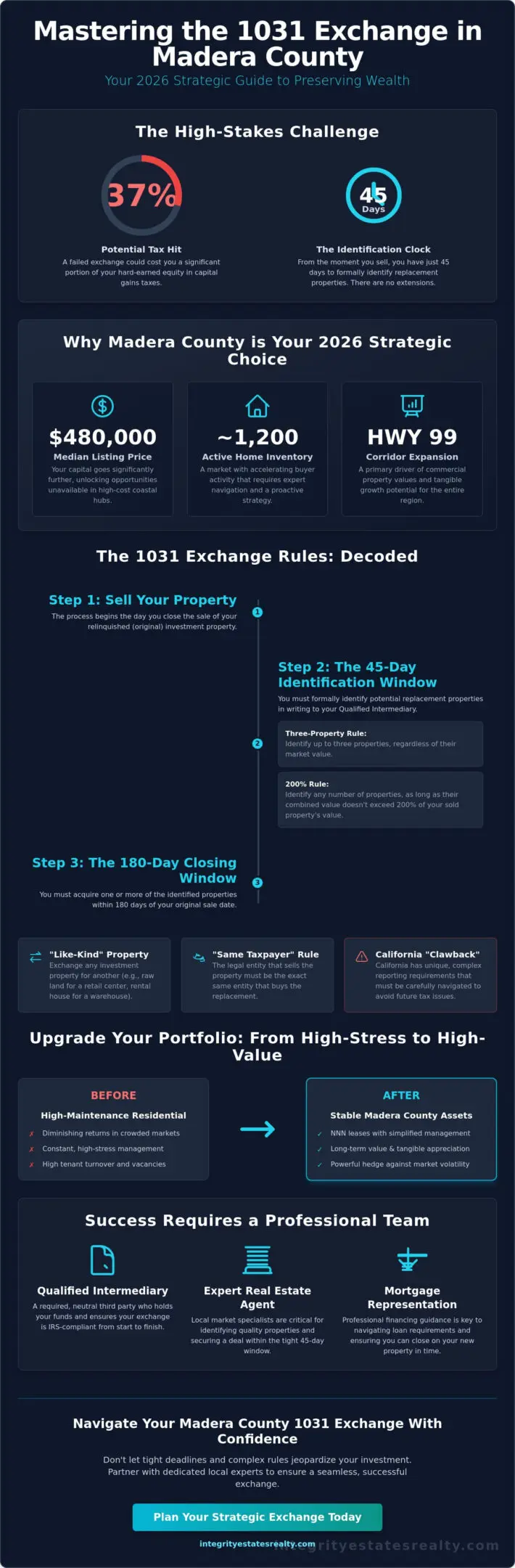
Imagine standing on day 40 of your identification period, watching the clock tick down while searching for a replacement asset that actually makes financial sense. In a market where buyer activity is accelerating and inventory sits at roughly 1,200 homes, finding quality 1031 exchange properties in Madera County requires more than just a quick search; it requires a proactive strategy. You’ve worked hard to build your equity, and it’s natural to feel the weight of a potential 37% tax hit if that 45-day window closes before you’ve secured a deal.
We understand that the pressure of IRS timelines combined with California’s unique “clawback” reporting can make a high-stakes transaction feel overwhelming. This guide is designed to provide the clarity you need to navigate these hurdles with confidence. You’ll discover how to identify high-performing assets amidst the current $480,000 median listing price environment and learn the steps to ensure a seamless transition. We’ll explore the local nuances of the 2026 market, helping you move from the stress of a looming deadline to the peace of mind that comes with a well-executed investment managed by dedicated local experts.
Key Takeaways
- Learn why Madera County has emerged as a premier 2026 destination for investors seeking to move capital from high-density coastal markets into more resilient local assets.
- Master the non-negotiable IRS timelines, including the 45-day identification window and the 180-day closing period, to ensure your tax deferral remains intact.
- Discover how to transition from high-maintenance residential units into stable Triple Net (NNN) commercial leases that offer long-term value and simplified management.
- Identify and acquire 1031 exchange properties in Madera County while strategically avoiding “boot” and navigating California’s complex tax reporting and clawback requirements.
- Understand the critical role of a Qualified Intermediary and how professional real estate and mortgage representation can streamline your path to a successful exchange.
Navigating 1031 Exchange Properties in Madera County: A 2026 Strategic Overview
A 1031 exchange isn’t just a tax loophole; it’s a sophisticated wealth-preservation strategy. By utilizing Internal Revenue Code section 1031, you can defer capital gains taxes on the sale of investment property by reinvesting those funds into a replacement asset of “like-kind.” In 2026, many savvy investors are focusing their attention on 1031 exchange properties madera county to escape the diminishing returns and high entry costs of overcrowded coastal hubs. This shift represents a broader movement toward the Central Valley, where land remains accessible and growth potential is tangible.
As a local brokerage, we see a growing trend of investors moving away from high-maintenance residential rentals in the Bay Area toward commercial and agricultural assets in Madera. The logic is sound. You’re trading high-stress management for assets that offer stability and long-term appreciation. Securing these properties requires a deep understanding of local zoning and market cycles, which is where expert local representation becomes your most valuable asset. We help you bridge the gap between financial logic and your long-term lifestyle goals.
Why Madera County is a Strategic Choice for 1031 Investors
The ongoing expansion of the Highway 99 corridor is a primary driver of commercial property values in the region. While Santa Clara and San Francisco see prices that often prohibit entry for mid-sized investors, Madera County remains remarkably affordable. With a median listing price of $480,000 as of March 2026, your capital goes significantly further here. Additionally, the region’s agricultural land serves as a powerful tool for wealth preservation. It offers a tangible hedge against inflation and market volatility that few urban assets can match. The stability of the Central Valley provides a sense of security that is increasingly rare in more speculative markets.
The Core Benefits of a 1031 Tax-Deferred Exchange
The most immediate advantage is the power of tax-free compounding. When you reinvest 100% of your sale proceeds without the IRS taking a significant cut, your wealth grows exponentially faster. Many of our clients use this mechanism to consolidate multiple smaller properties into a single, high-performing commercial asset. It’s also a cornerstone of smart estate planning. By following the “swap till you drop” strategy, you can continue deferring taxes throughout your lifetime, eventually passing the assets to heirs who receive a step-up in basis. This process can potentially eliminate the deferred tax liability entirely, securing your family’s financial legacy for generations.
Understanding the IRS Rules and California’s Unique 1031 Regulations
The 45-Day Identification and 180-Day Closing Windows
The 45-day rule is the most common point of failure for investors. From the moment you close the sale of your original property, you have exactly 45 calendar days to formally identify your replacement. There are no extensions for weekends or holidays. Most investors utilize the Three-Property Rule, which allows you to identify up to three potential properties regardless of their fair market value. Alternatively, the 200% Rule permits you to identify any number of properties as long as their combined value doesn’t exceed twice the value of what you sold. With buyer activity accelerating in early 2026 and inventory hovering around 1,200 homes, waiting until day 30 to start your search for 1031 exchange properties madera county is a recipe for unnecessary stress. You have a total of 180 days to close, but that initial 45-day sprint determines your destiny.
Navigating California’s “Clawback” Provision and Form 3840
California is notoriously protective of its tax revenue, and the “clawback” provision is proof of that dedication. If you exchange a property located in Madera County for a replacement property in a different state, California doesn’t simply forget about the deferred gain. You’re required to file FTB Form 3840 every year to report the status of that out-of-state property. This allows the state to “claw back” the taxes when you eventually sell that asset in a taxable transaction. While Madera County offers incredible local value, you’re still bound by these state-level reporting requirements. Securing a replacement requires a partner who understands these nuances; our team at Integrity Estates Realty provides the steady hand needed to navigate these technicalities.
It’s also vital to be aware of California Assembly Bill 1611 for the 2026 tax year. If you own 50 or more single-family residential rental properties, new regulations may prohibit you from deferring capital gains on those specific assets. This makes the transition into commercial or agricultural sectors even more attractive for large-scale portfolio holders looking to maintain their tax-advantaged status.
Strategic Property Types for 1031 Exchanges in Madera County
Selection is the soul of a successful exchange. In 2026, the most resilient 1031 exchange properties madera county are those that align with a “hands-off” management philosophy. We’re seeing a significant migration toward Triple Net (NNN) commercial leases. These assets shift the burden of property taxes, insurance, and maintenance onto the tenant. It’s a sophisticated way to secure your cash flow while reclaiming your time. For the investor moving out of a high-maintenance apartment complex, this transition offers a profound sense of relief and financial clarity.
Multi-family housing also plays a vital role in Madera’s growing suburban pockets. Evaluating these opportunities requires a keen eye for cap rate compression. When you identify a property in an area with pending infrastructure improvements, the potential for the cap rate to decrease, and the property value to increase, becomes a powerful driver of your long-term wealth. You aren’t just buying current income; you’re positioning yourself in the path of progress. We focus on identifying these “path of growth” assets before the broader market catches on, ensuring your exchange results in a high-performing legacy asset.
Agricultural Land and Productive Orchards
It’s a common misconception that you must exchange like-for-like in terms of specific property use. You can absolutely trade a suburban rental home for a productive almond orchard or vineyard. In Madera County, land valuation depends heavily on water rights and soil quality. As of June 2026, permanent crops remain a robust long-term wealth preservation tool. However, you must verify the specific water district allocations and groundwater sustainability plans before closing. The stability of agricultural land provides a tangible hedge against inflation that few urban assets can match, making it a favorite for those seeking generational security.
Commercial and Multi-Family Opportunities
Retail and industrial hubs near the primary transit arteries are seeing increased attention as businesses migrate toward the Central Valley. The demand for professional office space is also rising as regional hubs expand. If your investment strategy includes specialized medical or clinical assets, you can check out Healthcare Biz Brokers, Inc. for expert guidance on healthcare-related business and property valuations. While some investors look at commercial real estate gilroy for its proximity to the tech sector, Madera offers a different value proposition. It provides higher inventory levels and entry points that allow for greater portfolio diversification. With approximately 1,200 homes for sale in the county as of early 2026, the residential market also offers “like-kind” opportunities in growing mountain communities like Coarsegold and Bass Lake, where quality of life drives consistent demand.
Avoiding Common Pitfalls in the 1031 Identification Process
The transition from selling a property to identifying 1031 exchange properties madera county is fraught with technical traps that can trigger immediate tax liabilities. One of the most misunderstood concepts is “boot.” Boot is any non-like-kind property received in an exchange, such as cash proceeds or a reduction in mortgage debt that isn’t offset by new debt on the replacement asset. If you walk away from the closing table with cash in hand, that amount is taxable. Avoiding this requires meticulous financial planning before the 45-day window even begins. We prioritize transparency in these calculations to ensure your equity remains fully protected.
During the high-pressure 45-day identification period, professional inspections are non-negotiable. You don’t want to identify a property only to find significant structural issues on day 50 when it’s too late to change your list. We advocate for a “pre-identification” strategy where preliminary due diligence is performed on your top choices. This proactive approach alleviates the stress of the ticking clock and ensures the asset you acquire is as sound as your tax strategy. If you’re ready to secure your next asset without the stress of technical errors, partner with our experienced advisors to begin your strategic search today.
The Essential Role of a Qualified Intermediary
An investor can never touch the sale proceeds during a 1031 exchange without causing a “constructive receipt” violation. To maintain the tax-deferred status, a Qualified Intermediary (QI) must be engaged before the sale of your relinquished property closes. This third party holds the funds in a segregated account, ensuring you never have control over the cash. When vetting a QI, look for those with deep experience in California transactions and robust bonding. Integrity Estates Realty collaborates with top-tier QIs to protect our clients’ equity, providing an additional layer of security for your high-stakes investment.
Matching Debt and Equity to Ensure Full Deferral
To achieve a full tax deferral, the IRS requires you to follow a rigid rule: you must purchase a property of equal or greater value than the one you sold. This means replacing both the equity and the mortgage debt. If your sold property had a $200,000 mortgage, you must carry at least that much debt into your new Madera County acquisition. If you’re coming from the coast, you might find that your financing needs are different in the Central Valley. For those needing expert guidance on leverage, we recommend consulting with mortgage brokers santa clara county who understand the nuances of exchange financing for California investors.
Partnering with Integrity Estates Realty for Your Madera County Exchange
Successfully managing a tax-deferred exchange requires more than just a list of available addresses. It demands a partnership with a firm that acts as an ethical anchor, prioritizing your long-term financial health over a quick transaction. At Integrity Estates Realty, we position ourselves as a dual-threat resource for our clients. We combine sophisticated commercial real estate brokerage and residential representation with comprehensive mortgage loan origination. This integrated approach ensures that the transition from your relinquished asset to your new investment is handled with total transparency and professional precision. By managing both the real estate and the financing nuances under one roof, we eliminate the communication gaps that often lead to missed IRS deadlines.
Our firm serves the entire corridor from Gilroy to Madera, providing us with a unique perspective on the regional migration patterns of California capital. We understand that your investment isn’t just a physical asset; it’s a personal narrative and a dream for your family’s future. Our communication rhythm is intentional and calm, designed to guide you through the complexities of the Central Valley market without the frantic energy of high-pressure sales. We’re here to provide the reassurance you need to make major life decisions with absolute confidence.
Local Expertise Across the Central Valley
Jose M Hernandez brings over two decades of deep-rooted experience in California real estate to every transaction. Her extensive network allows our firm to source off-market 1031 exchange properties madera county and Fresno County that never reach the public portals. This is a critical advantage when you’re facing the 45-day identification clock. We utilize a personalized “concierge” approach to manage your timeline, performing preliminary due diligence on potential assets before you even close the sale of your original property. This proactive methodology ensures that when you identify a replacement, it’s an asset that truly aligns with your ROI goals and risk tolerance.
Comprehensive Support from Listing to Replacement
Our team handles the entire lifecycle of your exchange, from the strategic listing of your relinquished property to the final closing on your replacement asset. Because we are experts in mortgage services, we can streamline the financing of your new Madera County property through conventional loan processing, jumbo loan origination, or specialized FHA and VA programs. This internal synergy allows us to match your debt and equity requirements with precision, avoiding the pitfalls of “boot” and ensuring a full tax deferral. We invite you to a private consultation to review your property portfolio and map out a strategic 2026 investment timeline that secures your legacy in the Central Valley.
Securing Your Financial Legacy in the Central Valley
Mastering a tax-deferred exchange requires a delicate balance of timing and technical precision. By understanding the non-negotiable 45-day identification window and navigating California’s specific reporting requirements, you can successfully transition your equity into high-performing assets. Whether you’re moving from high-maintenance residential units into stable Triple Net commercial leases or productive orchards, the opportunities for 1031 exchange properties madera county offer a clear path to long-term wealth preservation. You’ve worked hard to build your portfolio; protecting it from significant tax hits is the logical next step in your investment journey.
Integrity Estates Realty provides the steady guidance needed to manage this complex transition. With over 20 years of California real estate and mortgage expertise, we offer a specialized understanding of Madera County’s agricultural and commercial markets. Our integrated brokerage and financing services ensure your replacement property is secured without the friction of managing multiple firms. Secure your 1031 exchange replacement property with Integrity Estates Realty today to ensure a seamless transition. We’re honored to be your partner in building a prosperous future in the Central Valley.
Frequently Asked Questions
What qualifies as a like-kind property in Madera County?
Like-kind refers to the nature or character of the property rather than its specific grade or quality. In Madera County, this means you can exchange a single-family rental for a retail center, an industrial warehouse, or even raw acreage. As long as both properties are held for productive use in a trade, business, or for investment, the IRS considers them like-kind.
Can I use a 1031 exchange for a vacation home in California?
You can only use a 1031 exchange for a vacation home if it qualifies as an investment property under Revenue Procedure 2008-16. This requires you to rent the property at fair market value for at least 14 days a year and limit your own personal use to 14 days or 10% of the rental days. If the home is purely for personal enjoyment, it won’t qualify for tax-deferral benefits.
What happens if I miss the 45-day identification deadline?
Missing the 45-day deadline results in a failed exchange, meaning your capital gains taxes are triggered immediately. The IRS is exceptionally strict about this window; it includes weekends and holidays with no room for error. This is why we emphasize starting your search for 1031 exchange properties madera county well before you close the sale of your original asset.
How does the California clawback provision affect my 1031 exchange?
The clawback provision ensures that California eventually collects tax on gains deferred within the state. If you sell a Madera property and buy one in another state, you must file Form FTB 3840 every year to report the status of that asset. When you finally sell that out-of-state property in a taxable event, California will “claw back” the taxes on the original gain.
Can I sell a rental house and buy agricultural land in Madera County?
Yes, selling a residential rental to acquire agricultural land is a common and strategic move in the Central Valley. The IRS defines like-kind broadly, allowing you to transition from high-maintenance housing to productive orchards or vineyards. This flexibility is a key reason why investors target 1031 exchange properties madera county to achieve long-term diversification and stability.
Do I need a special type of mortgage for a 1031 exchange property?
You don’t need a specific “1031 mortgage,” but the financing must be structured to replace the debt from your previous property. To avoid “mortgage boot,” which is taxable, the new loan should be equal to or greater than the loan on the property you sold. Working with a broker who understands these debt-matching requirements is essential for a clean deferral.
Is it possible to do a reverse 1031 exchange in Madera County?
Reverse exchanges are possible and allow you to secure a replacement property before you’ve sold your current one. This strategy is useful in competitive markets where you don’t want to lose a prime asset while waiting for a buyer. It requires an Exchange Accommodation Titleholder to hold the title of one of the properties until the sale of your relinquished asset is finalized.
How much are the typical fees for a Qualified Intermediary in 2026?
Fees for a Qualified Intermediary depend entirely on the complexity and structure of your specific transaction. A standard delayed exchange is typically the most straightforward and cost-effective option, while reverse or construction exchanges involve higher administrative costs due to the increased legal requirements. It’s best to consult with a professional to get a quote based on your 2026 investment plan.