
How to Determine Home Value in Monterey County: The 2026 Homeowner’s Guide
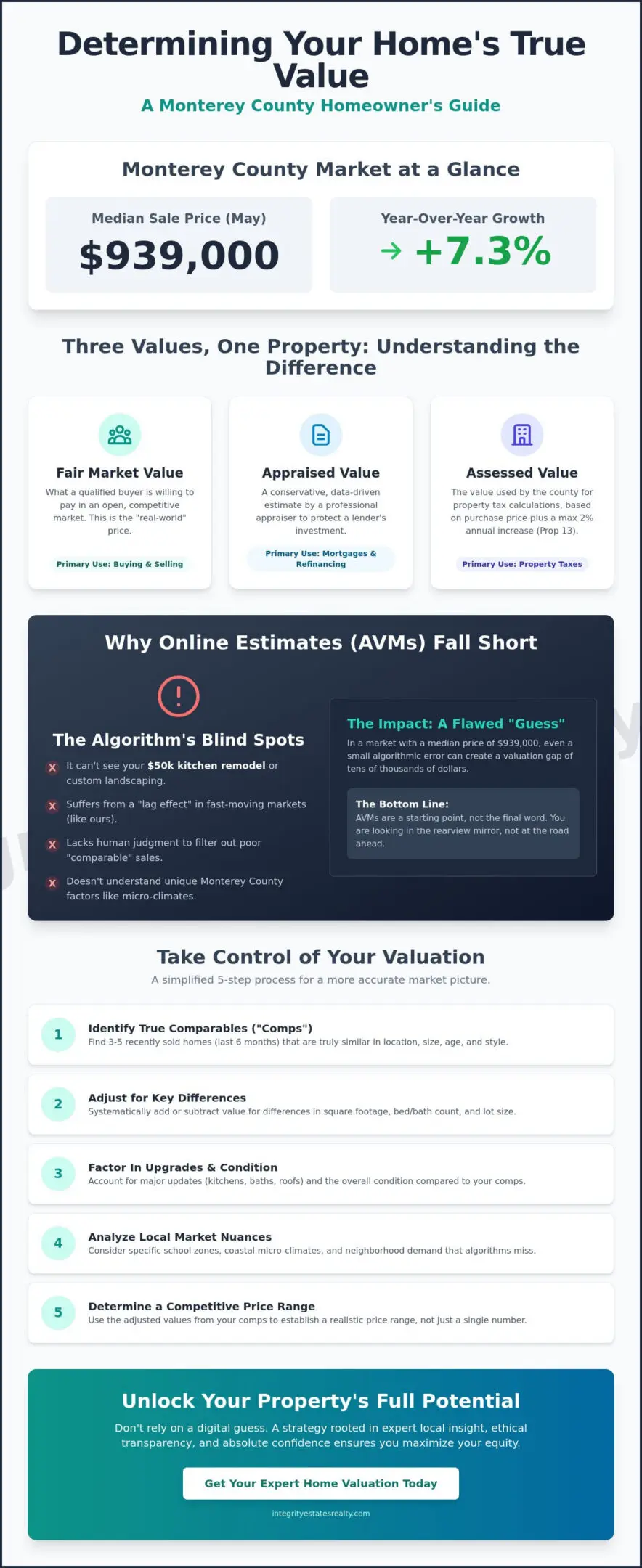
While the median sale price in Monterey County reached $939,000 this past May, a 7.3% increase from the previous year, your home’s true worth isn’t a number an algorithm can simply guess. It’s unsettling to watch online estimates fluctuate while trying to learn how to determine home value in Monterey County; these tools often miss the subtle details and micro-factors that define our local neighborhoods. You deserve more than a generic digital guess when preparing to sell or refinance your most significant asset.
We understand the frustration of seeing a gap between your tax bill and what neighbors are actually receiving at the closing table. This guide will show you how to blend precise financial data with the lifestyle factors that drive our unique coastal market to maximize your equity. You’ll gain a clear roadmap to navigate the nuances of 2026 valuations, from understanding the 20-day median market pace to distinguishing between assessed values and true market potential. We are here to ensure you move forward with a strategy rooted in expert local insight, ethical transparency, and absolute confidence.
Key Takeaways
- Define the critical differences between fair market value and bank appraisals to set realistic expectations for your next transaction or refinance.
- Uncover why automated online estimates often struggle with the “lag effect” and why digital tools shouldn’t be the final word on your property’s worth.
- Learn how to determine home value in monterey county by identifying unique local drivers like coastal micro-climates and specific neighborhood school zones.
- Master a five-step manual calculation process that utilizes recent, verified sales data to find your home’s true competitive edge in the current market.
- Understand how expert local representation and financing insight work together to unlock your property’s potential and protect your long-term equity.
Understanding the Three Pillars of Monterey County Property Value
When you are researching how to determine home value in Monterey County, you will likely encounter three distinct figures that rarely align. This discrepancy often causes unnecessary stress for homeowners, yet it is a natural byproduct of how California property is regulated and financed. To gain a clear picture of your equity, you must distinguish between these three specific valuations:
- Fair Market Value: This is the most fluid number, representing what a qualified buyer is willing to pay and what you are willing to accept in an open, competitive market.
- Appraised Value: This is a professional’s objective estimate, typically required by lenders to ensure the property provides sufficient collateral for a loan.
- Assessed Value: This is the figure used by the Monterey County Assessor to calculate your property taxes, which follows specific legal guidelines rather than current market heat.
These numbers don’t match because they serve different masters. A buyer cares about the future lifestyle your home provides, while a tax assessor is bound by historical acquisition costs. Understanding this allows you to approach your financial planning with a sense of calm and clarity.
Fair Market Value vs. Tax Assessments
California’s Proposition 13 creates a unique environment where your tax bill might suggest your home is worth far less than its actual price tag. Under this law, the assessed value is based on the market value at the time you purchased the home, with annual increases capped at just 2% for inflation. If you’ve owned your property for several years, your tax assessment will naturally lag behind the current market, especially given the 7.3% price growth we’ve seen in the county over the last year. A low assessment isn’t a sign of poor value; it’s a legal protection of your cash flow. Fair Market Value is the intersection of demand and supply.
The Role of the Appraised Value in Refinancing
If you are looking to secure a refinance mortgage Gilroy homeowners often rely on, the bank will require a formal real estate appraisal. Unlike buyers who might be swayed by an evocative ocean view or a designer kitchen, appraisers are intentionally conservative. They focus heavily on historical data from the previous six months to justify the loan’s risk. When considering how to determine home value in Monterey County for lending purposes, be aware of “red flags” that can lower this figure. In our local market, appraisers often scrutinize unpermitted additions or significant deferred maintenance in older Monterey properties. Addressing these issues before the appraiser arrives is a vital step in protecting your home’s true market potential.
Automated Valuation Models (AVMs): Why Online Estimates Often Fail
Most homeowners begin their journey by glancing at a “Zestimate” or a Redfin estimate. These platforms use Automated Valuation Models (AVMs) to process vast amounts of public record data and user-submitted information. While these tools offer a quick snapshot, they are often blunt instruments. They cannot see the $50,000 professional kitchen remodel you finished last spring or the custom drought-tolerant landscaping that defines your curb appeal. In a county where the median sale price reached $939,000 this year, even a small algorithmic error can result in a valuation gap of tens of thousands of dollars.
Timing is another significant hurdle for these digital tools. We currently see a “lag effect” where algorithms struggle to keep pace with shifting buyer sentiment. With 30-year fixed mortgage rates hovering around 6.68%, the pool of qualified buyers can change faster than public records can update. If you rely solely on a computer to determine the value of your home, you are essentially looking in the rearview mirror rather than at the road ahead. Online tools work best in high-volume subdivisions where every house is nearly identical, but they frequently fail when applied to the unique, character-filled lots common in our coastal region.
The Limitations of Algorithmic “Comps”
Algorithms lack the human judgment required to filter out “outlier” sales. A computer might pull a “comparable” sale from the Salinas city center to value a sprawling ranch property in Prunedale simply because the square footage matches. It doesn’t understand that these are two entirely different lifestyles. One high-priced sale to a family member or one distressed property sold at a steep discount can skew the entire local estimate, leading to a number that is either dangerously high or discouragingly low.
How to Use Online Tools Without Getting Misled
You can still use AVMs effectively if you treat them as a loose baseline rather than a final answer. Instead of focusing on the “estimated value” tab, navigate to the “recently sold” data from the last 90 days to see actual transaction prices. Cross-referencing at least three different platforms can help you find a median range, though this still lacks the “boots on the ground” insight needed for a precise strategy. If you want to know how to determine home value in monterey county with total accuracy, it’s wise to partner with a local expert who understands the specific block-by-block dynamics of our neighborhoods.
Localized Value Drivers Specific to Monterey County
While the county-wide median sale price sits at $939,000, the reality of your property’s worth often hinges on hyper-local variables that exist just outside your front door. If you want to know how to determine home value in Monterey County accurately, you have to look beyond square footage and bedroom counts. In our region, lifestyle and geography dictate price points in ways that few other California markets can match. These drivers create the “micro-markets” that define our coastal and valley communities.
Consider the “Micro-Climate Premium.” A home in Seaside might experience significantly different demand than one in the Salinas Valley purely based on the fog line and daily wind patterns. Buyers in 2026 are increasingly sensitive to these atmospheric details, just as they are to modern environmental metrics. High Flood Factor or Fire Factor ratings are no longer just fine print in a disclosure packet; they are active levers in price negotiations that can sway an offer by several percentage points. Similarly, school district boundaries remain a primary driver of equity. Even within the same zip code, crossing a street into a different district can create a massive price gap that automated tools often fail to capture.
The Salinas Valley vs. The Peninsula
There is a distinct valuation divide between agricultural-adjacent properties and the coastal hubs of the Peninsula. While Carmel often dominates the luxury conversation, the “bread-and-butter” markets of Salinas and Soledad offer different value propositions rooted in space and utility. For many, the appeal of Prunedale or North County lies in the balance between rural character and a manageable commute to Silicon Valley. To see how these regional dynamics shift as you move toward the Santa Clara County line, reviewing Gilroy real estate market trends provides essential context for the broader regional corridor.
The “ADU” Effect on Property Worth
California’s recent legislative focus on housing density has transformed how we view lot size and utility. In 2026, the potential for an Accessory Dwelling Unit (ADU) is a significant value multiplier. If your property has the zoning flexibility and physical space for a secondary unit, you aren’t just selling a home; you’re selling a multi-generational living solution or a potential passive income stream. Calculating the return on investment for an ADU requires an understanding of local building costs versus the $2,900 median monthly rent currently seen across the county. Zoning flexibility is a 2026 value multiplier that sophisticated buyers are willing to pay a premium for today.
5 Steps to Manually Calculate Your Home’s Market Value
While digital estimates provide a convenient baseline, they often lack the tactical precision required for a successful sale or refinance. To truly understand how to determine home value in Monterey County, you must step into the role of an analyst. This manual process allows you to account for the unique character of your property that a computer simply cannot perceive. By looking at the raw data, you can build a valuation that reflects the current 7.3% price growth seen across our local market.
- Step 1: Identify 3-5 “True Comps.” Focus exclusively on properties that have successfully closed escrow within the last 90 days. Active listings only show what sellers hope to get, not what buyers are actually paying.
- Step 2: Adjust for Square Footage. Calculate the average price-per-foot in your specific tract. Apply this rate to the difference in size between your home and your selected comparables.
- Step 3: Factor in Lot Size and Topography. In the hilly terrain of Seaside or the undulating landscapes of Prunedale, a flat, usable lot commands a significant premium over a sloped one.
- Step 4: Audit Condition. Be honest about how your home’s interior finishes and systems compare to the sold examples. A modern roof or updated HVAC system can be a major differentiator.
- Step 5: Apply a “Market Sentiment” Modifier. With a median of just 20 days on market, the current low inventory levels may allow for a slight upward adjustment if buyer demand is peaking.
Finding and Filtering Comparables
The most common mistake is relying on properties that are too far away or too old. Adhere strictly to the “Half-Mile Rule” whenever possible. In Monterey County, crossing a major thoroughfare or moving just one mile can put you in an entirely different price bracket with different school district influences. You should also filter for homes with similar bed and bath counts and a similar era of construction to ensure you are comparing apples to apples. This discipline prevents the “outlier effect” from skewing your final number.
Making Value Adjustments Like a Pro
Once you have your core data, it’s time to refine the figures based on specific assets. A sweeping view of the Santa Lucia mountains or a fully finished three-car garage can add substantial value, but you must also be prepared to subtract for deferred maintenance. If your roof is nearing the end of its life, savvy buyers will price those future costs into their offers. Don’t underestimate the “Curb Appeal” multiplier either. A home that feels welcoming from the first glance often sells faster and for more than a neglected property with identical specs. If you’re ready to see how these steps apply to your specific address, request a professional market analysis from our local team to ensure your strategy is rooted in reality.
The Integrity Estates Approach: Beyond the Spreadsheet
Mastering the technical steps of how to determine home value in Monterey County is a powerful first step, but data alone doesn’t capture the full narrative of your property. Real estate is fundamentally personal. While spreadsheets provide the “what,” our team provides the “why.” By combining deep analytical research with “boots on the ground” insights in Salinas and Gilroy, we bridge the gap between a cold market estimate and the true lifestyle value your home offers to a prospective buyer.
Our commitment to transparency and ethical valuation means we don’t just tell you what you want to hear to secure a listing. We provide a realistic, defensible roadmap based on current 2026 market conditions. Whether you are looking to maximize your equity during a sale or you’re curious about your home’s potential for a future move, a professional Comparative Market Analysis (CMA) remains your most reliable tool. It provides the peace of mind that comes from knowing your financial strategy is rooted in expert local wisdom rather than a generic digital guess.
Integrated Mortgage and Real Estate Insights
One of the most overlooked aspects of property valuation is its direct impact on your borrowing power. Understanding your current equity is essential when exploring FHA home loans Gilroy families use to transition into new homes. A higher valuation can also serve as a strategic lever to eliminate Private Mortgage Insurance (PMI) on your existing loan, potentially saving you hundreds of dollars every month. By consulting with Jose M Hernandez, you can develop a personalized equity roadmap that aligns your home’s value with your broader long-term financial goals. We view ourselves as your steadfast guide, ensuring that every dollar of equity is working toward your family’s future.
Next Steps for Monterey County Homeowners
If you’re ready to move beyond the research phase, the next step is preparation. Before a professional appraiser walks through your door, ensure your property is presented in its best light by addressing minor cosmetic repairs and documenting recent upgrades. While a desktop valuation is a helpful starting point for casual curiosity, a formal CMA is necessary for high-stakes decisions. This comprehensive report accounts for the micro-factors we’ve discussed, from school districts to ADU potential, providing a level of detail that algorithms simply can’t match. When you’re ready to see your true numbers and move forward with confidence, contact Integrity Estates Realty for a professional valuation tailored to your unique property.
Strategize Your Next Move with Precision
Navigating the complexities of 2026 valuations requires more than a digital estimate. You’ve learned that understanding the nuances of local micro-climates, ADU potential, and the specific “Half-Mile Rule” for comparables is essential for accuracy. Mastering how to determine home value in monterey county gives you the leverage needed to negotiate with confidence, whether you’re selling a Seaside cottage or a Salinas Valley estate. These insights transform your property from a simple address into a strategically positioned asset.
With over two decades of local California real estate experience, our team provides the “boots on the ground” insight that algorithms lack. Because we offer integrated mortgage brokerage services, we don’t just find your home’s value; we help you leverage it for future growth across Salinas, Seaside, and Santa Clara County. Get a Professional Comparative Market Analysis for Your Monterey Home and take the first step toward unlocking your property’s true market potential. Your home is the foundation of your family’s narrative, and we’re here to ensure that story is valued correctly.
Frequently Asked Questions
Does a low Monterey County tax assessment mean my home is worth less?
No, a low tax assessment is typically a result of California’s Proposition 13 protections. This law limits annual increases in assessed value to just 2% regardless of how fast market prices rise. While the median sale price in our county reached $939,000 this year, your tax bill might reflect a much lower historical purchase price. This gap is a financial advantage for you, not an indicator of low market equity.
How do micro-climates in Seaside and Marina affect property values?
Micro-climates act as powerful, invisible levers on buyer demand in our coastal communities. Properties located in “sun belts” that sit above the consistent marine layer often command a premium over homes that remain shrouded in fog for most of the day. Buyers in 2026 are increasingly specific about these atmospheric details, making local climate patterns a primary factor in neighborhood-specific pricing.
Can I use an online estimator for a rural property in Prunedale?
Online estimators are notoriously unreliable for rural areas like Prunedale or North County. These algorithms thrive on uniform data from high-density subdivisions but struggle with varying lot sizes, well systems, and unique topography. For properties with significant acreage or non-standard features, a manual valuation that accounts for land utility is the only way to ensure you don’t leave equity on the table.
What is the most accurate way to find home values in Salinas?
The most precise method is a professional Comparative Market Analysis (CMA) that focuses on the last 90 days of local activity. Understanding how to determine home value in monterey county requires looking at the 20-day median market pace currently seen in Salinas. A local expert can filter out “outlier” sales and focus on homes that truly mirror your property’s condition and location.
How much value does an ADU add to a Monterey County home in 2026?
An Accessory Dwelling Unit (ADU) is a significant value multiplier due to our region’s high housing demand. With median rents in the county sitting at $2,900 per month, the potential for passive income or multi-generational living is highly prized by modern buyers. While the exact dollar amount varies, the utility and zoning flexibility of an ADU often return a substantial percentage of the construction cost in added equity.
Why is my appraised value different from my neighbor’s recent sale price?
Appraised values are intentionally conservative because they serve as a lender’s safeguard for a mortgage. While your neighbor’s sale price might include an “emotional premium” from a competitive bidding war, an appraiser focuses strictly on historical, closed data from the last six months. This difference highlights the gap between what a specific buyer is willing to pay and what a bank is willing to lend against.
How often should I check my home’s value in Monterey County?
You should review your property’s value at least once a year or whenever you consider a major financial shift. Given the 7.3% year-over-year price growth we’ve seen recently, your equity position can change significantly in a short window. Regular check-ins help you decide if it’s the right time to refinance, eliminate private mortgage insurance, or leverage your equity for a new investment.
What environmental risks in Monterey County impact home insurance and value?
Flood Factor and Fire Factor ratings are now critical components of a property’s valuation profile. High risk scores can lead to limited insurance options or significantly higher premiums, which savvy buyers factor into their initial offers. Properties with lower environmental risk profiles are increasingly seen as safer long-term investments, often leading to faster sales and firmer pricing in the current market.