
Jumbo Loan Requirements in San Francisco: Your 2026 Financing Guide
In San Francisco’s 2026 market, a million-dollar mortgage is no longer a luxury; it’s the baseline for entry. With the median home price now reaching $1.7 million, many buyers find that traditional financing simply doesn’t cover the cost of a home in neighborhoods like Noe Valley or Sea Cliff. It’s natural to feel some anxiety about the current 6.6% interest rates or the complex documentation required for RSU and bonus-heavy income. You’ve built a significant financial foundation, and you need a financing strategy that respects the sophistication of your portfolio while providing a clear path forward.
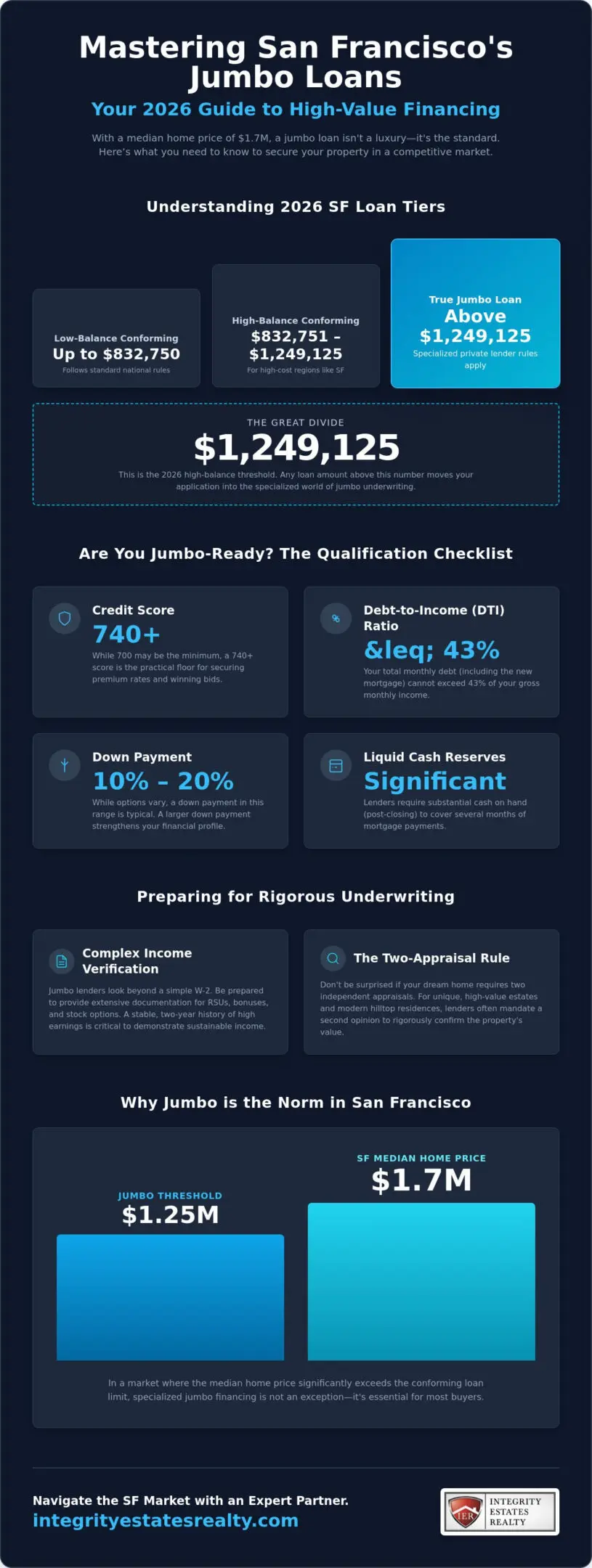
This guide will help you master the specific jumbo loan requirements san francisco lenders demand in 2026, ensuring you’re prepared for the $1,249,125 high-balance threshold. We’ll provide a comprehensive checklist for financial readiness, covering everything from the 740+ credit score benchmarks to the liquid reserve mandates that define today’s competitive landscape. By the end of this article, you’ll have the clarity needed to secure high-value property financing with the confidence of a local expert, supported by a brokerage that values your long-term legacy over a simple transaction.
Key Takeaways
- Identify the 2026 high-balance limit of $1,249,125 that differentiates conforming loans from the specialized jumbo financing needed for most San Francisco properties.
- Master the specific jumbo loan requirements san francisco lenders demand, including the 740 credit score floor and the strict 43% debt-to-income ratio caps.
- Evaluate your down payment options between 10% and 20% while calculating the liquid cash reserves necessary to satisfy luxury underwriting standards.
- Prepare for the rigorous documentation process, including the two-appraisal rule often required for unique high-value estates and modern hilltop residences.
- Learn why a collaborative partnership with a local brokerage provides the tactical edge needed to win bidding wars in a low-inventory market.
Understanding the 2026 Jumbo Loan Thresholds in San Francisco
A Jumbo mortgage is defined by what it isn’t. It’s any loan that exceeds the limits set by the Federal Housing Finance Agency (FHFA). In most of the United States, these boundaries are fairly rigid. However, the Bay Area operates on a different financial plane. Because San Francisco is designated as a high-cost area, the ceiling for standard financing is significantly higher than the national average. This designation recognizes that a “standard” home price in our city would be considered a luxury estate elsewhere.
San Francisco, Marin, and Santa Clara counties share the highest loan thresholds in the nation. This isn’t just a matter of prestige; it’s a reflection of a market where the median home price has climbed to $1.7 million. Mastering the jumbo loan requirements san francisco lenders enforce begins with distinguishing between three distinct tiers of financing. You aren’t just looking for a loan. You’re looking for a tactical financial instrument that aligns with your long-term wealth strategy.
The $1,249,125 Milestone: Your Starting Point
For 2026, the high-cost conforming limit in San Francisco is set at $1,249,125. This number is the Great Divide of Bay Area real estate. If your loan amount is even one dollar above this threshold, the file moves from the automated systems of Fannie Mae and Freddie Mac into the hands of specialized jumbo underwriters. These professionals look beyond simple algorithms to evaluate the totality of your financial life. This limit has seen a steady climb as we’ve watched Gilroy real estate market trends and broader regional values appreciate, forcing the FHFA to adjust their definitions of “conforming” to keep up with California’s reality.
Conforming High-Balance Loans vs. True Jumbo
There is a often-misunderstood middle ground in our market. Financing falls into three specific categories:
- Low-Balance Conforming: Loans up to $832,750. These follow standard national rules.
- High-Balance Conforming: Loans between $832,751 and $1,249,125. These are still technically “conforming” but are specific to high-cost regions like San Francisco.
- True Jumbo: Any loan exceeding $1,249,125. These are held on a bank’s own books or sold to private investors.
The difference isn’t just academic. High-balance loans often carry slightly different interest rates than true Jumbos because they still adhere to some government-backed guidelines. Once you cross into true Jumbo territory, private investor rules take over. This is where documentation becomes more rigorous, and the relationship with your brokerage becomes your greatest asset. We don’t just process paperwork; we curate a narrative of financial stability that resonates with private lenders.
Financial Qualification Standards: Credit, DTI, and Income
Lenders in the 2026 San Francisco market aren’t just looking at a score; they’re looking at a narrative of fiscal responsibility. While the official conforming loan limits define the legal boundaries of standard financing, the jumbo loan requirements san francisco buyers face are far more nuanced. A credit score of 700 might get you in the door, but a 740 is the practical floor for securing the premium rates necessary for a high-value transaction. In a city where bidding wars are standard, having a pristine credit profile is your most effective bargaining chip.
Debt-to-income (DTI) ratios remain a strict gatekeeper for luxury financing. Most non-conforming programs in 2026 cap DTI at 43%. This means your total monthly debt, including the new mortgage, taxes, and insurance, cannot exceed 43% of your gross monthly income. Lenders also look for a two-year history of consistent employment. They want to see that your high earning potential isn’t just a recent peak, but a sustainable plateau. This “sophisticated borrower” profile goes beyond the spreadsheet; it’s about demonstrating that you can maintain your lifestyle while servicing a significant debt load.
Navigating Tech Income: RSUs, Bonuses, and Stock Options
For tech professionals, income isn’t always found on a standard W-2. Lenders now use sophisticated formulas to calculate Restricted Stock Units (RSUs) and bonuses. To count RSUs as qualifying income, you’ll typically need a two-year vesting history with the same employer and proof that the stock will continue to vest for at least three more years. Variable income strategies often involve using a two-year average of bonuses to offset DTI challenges in our high-tax environment. Understanding how to present this data is vital, and consulting a lifestyle financing guide can help you organize your documentation to meet these rigorous standards.
Self-Employed and 1099 Qualification in SF
Entrepreneurs in the Bay Area face even more rigor. You’ll need two years of full tax returns and a year-to-date Profit and Loss (P&L) statement that reflects the current fiscal year’s health. Lenders carefully scrutinize write-offs that might lower your taxable income but also reduce your borrowing power. If traditional tax returns don’t reflect your actual liquidity, bank statement programs offer an alternative, focusing on 12 to 24 months of deposits to prove cash flow. This flexibility ensures that high-liquidity business owners aren’t penalized for the creative accounting often required to run a successful San Francisco firm.
The Reserve and Down Payment Reality for Bay Area Luxury
Securing a high-value property in the City requires more than just a high income; it demands a clear demonstration of liquidity. While the 20% down payment remains the gold standard for luxury transactions, the 2026 market offers more flexibility than many realize. Well-qualified buyers can often find paths with 10% or 15% down. However, once a loan amount crosses the $2 million mark, lenders typically return to a “skin in the game” philosophy, where a 20% equity stake is non-negotiable. This protects the lender’s interest in a market where even minor price fluctuations involve six-figure sums.
Moving large sums of money requires a meticulous paper trail. Lenders will scrutinize every transfer over a certain threshold to ensure the funds are seasoned and legally sourced. If you’re receiving assistance from family, gift fund rules for jumbo loan requirements san francisco are stricter than those for conforming loans. Most lenders require the borrower to contribute at least 5% or 10% of their own funds before any gift money is applied. We help our clients document these transfers early to avoid the last-minute stress that often derails high-stakes closings.
Post-Closing Liquidity: The Reserve Requirement
Perhaps the most common reason for a jumbo loan denial isn’t the credit score or the down payment, but the post-closing reserves. Lenders want to see that you won’t be “house poor” after the keys are in your hand. In 2026, most programs demand between 6 and 12 months of PITI (Principal, Interest, Taxes, and Insurance) held in liquid accounts. Eligible assets for these reserves include:
- Liquid Cash: Funds in personal checking and savings accounts.
- Brokerage Accounts: Stocks, bonds, and mutual funds (often valued at 70% to 80% to account for market volatility).
- Retirement Accounts: 401(k) or IRA balances, though these are typically discounted more heavily due to potential withdrawal penalties.
Calculating PITI in San Francisco is particularly critical because of our high property tax environment. We ensure your reserve calculations account for the most current tax assessments so there are no surprises during the final underwriting stage.
Piggyback Loans: The 80/10/10 Strategy
For buyers who want to preserve liquidity while avoiding Private Mortgage Insurance (PMI), the 80/10/10 “piggyback” structure remains a tactical choice. This involves a first mortgage at 80% of the home’s value, a second mortgage at 10%, and a 10% cash down payment. This strategy is a specialty of top-tier mortgage brokers Santa Clara County and San Francisco firms, as it can lower the overall monthly payment compared to a single high-interest jumbo loan. It’s a sophisticated way to navigate the 2026 rate environment while keeping more of your capital working in other investments.
Documentation and Appraisal Rigor for San Francisco Property
While your financial profile establishes your ability to pay, the property itself must stand up to intense scrutiny. In the 2026 market, the jumbo loan requirements san francisco lenders enforce often include the “Two-Appraisal Rule.” If you’re seeking a loan over $1.5 million or $2 million, expect two independent valuations. This isn’t just a formality; it’s a risk mitigation strategy. Lenders want to ensure that the unique architecture and micro-location of a San Francisco residence justify the high-value investment. A discrepancy between these two reports can stall a transaction, making it vital to work with a team that understands local valuation nuances.
Finding “comps” in our city is notoriously difficult. A renovated Victorian in Pacific Heights doesn’t compare easily to a modern hilltop home in Twin Peaks, even if the square footage is similar. Lenders also look closely at property condition. While a fixer-upper might seem like a great investment, these properties rarely qualify for standard jumbo financing. If the home isn’t in “move-in” condition, you may need specialized bridge products rather than a standard non-conforming loan. You should also be prepared to write a Letter of Explanation (LOE) for any unusual financial activity, as underwriters will leave no stone unturned.
Full Documentation vs. Asset Depletion
Underwriting for high-value loans is a deep dive into every schedule, K-1, and tax return you’ve filed. We recommend preparing a “Loan Bible” that includes all your financial records before your first meeting. For high-net-worth individuals with low taxable income, asset depletion is a powerful 2026 strategy. This allows us to use your total liquid assets to calculate an income stream, bridging the gap between your tax filings and your actual purchasing power. If you’re ready to organize your portfolio, let’s start building your financial narrative together.
Condo-Specific Jumbo Requirements
San Francisco’s high-rise market comes with its own set of rules. Lenders distinguish between warrantable and non-warrantable condos based on the building’s financial health and legal structure. If an HOA has a pending lawsuit or insufficient cash reserves, the building can be “blacklisted” by certain jumbo lenders. Owner-occupancy ratios also matter; if too many units are rentals, it can impact your interest rate or even your eligibility. We vet the building’s budget and HOA documents early in the process to ensure the collateral is as strong as the borrower.
Navigating the 2026 SF Market with Integrity Estates Realty
In a high-stakes market like San Francisco, the traditional gap between a real estate agent and a mortgage lender can create dangerous delays. We’ve bridged that gap through our integrated brokerage model. By bringing residential representation and specialized jumbo loan origination under one roof, we ensure that every piece of your financial narrative is aligned before you ever set foot in an open house. This internal synergy allows us to address potential hurdles in real time, providing the peace of mind that is so often missing in high-value transactions.
Our team’s local pride is matched only by our regional expertise. We understand the nuances that define the Bay Area’s diverse landscape. Whether you’re targeting a historic estate in Nob Hill or exploring the expanding luxury market and homes for sale in Gilroy, we provide the context that national lenders often overlook. We don’t just see a physical asset; we see a personal dream and a long-term financial legacy. This perspective allows us to guide you through the jumbo loan requirements san francisco lenders demand with the care of a personal advisor.
Jose M Hernandez leads our efforts with a sophisticated approach to complex financing. She recognizes that Bay Area wealth is rarely found in a simple paycheck. Jose M Hernandez specializes in crafting custom strategies for professionals with heavy RSU portfolios, variable bonus structures, and self-employment income. Her commitment to transparency ensures you’re never left wondering about the status of your file. We prioritize long-term relationships over quick transactions, acting as an ethical anchor in a fast-paced industry.
Strategic Pre-Approval for Competitive Bidding
In 2026, a standard pre-approval letter isn’t enough to win a bidding war for a $2 million property. We provide a fully underwritten pre-approval. This means your credit, income, and assets are vetted by an underwriter before you make an offer. When a listing agent sees an offer from our firm, they know the financing is solid. This allows us to advocate for shorter contingency periods and closing timelines of 21 days or less, positioning your offer at the top of the pile.
Your Partner in Bay Area Real Estate
Success in San Francisco real estate requires a blend of deep-rooted experience and modern market technology. We’ve spent over 20 years refining our process to meet the needs of the city’s most discerning buyers. We invite you to a personalized financial consultation where we can map out a strategy tailored to your unique portfolio. Secure your San Francisco Jumbo Pre-Approval with Integrity Estates Realty today and step into the market with the confidence of a fully prepared partner.
Securing Your Legacy in the City
The journey to owning a piece of San Francisco’s skyline is a sophisticated endeavor that requires more than just a high credit score. You’ve now mastered the critical benchmarks, from the $1,249,125 high-balance threshold to the rigorous documentation of tech-heavy income. These jumbo loan requirements san francisco lenders demand are designed to ensure long-term stability in a fast-moving market. By preparing your financial documentation early and understanding the necessity of post-closing reserves, you’ve already positioned yourself ahead of the competition.
At Integrity Estates Realty, we bring over two decades of California market expertise to your side. We are uniquely dual-licensed in both real estate representation and mortgage origination, which allows us to streamline your path from the initial search to the final closing. We specialize in the complex income profiles that define our region, ensuring that your RSUs and bonuses are treated with the precision they deserve. You deserve a partner who is as invested in your future as you are.
Start Your Sophisticated SF Home Search & Financing with Integrity Estates Realty
We’re here to provide the transparency and ethical guidance needed to turn your financial narrative into a successful property acquisition. Your San Francisco dream is within reach, and we’re honored to guide you home.
Frequently Asked Questions
What is the minimum credit score for a jumbo loan in San Francisco in 2026?
Most jumbo programs require a minimum credit score of 700 to qualify. However, to secure the most competitive interest rates in the current 2026 market, a score of 740 or higher is typically the practical floor. Lenders use these higher benchmarks to offset the increased risk associated with high-value financing in the Bay Area’s unique landscape.
Can I get a jumbo loan with only 10% down in the Bay Area?
You can obtain a jumbo loan with as little as 10% down for well-qualified buyers in the San Francisco market. High-balance conforming loans up to the $1,249,125 threshold often allow for even less, sometimes as low as 5% down. Once your loan amount exceeds that limit, a 10% to 15% down payment is standard, though 20% remains the preferred benchmark for loans exceeding $2 million.
How much are jumbo loan interest rates compared to conforming loans?
Jumbo loan interest rates are currently very competitive and sometimes even lower than conforming rates. As of June 2026, national averages for a 30-year fixed jumbo mortgage hover around 6.64%. Because these loans target borrowers with sophisticated financial profiles, banks often offer aggressive pricing to establish a long-term relationship with high-net-worth clients.
Do I need to show my tax returns for a jumbo loan if I am W-2?
Yes, full documentation including two years of tax returns is a standard part of the jumbo loan requirements san francisco underwriters enforce. Even for W-2 employees, lenders scrutinize these documents to verify the consistency of bonuses and RSU vesting schedules. This deep dive ensures that your total compensation package is stable enough to support a high-value mortgage over the long term.
What happens if the appraisal comes in lower than the purchase price?
If an appraisal comes in low, you must either cover the valuation gap with additional cash or renegotiate the purchase price with the seller. Because jumbo financing is based on the lower of the purchase price or the appraised value, a shortfall can shift your loan-to-value ratio. We work to prevent these surprises by conducting a rigorous analysis of comparable sales before you ever submit an offer.
Are jumbo loans harder to get than conventional loans?
Jumbo loans are more rigorous because they require manual underwriting rather than the automated systems used for conventional loans. Underwriters look deeper into your liquid reserves, the seasoning of your funds, and the specific condition of the property. While the process is more detailed, it allows for a more nuanced evaluation of complex income streams that automated systems might reject.
Can I use a jumbo loan to buy a multi-unit property in SF?
You can use jumbo financing to purchase multi-unit properties, such as a duplex or a fourplex, within San Francisco. These transactions typically carry stricter reserve requirements and may require a larger down payment than a single-family residence. Lenders will also factor in the potential rental income from the additional units when calculating your qualifying debt-to-income ratio.
Does San Francisco have specific first-time buyer programs for jumbo amounts?
There aren’t government-backed “jumbo” programs specifically for first-time buyers, but the high-cost area designation is a major benefit. This allows you to access high-balance conforming loans up to $1,249,125 with more flexible terms. For amounts exceeding this, we focus on private investor programs that offer tailored solutions for emerging professionals who have high earning potential but perhaps less accumulated wealth.