
Avoiding Foreclosure in Hayward, CA: A 2026 Homeowner’s Strategic Guide
Did you know that foreclosure starts in California surged by 20% in the first quarter of 2026? If you’re feeling the pressure of persistent lender calls or the confusion of shifting state timelines, you aren’t alone in this struggle. It’s a heavy burden to worry about losing your home while trying to preserve the equity you’ve built. We’re here to help you regain control by exploring every avenue for avoiding foreclosure in hayward ca. You deserve a clear path forward that prioritizes your peace of mind and your financial future.
This strategic guide breaks down the latest 2026 legislative updates, including the 45-day postponement rights under AB 2424 and the new short sale protections of AB 1542. We’ll examine how to leverage local Hayward resources, navigate the loan modification process, and explore refinancing options to keep your credit intact. By the end of this article, you’ll have a professional roadmap to stop the auction and protect your most valuable asset.
Key Takeaways
- Understand the critical 120-day federal window and the California non-judicial process to identify your specific windows of opportunity for intervention.
- Learn how to access the 2026 Alameda County Foreclosure Prevention Program and its potential $75,000 grant designed for eligible homeowners in financial distress.
- Discover the “Integrity Advantage” for avoiding foreclosure in hayward ca by balancing loan modifications with strategic, equity-preserving sales.
- Identify the five immediate steps to take if you fall behind, including why establishing a third-party record with a HUD-approved counselor is vital for your defense.
- Evaluate current 2026 mortgage rates and eligibility requirements to determine if refinancing your debt is a viable path to long-term stability.
Understanding the Foreclosure Timeline in Hayward, CA
Foreclosure isn’t a single, sudden event. It is a structured legal timeline that offers specific windows for strategic intervention. Understanding the foreclosure process helps you replace paralyzing fear with a tactical plan. In Hayward, the journey begins long before a legal filing appears at the Alameda County Recorder’s Office.
Federal law provides a vital 120-day “pre-foreclosure” buffer. During these four months, your loan servicer is legally barred from starting the formal foreclosure process. This time is intended for you to explore loss mitigation, such as a loan modification or a repayment plan. If the 120-day mark passes without a resolution, the lender records a Notice of Default (NOD). This document officially starts the clock on the California non-judicial process. It’s a public record that signals to the market that your mortgage is in distress.
Once the NOD is recorded, California law mandates a 90-day waiting period. This is the most critical time for avoiding foreclosure in hayward ca. It’s your primary opportunity to reinstate the loan by paying the arrears or to negotiate a strategic sale. If the 90 days expire without a cure, the lender issues a Notice of Trustee Sale (NOTS). This notice is posted on your property and published in local newspapers. It marks the final 21-day countdown to the public auction on the courthouse steps.
The Pre-Foreclosure Period: Your Window of Opportunity
The first 90 days of missed payments are often the most stressful, yet they offer the most flexibility. By day 45, you’ll likely receive a “breach letter” from your servicer. This document outlines exactly how much you owe and provides a deadline to pay it before the lender accelerates the loan. Many homeowners mistake the lack of immediate legal action for breathing room. This is a myth. Every day you wait, late fees and interest accumulate, making it harder to protect your home equity. Taking action during this initial phase is the most effective way to secure a favorable outcome.
California’s Non-Judicial Foreclosure Laws
In Hayward, most foreclosures are non-judicial. This means the lender doesn’t have to sue you in court to take the property; they rely on the “power of sale” clause in your deed of trust. While this process is faster than a court case, it also grants you the “right of reinstatement.” You can stop the foreclosure at any point up until five days before the sale by paying the past-due amount plus fees. It’s also important to know that California has very limited “redemption” rights after the sale occurs. Unlike some states, you can’t usually buy the house back after the auction, so your strategy must focus on avoiding foreclosure in hayward ca before the gavel falls.
Hayward and Alameda County Foreclosure Resources
Managing a financial crisis feels isolating, but Hayward homeowners have access to specialized local support that state-level programs no longer provide. Since the California Mortgage Relief Program exhausted its funds in January 2026, the focus has shifted to the Alameda County Foreclosure Prevention Program (FPP). This initiative is a vital lifeline for those committed to avoiding foreclosure in hayward ca. It offers a grant of up to $75,000 to help homeowners catch up on missed payments and secure their property’s future. Taking proactive steps to avoid foreclosure often starts with these localized grants that understand the specific market pressures of the East Bay.
Beyond direct financial aid, Hayward City Hall and various non-profits offer advocacy services. HUD-approved housing counseling agencies, such as ECHO Housing, provide free guidance to help you communicate with lenders. These counselors act as your professional intermediary, ensuring your voice is heard during high-stakes negotiations. If you’re feeling overwhelmed by the paperwork, a professional equity analysis can help you determine if a grant or a strategic sale is your best path forward.
Applying for the Foreclosure Prevention Program (FPP)
The FPP isn’t a “no-strings-attached” handout; it’s a strategic tool for qualified residents. To be eligible in 2026, you must meet specific income limits based on the Area Median Income (AMI) for Alameda County. The program typically favors owner-occupied, single-family residences. You’ll need to provide a comprehensive documentation package, including:
- Recent federal tax returns and W-2s.
- A detailed hardship letter explaining your financial setback.
- Three months of bank statements to verify liquid assets.
You must also understand the “recoverable grant” clause. While the funds cure your immediate default, the grant often functions as a silent lien. If you sell the home or refinance for cash-out purposes later, the county may require the grant to be repaid from your sale proceeds. This ensures the funds eventually return to the program to help the next homeowner in need.
Legal Advocacy and Tenants’ Rights in Hayward
If your situation involves legal complexities, the Legal Aid Society of Alameda County offers specialized services for distressed homeowners. They can help you identify predatory lending practices or service errors that might provide grounds for a foreclosure pause. These protections extend to those renting out their homes as well. For those also managing estate planning or title concerns, heggstadhelp.com provides specialized Heggstad petition services to transfer property into California trusts. If you’re a landlord or a tenant in a property facing auction, the Hayward Rent Stabilization and Tenant Protection Act provides specific safeguards. Foreclosure doesn’t automatically terminate a lease in Hayward. Tenants may have the right to remain in the property for the duration of their lease or receive significant notice before relocation, protecting the community’s housing stability even during individual financial transitions.
Similarly, when properties are tied up in legal entities, The Irrevocable Trust Doctor can help evaluate if a trust modification is necessary to facilitate a sale or refinance under California law.
Strategic Options: Loan Modification, Refinance, or Sale?
While many resources focus solely on retention, the most sophisticated strategy for avoiding foreclosure in hayward ca involves a cold, hard look at your home’s equity versus your long-term debt capacity. Every path has a distinct impact on your credit and your future housing options. A loan modification can lower your monthly obligation by extending the term or reducing the interest rate, but it often requires a rigorous trial period that not every household can sustain. If the modification doesn’t fit your budget, you must decide if keeping the asset is worth the risk of losing your accumulated wealth.
Hayward’s average home price reached $1,025,868 in June 2026. This high valuation means many local homeowners are sitting on significant equity that could be lost if the bank takes the property at auction. If you find yourself in default, a short sale might seem like a last resort. However, under California’s AB 1542, which became effective February 1, 2026, lenders are now required to respond to short sale packages within 45 business days. This law also prohibits deficiency judgments on primary residences for qualifying sellers, providing a clean break that a foreclosure auction simply cannot offer.
The Refinance Path: Is it Still Possible?
As of July 2026, 30-year fixed mortgage rates are averaging 6.63%, while 15-year options sit near 6.13%. Securing a refinance mortgage while in default is difficult but not impossible. Most wholesale lenders require at least 20% equity to consider a “hardship refinance” for a borrower in distress. This path allows you to consolidate high-interest debt and lower your total monthly outflow, but it requires a steady income to qualify. It’s a race against the clock. You must close the new loan before the lender records a Notice of Trustee Sale to avoid predatory interest rates.
Selling Your Hayward Home to Save Your Equity
If the numbers for a modification or refinance don’t add up, a strategic sale is often the most ethical way to protect your financial legacy. By analyzing Gilroy real estate market trends, we see a consistent demand for Bay Area housing that mirrors the Hayward landscape. A quick, professional sale allows you to pay off the lender in full and walk away with your remaining equity. When you choose to sell my home in Gilroy or Hayward through a proactive listing, you maintain control over the timeline. This prevents the “zombie debt” issues associated with the new AB 130 regulations and ensures you exit the situation with the capital needed for your next chapter.
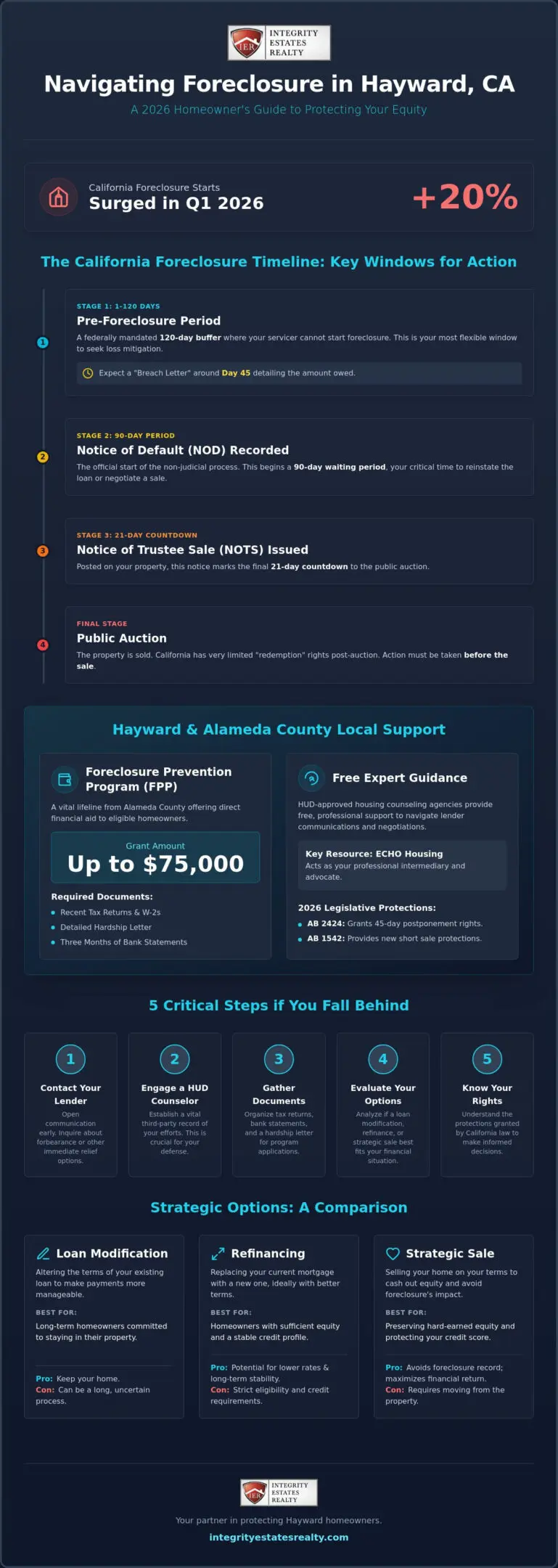
5 Critical Steps to Take the Moment You Fall Behind
The first missed payment often triggers a paralyzing sense of dread. However, the actions you take in the first 30 days determine whether you maintain control or succumb to the process. To succeed in avoiding foreclosure in hayward ca, you must transition from a defensive posture to an active one. Your lender isn’t your enemy, but they are a large bureaucracy that requires specific inputs to pause their automated legal engines. Following a methodical path ensures you don’t miss the narrow windows of opportunity provided by California law.
- Open every piece of mail: Ignoring certified letters won’t stop the clock. These envelopes often contain “breach letters” or legal notices that define your remaining rights and deadlines.
- Establish a third-party record: Contact a HUD-approved housing counselor immediately. Having a professional advocate creates a paper trail showing you’re acting in good faith, which is vital if the case escalates.
- Assemble your Hardship Package: Lenders won’t discuss modifications without a complete financial snapshot. Gather two years of tax returns, 60 days of pay stubs, and your most recent bank statements.
- Request a “Foreclosure Workout” meeting: Use your right to a consultation to discuss loss mitigation options like forbearance or repayment plans before a Notice of Default is recorded.
- Obtain a professional valuation: You cannot make a strategic decision without knowing your home’s current market value. This determines if you should fight for a modification or sell to protect your equity.
If you need an accurate assessment of your property’s value to weigh your options, you can request a personalized equity analysis today. Knowing if you have enough equity to sell and move on is a vital piece of the puzzle.
Writing an Effective Hardship Letter
Your hardship letter is the emotional and logical core of your application. Lenders categorize hardships as either temporary or permanent. A temporary hardship, like a three-month medical leave, suggests you can resume payments soon. A permanent hardship, such as a divorce or a long-term disability, may require a more drastic solution like a loan modification or a short sale. Avoid a narrative that focuses solely on the “victim” aspect. Instead, clearly document the event and explain your concrete plan to resolve the delinquency. Lenders want to see a path toward a performing loan, not just a list of problems. They’re looking for stability and a reason to believe you’ll be a reliable borrower moving forward.
Communicating with Your Loan Servicer
California law provides you with the “Single Point of Contact” (SPOC) rule. This means your lender must assign an individual or a small team to your case, preventing the frustration of repeating your story to a different representative every time you call. Log every interaction meticulously. Write down the name of the person you spoke with, their employee ID, the date, and a reference number for the call. If a servicer refuses to provide loss mitigation options or ignores your complete package, this log becomes essential evidence for your HUD counselor or legal advocate. Staying organized is your best defense against bureaucratic errors. It shows the lender you’re a serious participant in the process, which often leads to more professional treatment.
How Integrity Estates Realty Protects Hayward Homeowners
The path to financial recovery requires more than just a standard real estate agent. It demands a partner who understands the mechanical intricacies of your mortgage. Integrity Estates Realty provides what we call the “Integrity Advantage,” a unique blend of high-level real estate representation and sophisticated mortgage brokerage. When you’re focused on avoiding foreclosure in hayward ca, this dual perspective is your most powerful asset. We don’t just look at the market value of your home; we analyze the underlying debt structure to find the most efficient exit or retention strategy for your specific situation.
Our firm prioritizes transparency and ethical conduct above all else. We begin every partnership with a personalized equity analysis. This isn’t a simple estimate; it’s a comprehensive breakdown of your property’s worth, the total payoff for all liens, and the exact net proceeds you could expect from a sale. This clarity eliminates the guesswork and allows you to make decisions based on financial logic rather than fear. Our goal is to ensure that if you do choose to move on, you walk away with the equity you’ve worked so hard to build.
Our Dual Expertise in Real Estate and Mortgages
Our background as mortgage brokers in Santa Clara County gives us a distinct edge when helping Hayward residents. We understand how lenders think because we speak their language. While a traditional agent might wait for you to secure financing, we proactively evaluate your file for an emergency refinance or a transition into a more stable FHA or VA loan. We maintain relationships with wholesale lenders who specialize in “bruised credit” scenarios, offering options that big-box banks often overlook. This specialized knowledge is vital for avoiding foreclosure in hayward ca through debt restructuring rather than just liquidation.
Your Partner in the East Bay Community
Jose M Hernandez brings over 20 years of ethical real estate leadership to every client she serves. In an industry that can sometimes feel transactional, Jose M Hernandez has built a reputation as an ethical anchor in the East Bay. The word “Integrity” isn’t just part of our brand name; it’s a recurring thematic promise to our clients. We understand that financial distress is a heavy burden, and we approach every case with a compassionate, non-judgmental mindset. We act as your steadfast guide, leading broker-led negotiations with your servicer to pause the foreclosure clock and create the space you need to breathe. We invite you to schedule a confidential equity and debt review today to explore your options in a safe, professional environment.
Your Strategic Path Toward Financial Stability
Navigating the complexities of the 2026 real estate landscape requires more than just hope; it demands a clear, data-driven strategy. By understanding the California foreclosure timeline and utilizing local Hayward resources like the Foreclosure Prevention Program, you can move from a place of uncertainty to one of control. Whether you choose to pursue a loan modification, a strategic refinance, or an equity-preserving sale, the key is acting before the clock runs out. We’ve explored the critical steps for avoiding foreclosure in hayward ca, and now the power to protect your home equity is in your hands.
At Integrity Estates Realty, we bring over 20 years of California real estate experience and a unique dual licensure in real estate and mortgage brokerage to your side. We provide bilingual support in English and Spanish to ensure every Hayward resident feels heard and understood throughout this process. You don’t have to face this journey alone. Our team is ready to act as your ethical anchor and professional guide. Request a Confidential Foreclosure Options Review with Integrity Estates Realty to begin mapping out your recovery. There is a brighter chapter ahead, and we’re here to help you reach it.
Frequently Asked Questions
How long does the foreclosure process take in Hayward, CA?
The non-judicial foreclosure process in Hayward typically takes a minimum of 200 days from your first missed payment. This timeline includes a mandatory 120-day federal waiting period before a Notice of Default can be filed; followed by a 90-day period after the notice is recorded and a final 21-day countdown to the auction. Acting early is the most effective way of avoiding foreclosure in hayward ca before these legal deadlines expire.
Can I stop a foreclosure the day before the house is sold?
You can technically stop a foreclosure the day before a sale, but it usually requires paying the full loan balance or filing for bankruptcy protection to trigger an automatic stay. Your legal right to reinstate the loan by only paying the past-due amount expires five business days before the scheduled auction. While last-minute saves are possible through court injunctions, they’re complex and require immediate professional or legal intervention.
What is the Alameda County Foreclosure Prevention Program?
This is a localized financial assistance initiative that provides eligible homeowners with a recoverable grant of up to $75,000 to cure mortgage delinquencies. The program is specifically designed for low-to-moderate income residents who’ve experienced a documented financial hardship. Because these funds are limited, you should apply as soon as you receive a breach letter from your lender to ensure your application is processed before the auction date.
Will a short sale ruin my credit as much as a foreclosure?
A short sale generally has a less damaging impact on your credit score and allows for a faster recovery than a formal foreclosure. While both will lower your score, a foreclosure is a major derogatory mark that can prevent you from securing a standard mortgage for up to seven years. In contrast, many homeowners who complete a short sale can qualify for a new home loan in as little as two to three years.
Can I refinance my mortgage if I have already received a Notice of Default?
Refinancing is still possible after receiving a Notice of Default, but you’ll likely need at least 20% equity and a stable income to qualify with a wholesale lender. Most traditional banks will decline applications once a formal default is recorded. We often help clients navigate this by identifying specialized lenders who focus on distressed situations, provided the property value in Hayward supports the new loan amount.
What happens to my equity if the bank forecloses on my Hayward home?
You risk losing all your built-up equity if the property goes to a trustee sale, as houses often sell for significantly less than market value at auction. Any proceeds from the sale are first used to pay off the primary mortgage; followed by junior liens, late fees, and legal costs. If you have significant equity, selling the home traditionally before the auction is almost always the mathematically superior choice for avoiding foreclosure in hayward ca.
Is there a way to stay in my home as a tenant after foreclosure?
Staying as a tenant is very rare and depends entirely on whether the new owner is open to a lease-back agreement. Most institutional investors and banks that buy properties at auction prefer the home to be vacant so they can renovate and resell it. Some specialized non-profit programs exist to help residents remain in place, but these are highly competitive and have strict participation requirements.
Does California have a “Homeowner Bill of Rights”?
Yes, the California Homeowner Bill of Rights provides essential protections that prohibit lenders from “dual tracking,” which is the practice of foreclosing while a loan modification is under review. It also mandates that your servicer provides a single point of contact to prevent communication breakdowns. If a lender violates these rights, you may have grounds to sue for a permanent injunction to stop the sale and seek economic damages.