
2026 Gilroy, CA Cost of Living: Homebuyer Guide
The obvious move when you’re priced out of San Jose is to look closer to the city. The smarter move is to look south toward Gilroy. Understanding the true cost of living in Gilroy, CA reveals something that surprises most buyers: you don’t have to sacrifice a Silicon Valley lifestyle to find a budget that actually breathes.
That anxiety you feel scrolling through Santa Clara County listings, watching median prices climb while your pre-approval feels increasingly inadequate, is completely valid. California’s utility costs, property taxes, and day-to-day expenses are real pressures, and the mortgage landscape in a high-value market can feel like a maze with no clear exit.
This guide is built to change that. Drawing on over two decades of local market expertise, we’ll walk you through a detailed breakdown of what life in Gilroy genuinely costs in 2026, from housing and groceries to commuting and financing. By the time you finish reading, you’ll know exactly where Gilroy stands against neighboring cities, what your monthly budget realistically looks like, and which loan options, including FHA, VA, and conventional programs, could make homeownership here a concrete plan rather than a distant hope.
Key Takeaways
- The cost of living in Gilroy, CA positions it as one of Santa Clara County’s most strategic entry points for buyers priced out of San Jose, with housing costs running 15–20% lower while keeping you within the same county.
- Gilroy’s 2026 median home price sits above $1.3M, but the rental market and regional comparisons reveal meaningful opportunities that a straightforward price tag alone won’t show you.
- Daily expenses — from PG&E utility rates to grocery costs — follow California norms more closely than most buyers expect, making a complete budget picture essential before you commit.
- FHA and VA loan programs can significantly reduce the down payment barrier in a high-cost market like Gilroy, and understanding how to leverage them is a key part of making homeownership here financially realistic.
- Integrated mortgage and real estate representation — the kind backed by over two decades of local expertise — can simplify the path from pre-approval to closing in ways that working with disconnected providers rarely does.
Understanding Gilroy, CA Cost of Living in 2026
Gilroy sits at a genuinely interesting inflection point in 2026. It’s still recognizably the Garlic Capital of the World, rooted in agricultural heritage and a tight-knit community identity, but the city has quietly evolved into something more layered: a legitimate residential destination for tech professionals, remote workers, and growing families who’ve done the math on Santa Clara County’s northern tier and found it wanting.
That migration pattern is real and accelerating. With Highway 101 and Caltrain’s Capitol Corridor connecting Gilroy to the broader Bay Area employment corridor, professionals working in San Jose, Sunnyvale, or even further north are discovering that the commute trade-off buys them something genuinely valuable: square footage, quieter streets, and a community that still feels like a place rather than a market.
The cost of living in Gilroy, CA reflects this dual identity. You’re paying California prices, full stop. But within that California context, Gilroy consistently offers more purchasing power than its northern neighbors in the county.
Why National Averages Don’t Tell the Whole Story
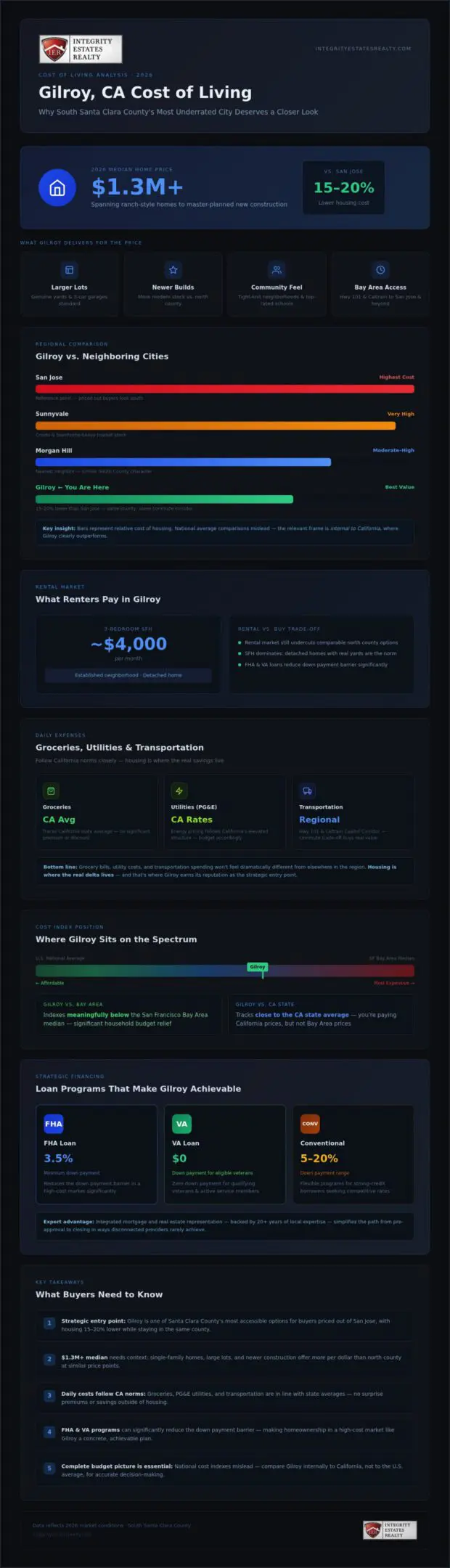
Cost-of-living indexes that benchmark against national averages can actually mislead California buyers. Knowing that Gilroy runs significantly above the U.S. average tells you almost nothing useful if you’re already living in San Jose or Morgan Hill and evaluating a lateral move. The relevant comparison is internal to California, and within that frame, Gilroy indexes below the state’s most expensive metros in ways that matter for household budgets. Put plainly: Gilroy’s cost-of-living index sits meaningfully below the San Francisco Bay Area median, even while tracking close to the broader California state average.
What that means practically is that your grocery bill, your utility costs, and your transportation spending won’t feel dramatically different from what you’d experience elsewhere in the region. Housing is where the real delta lives, and that’s where Gilroy earns its reputation as a strategic entry point.
The 2026 Economic Outlook for South County
Inflation’s grip on everyday goods has eased somewhat from its peak years, but California’s structural cost pressures, energy pricing, insurance premiums, and local service costs, remain elevated. South County’s local job market has seen steady growth in logistics, healthcare services, and small business sectors, which has supported household spending capacity without driving the kind of demand-side price spikes seen further north.
For a deeper look at how these economic currents are shaping property values and buyer activity specifically, the Gilroy real estate market trends analysis for 2026 provides essential context that any serious buyer should review before drawing conclusions from price data alone.
The Gilroy premium you’re paying buys something concrete: larger lots, newer construction relative to the northern county stock, schools that consistently draw favorable community reviews, and a pace of life that many buyers find is worth more than they expected once they’re actually living it.
Housing and Real Estate: The Primary Cost Driver
Gilroy’s 2026 median home price sits in the $1.3M range, a number that commands respect but deserves context. That figure reflects a broad market spanning everything from modest ranch-style homes near downtown to spacious newer construction in South Gilroy’s master-planned communities. The price tag alone doesn’t tell you what you’re actually getting, and in Gilroy’s case, what you’re getting often surprises buyers who arrive with Bay Area fatigue and low expectations.
Single-family homes dominate the inventory here. Unlike San Jose or Sunnyvale, where condos and townhomes represent a significant share of available stock, Gilroy’s market skews toward detached properties with genuine yards, three-car garages, and square footage that would cost considerably more twenty miles north. That physical reality is a meaningful part of understanding the true cost of living in Gilroy, CA.
On the rental side, approximately $4,000 per month in Gilroy typically secures a three-bedroom single-family home in an established neighborhood, a figure that reflects the regional market but still undercuts comparable rentals in Morgan Hill or Los Gatos by a meaningful margin. Luxury apartment options are more limited here than in denser Silicon Valley cities, which is itself a reflection of Gilroy’s character: this is predominantly a homeownership community.
Property taxes in Santa Clara County follow California’s Proposition 13 framework, with a base rate of 1% of assessed value plus voter-approved local bonds and assessments. On a $1.3M purchase, your baseline property tax obligation runs approximately $13,000 annually before those additional levies are applied. Buyers should request a full tax bill breakdown from their agent before closing, since the final number often runs higher than the base rate suggests.
Homeowners insurance adds another layer of complexity. California’s insurance market has contracted significantly in recent years, with several major carriers reducing their presence in the state. Premiums in Santa Clara County have risen accordingly, and buyers financing a home here should budget for insurance costs that may run higher than national benchmarks suggest. Shopping multiple carriers and working with a knowledgeable local lender who understands how insurance costs affect debt-to-income ratios is no longer optional; it’s essential.
Buying vs. Renting in Gilroy
The equity argument for buying in Gilroy is grounded in observable patterns: South County has appreciated steadily over the past decade, driven by constrained supply and sustained demand from buyers migrating from higher-cost areas. Renting preserves flexibility but builds nothing. For buyers committed to the region, the long-term calculus typically favors ownership, provided the financing structure is sound from the start. The Gilroy Buyer’s Lifestyle and Financing Guide offers a deeper look at property types, neighborhoods, and financing strategies worth reviewing before you decide.
Hidden Costs of Homeownership
Several cost categories catch buyers off guard after closing. Newer Gilroy developments, particularly in South Gilroy, frequently carry Mello-Roos special tax assessments that fund infrastructure improvements and community facilities. These can add hundreds of dollars monthly to your effective housing cost and don’t disappear after a few years the way some buyers assume. HOA fees in planned communities range considerably depending on amenities, and larger lots common in Gilroy’s suburban and semi-rural areas bring real maintenance obligations: irrigation systems, landscaping, and fencing costs that urban condo owners never encounter. Budget for them honestly.
Daily Expenses: Groceries, Utilities, and Transportation
Housing dominates the conversation around the cost of living in Gilroy, CA, and rightfully so. But the day-to-day expenses that accumulate quietly, grocery runs, utility bills, the morning commute, are what determine whether a household budget actually holds together month after month. This is where buyers who’ve done only partial research get surprised, and not always pleasantly.
Gilroy’s agricultural roots create a reasonable expectation: local produce, lower food costs. The reality is more nuanced. Yes, farmstand access and seasonal availability give Gilroy residents genuine advantages for fresh produce, particularly during the summer and fall harvest windows. But full-service grocery shopping at major chains tracks closely with broader Bay Area pricing. Expect to pay California-market rates for packaged goods, dairy, and proteins. The savings at a local farmstand are real but seasonal; your monthly grocery bill won’t look dramatically different from what you’d spend in Morgan Hill or San Jose.
The Commuter’s Tax: Gas and Maintenance
South County gas prices generally track at or slightly below the California state average, but that modest discount evaporates quickly when you factor in the mileage reality of a Gilroy commute. A round trip to San Jose’s downtown core covers roughly 60 to 70 miles. Daily. Five days a week. The math compounds: annual fuel and maintenance costs for a Gilroy-to-San Jose commuter can run meaningfully higher than what the same professional would spend living closer to work, and that’s before accounting for the time cost. Trading 90 minutes of daily commuting for a lower mortgage payment is a legitimate trade, but it’s a trade, not a free lunch. Run the full numbers before you commit.
Caltrain does serve Gilroy, and the Capitol Corridor connection is genuinely useful for commuters whose employers sit near a station. Monthly pass costs vary by zone, and Gilroy sits at the southern terminus, meaning fares are among the higher end of the system’s pricing structure. For the right commuter profile, it’s a viable option that eliminates fuel and parking costs entirely. For most South County residents, though, driving remains the practical default.
Utility Management in a Mediterranean Climate
PG&E serves Gilroy, and in 2026, that comes with some of the highest electricity rates in the country. Gilroy’s Mediterranean climate means air conditioning is a genuine necessity from late May through September, not a luxury. Summer cooling costs can push monthly electric bills significantly higher than a buyer accustomed to a milder climate might expect.
Solar panel adoption has accelerated across South County precisely because of this pressure. A properly sized rooftop system can substantially reduce or eliminate net electricity costs, and with Santa Clara County’s sun exposure, the return on investment is well-documented. Buyers evaluating homes should specifically ask whether an existing solar installation is owned outright or financed through a lease or power purchase agreement; the distinction has real implications for your monthly costs and for how the system is treated during the mortgage underwriting process.
Water and trash services add a modest but consistent line to the monthly budget. Santa Clara County has implemented tiered water pricing structures that include conservation surcharges for usage above baseline thresholds. Gilroy’s larger lots and yards, one of the features that makes the city genuinely appealing, also mean higher landscape irrigation demands. Buyers moving from a condo or smaller urban property should budget accordingly and ask about historical water bills for any home they’re seriously considering.
Comparing Gilroy: How It Stacks Up Regionally
Numbers on a cost-of-living index tell you something. They don’t tell you what it actually feels like to choose Gilroy over Morgan Hill, or why a family that could technically afford San Jose keeps ending up in South County instead. That gap between the spreadsheet and the lived experience is exactly where most regional comparisons fail buyers. Let’s close it.
Gilroy vs. San Jose is the comparison that matters most for the majority of buyers evaluating the cost of living in Gilroy, CA. Housing costs in Gilroy run roughly 15 to 20 percent below San Jose’s median, and you’re still inside Santa Clara County. Same school funding structures, same county services, same property tax framework. The savings aren’t coming at the cost of leaving a familiar administrative and civic ecosystem. They’re coming from geography, and geography is something you can work around with a commute plan.
Morgan Hill sits directly between Gilroy and San Jose, and its pricing reflects that position precisely. Morgan Hill commands a premium over Gilroy that’s difficult to justify on pure value terms. You’re buying proximity and a slightly different community character. For some buyers, that’s worth it. For buyers prioritizing square footage, lot size, and overall purchasing power, Gilroy typically wins the comparison on paper and in practice.
Salinas offers lower nominal prices, but the comparison is less favorable than it first appears. Salinas sits in Monterey County, outside the Santa Clara County school district structure, further from the Silicon Valley employment corridor, and with a distinct economic profile that changes the risk calculus for long-term appreciation. Lower entry price doesn’t automatically mean better value, and for buyers whose professional lives are anchored to the Bay Area tech economy, Salinas represents a different kind of trade-off entirely.
The Silicon Valley Value Proposition
Price-per-square-foot comparisons between Gilroy and cities like Sunnyvale or Mountain View are striking. In those northern Silicon Valley markets, buyers are frequently paying a significant premium for older housing stock on smaller lots in more congested neighborhoods. Gilroy’s newer construction, particularly in South Gilroy’s planned communities, delivers more livable space per dollar than much of what’s available further north. School district ratings across South County are consistently favorable, and that correlation between school quality and housing cost is far less punishing here than in markets where top-rated districts have fully priced out middle-income families. It’s also worth noting that some current Gilroy homeowners are leveraging accumulated equity to sell their home in Gilroy and upgrade locally, a move that speaks to the depth of the market here.
South County Lifestyle Benefits
Gilroy’s lifestyle advantages don’t show up in any cost-of-living index, but they’re real and they compound. Proximity to Henry W. Coe State Park, the Santa Cruz Mountains, and a growing wine country corridor along Hecker Pass means that recreational access others pay premium urban amenity fees to approximate is essentially built into the address. The Gilroy Garlic Festival isn’t just a quirky local tradition; it’s a reflection of a community that still invests in shared identity, and that civic cohesion has genuine value for families putting down roots. A slower pace of life without disconnecting from the tech economy’s orbit is a rare combination. Gilroy offers it. That’s why growing families keep landing here, and why the cost of living in Gilroy, CA, understood completely rather than just numerically, consistently earns its reputation as South County’s strategic sweet spot.
If you’re working through how these regional dynamics affect your specific buying position, connect with a local market specialist who can translate the comparisons into a personalized financial picture.
Strategic Financing: Making Gilroy Affordable
Understanding the cost of living in Gilroy, CA is only half the equation. The other half is structuring a financing plan that actually works in a high-cost Santa Clara County market. This is where many buyers stall: they find the right neighborhood, run the regional comparisons, and then hit a wall when the down payment math doesn’t cooperate. The right loan structure changes that conversation entirely.
High-cost markets create friction at every stage of the mortgage process. Appraisal complexity, insurance underwriting, jumbo loan thresholds, debt-to-income calculations that don’t account for California’s cost realities. Working with a mortgage broker in Santa Clara County who operates specifically in this environment removes that friction in ways a national lender working from a remote call center simply cannot replicate. Local knowledge isn’t a soft benefit here. It’s a structural advantage that shows up in your rate, your timeline, and your closing costs.
FHA and VA Loan Opportunities
For buyers who don’t have a conventional 20% down payment sitting in a brokerage account, FHA and VA programs are the most powerful tools available in Gilroy’s market. The Federal Housing Administration sets high-cost area loan limits annually, and Santa Clara County consistently qualifies for elevated limits that make FHA financing viable well above the national baseline. That means buyers can access FHA’s lower down payment requirements on properties that would fall outside FHA eligibility in most of the country. For specific 2026 limits and qualification requirements, the FHA home loans in Gilroy guide provides the current figures and program details you’ll need.
VA loans deserve special attention for veterans and active-duty service members considering South County. No down payment requirement, no private mortgage insurance, and competitive interest rates combine to make VA financing genuinely transformative in a market where entry costs are otherwise steep. Gilroy’s growing veteran community reflects this reality. For families who qualify, VA financing is frequently the single most effective affordability tool available, full stop.
For purchases that exceed conforming loan limits, jumbo loan origination requires a lender who understands Santa Clara County’s appraisal landscape and can structure terms that reflect the local market’s actual risk profile, not a generic high-value property template.
The Integrity Estates Advantage
Jose M Hernandez has spent over two decades building something that most buyers don’t realize they need until they’re deep in a transaction: a practice where real estate representation and mortgage brokerage operate from the same office, guided by the same professional relationship. The practical effect is significant. Your agent already understands your financing structure when negotiations begin. Your loan officer already knows the property’s context when underwriting questions arise. That coordination eliminates the gaps where deals quietly fall apart.
Getting pre-approved is the right first step. It sharpens your search, strengthens your offers, and gives you a clear picture of what your monthly obligation actually looks like across different loan structures. Connect with Integrity Estates Realty & Mortgage to start that conversation with a team that knows Gilroy’s market from both sides of the transaction.
Your Next Step Toward a Smarter California Address
The cost of living in Gilroy, CA tells a story that raw price tags alone can’t capture. You’re looking at a market that delivers genuine Santa Clara County value: more square footage, larger lots, favorable school options, and a community identity that holds, all while sitting 15 to 20 percent below San Jose’s median. The daily expenses are California-realistic, the commute requires honest planning, and the financing landscape rewards buyers who approach it with the right team.
Those three realities, housing value, budget clarity, and strategic financing, are exactly what Integrity Estates Realty and Mortgage has spent over 20 years helping South County buyers navigate. With integrated real estate and mortgage services under one roof, and deep specialization in FHA and VA loan programs, the path from “considering Gilroy” to “closing in Gilroy” becomes a coordinated process rather than a fragmented one.
Don’t leave that coordination to chance. Plan your move to Gilroy with the local experts at Integrity Estates Realty and start building a financial picture that actually works for your household. The right address is closer than you think.
Frequently Asked Questions About the Cost of Living in Gilroy, CA
Is Gilroy, CA expensive to live in?
Yes, Gilroy is expensive by national standards, but within California’s context it’s one of Santa Clara County’s more accessible markets. You’re paying California prices across groceries, utilities, and services, but housing costs run noticeably below what comparable properties command in San Jose or Morgan Hill. The honest answer is that Gilroy is expensive, just strategically so relative to its neighbors.
What is the average salary needed to live comfortably in Gilroy?
For a household purchasing a median-priced home in Gilroy, lenders typically look for gross annual income that supports a mortgage payment plus taxes, insurance, and assessments without exceeding standard debt-to-income thresholds. For most buyers financing at current rates, that points toward household incomes in the $200,000 to $250,000 range for ownership. Renters can manage comfortably on somewhat less, though South County rental costs are firmly in California territory.
How do property taxes in Gilroy compare to other California cities?
Gilroy follows Santa Clara County’s property tax structure, governed by Proposition 13’s 1% base rate on assessed value. That baseline is consistent across California, so Gilroy isn’t uniquely punishing on property taxes. The meaningful difference comes from Mello-Roos assessments layered onto newer South Gilroy developments, which can meaningfully increase your effective annual tax obligation beyond what the base rate suggests. Always request a full tax bill, not just the base rate, before closing.
Are there affordable housing programs in Gilroy for first-time buyers?
First-time buyers in Gilroy have real options worth exploring. Santa Clara County qualifies as a high-cost area for FHA loan purposes, which means elevated loan limits that make FHA’s lower down payment structure viable at Gilroy price points. VA financing eliminates the down payment requirement entirely for eligible veterans. The City of Gilroy has periodically offered below-market-rate programs through its housing department, so checking current availability directly with the city is worthwhile alongside your loan research.
How much does the average utility bill cost in Gilroy?
PG&E electricity rates in 2026 rank among the highest in the country, and Gilroy’s warm summers mean air conditioning drives real seasonal spikes. A typical household can expect monthly electric bills to climb substantially from May through September. Water costs add another consistent line item, particularly for homes with larger lots and irrigation systems. Buyers moving from smaller urban properties should budget meaningfully more for utilities than their previous experience might suggest.
Is it cheaper to live in Gilroy or Morgan Hill?
Gilroy is generally more affordable than Morgan Hill, particularly on housing costs. Morgan Hill commands a premium that reflects its proximity to San Jose and a slightly different community character, but that premium is difficult to justify on pure value terms for buyers prioritizing square footage and purchasing power. The cost of living in Gilroy, CA tracks below Morgan Hill in the housing category specifically, while daily expenses like groceries and utilities remain broadly comparable between the two cities.
What are the average grocery costs for a family of four in Gilroy?
Grocery costs for a family of four in Gilroy track closely with broader Bay Area pricing at major chains. Seasonal farmstand access provides genuine savings on fresh produce during summer and fall harvest windows, but packaged goods, dairy, and proteins price at California-market rates year-round. Families shouldn’t expect dramatic savings over what they’d spend in San Jose or Morgan Hill; the agricultural heritage creates opportunity for fresh produce savings, not a wholesale discount on the full grocery bill.
How do gas prices in Gilroy compare to San Jose?
Gilroy gas prices generally track at or slightly below the California state average, which often places them modestly below San Jose’s figures. That gap is real but modest, typically a few cents per gallon. The more significant fuel cost factor for Gilroy residents is volume: a daily commute to San Jose covers 60 to 70 miles round trip, meaning annual fuel expenditure can exceed what a closer-in resident spends despite paying a lower per-gallon price. Distance matters more than the pump price differential.