
How to Buy Commercial Property in Santa Clara County: The 2026 Investor’s Roadmap
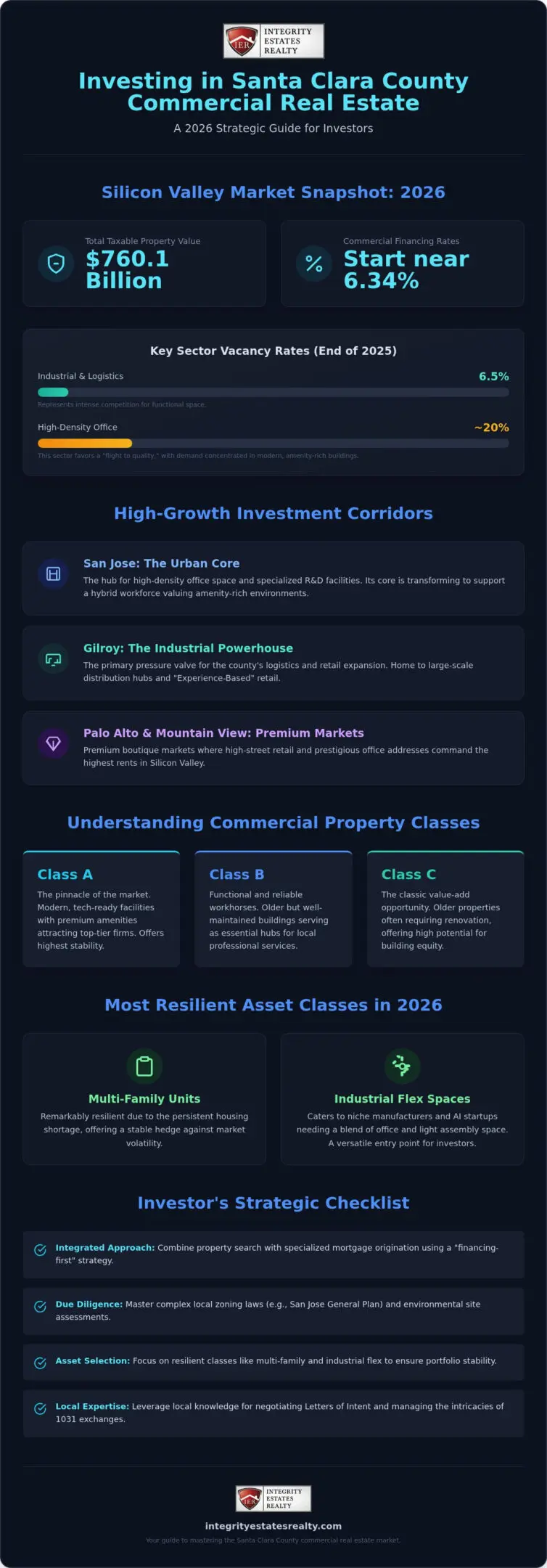
With Santa Clara County’s total taxable property value reaching a record $760.1 billion in 2026, the Silicon Valley commercial market remains a titan of opportunity, even as it transitions into a more normalized state. Learning how to buy commercial property in santa clara county requires more than just capital; it demands a strategic “financing-first” approach and a deep understanding of local zoning nuances. You’ve likely realized that high entry costs and the complex layers of the San Jose General Plan can make even seasoned investors pause. It’s a high-stakes environment where the difference between a legacy asset and a costly mistake often comes down to the quality of your local data.
We believe that every transaction is a partnership, and your success depends on having a steadfast guide by your side. This roadmap provides you with a clear, ethical path to master these complexities, ensuring you move forward with total peace of mind. We’ll explore the step-by-step acquisition process, demystify local financing options with rates starting near 6.34%, and identify high-growth corridors from the industrial hubs of San Jose to the emerging opportunities in Gilroy. By the end of this guide, you’ll have the clarity needed to turn a complex acquisition into a cornerstone of your long-term wealth.
Key Takeaways
- Understand how the “Silicon Valley Effect” creates distinct investment opportunities in high-growth corridors like Gilroy compared to the established hubs of San Jose.
- Master the essential steps of how to buy commercial property in santa clara county by using an integrated approach that combines property search with specialized mortgage origination.
- Navigate complex local zoning laws and environmental site assessments with a detailed seven-step due diligence checklist tailored for the 2026 regulatory environment.
- Identify the most resilient asset classes, including multi-family units and industrial spaces, to ensure your portfolio remains stable during market transitions.
- Learn why local expertise is vital for negotiating sophisticated Letters of Intent and managing the intricacies of 1031 exchanges to protect your long-term wealth.
Understanding the Santa Clara County Commercial Landscape in 2026
The current 2026 Santa Clara County economic landscape is defined by a shift from pure digital software to tangible physical infrastructure. While the region remains the global heart of tech, the current cycle is driven by the massive hardware requirements of Artificial Intelligence and a resurgence in biotech manufacturing. This evolution means that learning how to buy commercial property in santa clara county now requires an eye for specialized power needs and laboratory zoning. It’s a market that rewards precision over speculation, where understanding the underlying economic narrative is as important as the physical asset itself.
The “Silicon Valley Effect” is no longer confined to the shadows of the Apple Park spaceship. As San Jose continues to densify, traditional industrial and logistics operations are migrating toward the South County corridor. This migration makes it vital to monitor gilroy real estate market trends, as this area now serves as the primary pressure valve for the county’s logistics and retail expansion. With industrial vacancy rates hovering around 6.5% at the end of 2025, the competition for functional space remains intense, pushing savvy investors to look where the expansion is actually happening.
Key Sub-markets: From San Jose to Gilroy
San Jose remains the undisputed hub for high-density office space and specialized R&D facilities. Its urban core is undergoing a transformation to support a hybrid workforce that values central, amenity-rich environments. In contrast, Gilroy has emerged as the county’s industrial powerhouse. It’s where you’ll find the logistics hubs and large-scale retail centers that sustain the region’s commerce. Meanwhile, Palo Alto and Mountain View maintain their status as premium boutique markets, where high-street retail and prestigious office addresses command the highest rents in the valley.
Commercial Property Classes: A, B, and C
Understanding property classification is essential for aligning your acquisition with your risk tolerance. Class A properties represent the pinnacle of the market; these are modern, tech-ready facilities with premium amenities that attract the world’s leading firms. They offer the most stability but come with a higher price tag. Class B properties are the functional, reliable workhorses of the community. These are often older buildings that remain well-maintained and serve as essential hubs for local professional services. Finally, Class C properties represent the classic value-add play. These buildings often require significant renovation or repositioning, but for the investor who understands the local landscape, they offer a powerful way to build equity in a competitive region.
Identifying the Right Commercial Asset for Your Portfolio
Choosing the right asset class is the first pillar of success when discovering how to buy commercial property in santa clara county. In 2026, the market isn’t a monolith. Multi-family units remain remarkably resilient due to the persistent housing shortage, offering a stable hedge against market volatility. We’re also seeing a massive surge in “Industrial Flex” spaces. These small-scale warehouses cater to niche manufacturers and AI startups that need a blend of office space and light assembly areas. They represent a versatile entry point for investors who want to capture the valley’s innovative spirit without the overhead of a massive campus.
High-density office space continues to face headwinds, with vacancy rates hovering near 20% for the third consecutive year. It’s a sector that currently favors a “flight to quality,” where only the most modern, amenity-rich buildings attract stable tenants. Retail, however, has found a second life by focusing on services that can’t be replicated by e-commerce. Success in today’s market involves identifying properties that serve the daily lifestyle needs of the community, creating a sense of belonging that goes beyond a simple transaction.
Retail and Mixed-Use Opportunities
Downtown Gilroy and Willow Glen are leading the way in “Experience-Based” retail. These districts prioritize dining, wellness, and social spaces that draw consistent foot traffic. If you’re looking at these areas, pay close attention to mixed-use zoning. Combining ground-floor retail with upper-floor residential units can significantly de-risk your investment by diversifying your income streams. For a deeper dive into these specific neighborhoods, our guide on commercial real estate in Gilroy offers localized data on tenant demand and emerging retail trends.
Industrial and Logistics Hubs
The Highway 101 corridor is the lifeblood of the county’s logistics network. As e-commerce delivery expectations tighten, the demand for “last-mile” warehouse space has kept industrial vacancy rates low, sitting at approximately 6.5% at the end of 2025. However, these sites come with strict environmental hurdles. Navigating the California Environmental Quality Act (CEQA) is non-negotiable for industrial acquisitions in Santa Clara County. It’s helpful to review a professional Commercial Real Estate Due Diligence Checklist to ensure you’re accounting for every potential regulatory delay. If you’re feeling overwhelmed by these technical choices, our team can help you align your portfolio with these high-growth sectors through a personalized market consultation.
Financing Your Santa Clara Commercial Purchase
Securing capital in Silicon Valley is an exercise in transparency and preparation. Because of the high entry costs, understanding the nuances of how to buy commercial property in santa clara county often starts with a robust financing strategy before you even tour a property. A specialized mortgage broker in Santa Clara County acts as your advocate, bridging the gap between your investment goals and the stringent requirements of institutional lenders. In 2026, lenders are looking for more than just collateral; they’re looking for a narrative of stability and growth.
For owner-users, the SBA 504 and 7(a) programs remain the gold standard. These government-backed loans allow businesses to preserve capital, often requiring as little as 10% down. Conversely, conventional commercial loans in 2026 typically offer rates starting around 6.34%, though these are reserved for properties with strong cash flows and lower Loan-to-Value (LTV) ratios, usually between 65% and 75%. Lenders place a heavy emphasis on the Debt Service Coverage Ratio (DSCR), which measures the property’s ability to cover its debt obligations. A ratio of 1.25 or higher is often the baseline for approval in this competitive landscape.
SBA Loans vs. Conventional Financing
Choosing between SBA and conventional financing depends largely on your role as an owner or an investor. SBA 504 loans are ideal for long-term fixed rates when you intend to occupy at least 51% of the building. Conventional financing is better suited for pure investors who have higher liquidity and seek to acquire multi-tenant assets. If you’re targeting a value-add property that needs significant renovation before it’s “bankable,” bridge loans are a viable short-term solution. These currently range from 6.6% to over 11%, providing the speed and flexibility needed to close quickly and stabilize the asset.
The Pre-Approval Process for Commercial Buyers
A streamlined pre-approval process is your strongest tool in a negotiation. You’ll need to gather at least three years of tax returns, detailed Profit and Loss statements, and current rent rolls for the target property. Your personal credit score still carries weight, often influencing the specific interest rate tier you’ll qualify for. At Integrity Estates Realty, we provide an integrated approach by handling both the property search and the mortgage origination. This single point of contact simplifies the lender relationship and ensures that your financial profile is presented with the professional precision that Santa Clara lenders expect.
The 7-Step Commercial Due Diligence Checklist
The due diligence phase is where an investment’s potential is either confirmed or corrected. When you’re mastering how to buy commercial property in santa clara county, this period serves as your primary defense against unforeseen liabilities. It’s a methodical transition from the excitement of a listing to the cold reality of hard data. In a market as sophisticated as Silicon Valley, skipping a single step can lead to significant financial exposure, particularly when dealing with aging infrastructure or complex zoning overlays.
- Step 1: Zoning and Land Use Verification. Confirming that your intended use aligns with San Jose municipal codes or Santa Clara County’s broader regulations.
- Step 2: Environmental Site Assessment. A Phase I ESA is the baseline for identifying historical contamination risks.
- Step 3: Financial Audit. This involves a granular review of verified rent rolls, utility bills, and three years of operating expenses.
- Step 4: Physical Inspection. Assessing the remaining useful life of the roof and HVAC systems while ensuring full ADA compliance.
- Step 5: Title Review and ALTA Survey. Identifying any easements or encroachments that might limit future development.
- Step 6: Insurance and Liability Review. Evaluating the cost of coverage in high-value or high-risk zones.
- Step 7: Final Underwriting. Re-verifying the property’s cash flow against current interest rates before the feasibility period expires.
Navigating Local Zoning and Permits
Distinguishing between ‘Permitted Use’ and ‘Conditional Use’ is vital for any commercial acquisition. Permitted uses are allowed by right, while conditional uses require a specific permit and public hearings, which can add months to your timeline. The San Jose Planning Division plays a critical role here, especially if you’re considering a commercial conversion or a change in density. Entitlements are the legal rights granted by government entities to develop or use a property in a specific way, and they are often the most valuable component of a commercial deal because they eliminate the risk of project rejection.
Environmental and Legal Protections
California’s CEQA standards are among the strictest in the nation, making a Phase I ESA a non-negotiable requirement for any prudent buyer. If the Phase I suggests potential issues, you’ll need to move to a Phase II, which involves soil and groundwater testing. For multi-tenant assets, you must also secure Estoppel Certificates, which are documents signed by tenants that confirm the terms of their leases and ensure no undisclosed side agreements exist. All of this must happen within the ‘Feasibility Period,’ the contractually defined window that allows you to withdraw from the deal if the property doesn’t meet your standards. To ensure your next acquisition is backed by this level of professional scrutiny, we invite you to partner with our brokerage for expert due diligence support.
Closing the Deal: Why Local Expertise Matters
The final stage of an acquisition is often the most delicate. It’s where the theoretical strategy meets the binding signature. In the journey of learning how to buy commercial property in santa clara county, the negotiation phase usually begins with a Letter of Intent (LOI). This document serves as a non-binding handshake that outlines the essential terms. However, the transition to the Purchase and Sale Agreement (PSA) is where the real work happens. The PSA is a comprehensive legal contract that codifies every protection, contingency, and deadline discussed during due diligence.
Escrow and title services act as the neutral gatekeepers of your transaction. If you’re executing a 1031 exchange, these entities are vital for maintaining the strict timelines required by the IRS to defer capital gains taxes. A local expert ensures that your exchange coordinator and the escrow officer are in perfect sync, preventing costly administrative errors. It’s about more than just moving money; it’s about protecting the wealth you’ve worked hard to build.
The Power of a Combined Real Estate and Mortgage Approach
Deal fatigue is a common hurdle in high-stakes Silicon Valley transactions. Managing a property search with one brokerage and financing with an outside lender often leads to communication gaps and missed deadlines. We solve this by integrating both services under one roof. Jose M Hernandez brings over 20 years of experience to every deal, acting as a steadfast guide who understands both the physical asset and the underlying mortgage structure. This integrated approach shields your equity and ensures a composed, methodical flow toward the closing table.
Consider a recent acquisition we managed in the Gilroy corridor. By handling both the industrial site search and the complex mortgage origination in-house, we were able to identify a potential appraisal gap early and restructure the financing before it could derail the deal. This level of foresight saved the client significant stress and ensured a successful transition. If your investment strategy includes a personal residence near your commercial holdings, you may also want to explore homes for sale in Gilroy to see how live-work investments can simplify your daily life.
Next Steps for Your Investment
Success in commercial real estate is rarely a one-time event; it’s a narrative that unfolds over decades. We invite you to schedule a comprehensive portfolio review to ensure your current assets are aligned with the 2026 market shifts we’ve discussed. Additionally, joining our local investor network provides you with early access to off-market opportunities that never reach public listings. When you’re ready to refine your strategy on how to buy commercial property in santa clara county, our team is prepared to serve as your ethical anchor and professional partner.
Ready to secure your place in the Silicon Valley market? Contact Integrity Estates Realty for a Commercial Consultation today to begin your acquisition journey with confidence.
Your Future in the Silicon Valley Commercial Market
Mastering the nuances of how to buy commercial property in santa clara county is a journey that rewards those who prioritize local data and integrated strategies. You’ve seen how the 2026 market demands a “financing-first” mentality combined with a rigorous approach to due diligence. Whether you’re targeting industrial flex space in San Jose or retail opportunities in Gilroy, success hinges on your ability to navigate complex zoning laws and environmental standards with total clarity. It’s a high-stakes environment where a composed, methodical approach is your greatest asset.
At Integrity Estates Realty, we’re more than just brokers; we’re your steadfast partners in long-term wealth creation. With over 20 years of local expertise and a unique model that integrates commercial brokerage with mortgage origination, we provide the ethical anchor you need in a competitive industry. We proudly serve Santa Clara, Monterey, and Fresno counties, ensuring your acquisition is handled with professional precision from the first tour to the final key exchange. We’re as invested in your future as you are.
Secure Your Silicon Valley Investment with Integrity Estates Realty today. We look forward to helping you turn your commercial aspirations into a lasting legacy and a place where your business truly belongs.
Frequently Asked Questions
How much down payment is required for commercial property in Santa Clara County?
Down payment requirements vary based on the specific loan program. For owner-users, an SBA 504 loan typically requires a 10% down payment. Conventional commercial loans usually require between 25% and 35% down, depending on the property’s cash flow and your financial profile. This initial investment is a critical step in learning how to buy commercial property in santa clara county, as it dictates your leverage and long-term interest costs.
What is a 1031 exchange and can I use it for Santa Clara real estate?
A 1031 exchange allows you to defer capital gains taxes by reinvesting the proceeds from a sold property into a “like-kind” replacement. This strategy is frequently used in Santa Clara County to upgrade portfolios without immediate tax penalties. You must identify a replacement property within 45 days and close within 180 days. It is an essential tool for investors aiming to build long-term equity in high-value California markets.
How long does the commercial buying process typically take in California?
The commercial buying process in California generally takes between 60 and 120 days. This timeline includes a 30 to 60 day due diligence period for physical and environmental inspections. Financing often requires the most time; SBA loans sometimes take up to 90 days to fully fund. Having an integrated team handle both the brokerage and the mortgage can help streamline these milestones and prevent unnecessary delays during the transaction.
Is it better to buy commercial property as an individual or an LLC?
Most investors choose to buy commercial property through a Limited Liability Company (LLC) rather than as individuals. An LLC provides a layer of protection for your personal assets and offers flexible tax structures for multiple partners. While we provide the real estate and mortgage expertise, we always recommend consulting with your legal and tax advisors to ensure the entity structure aligns with your specific estate planning and liability needs.
What are common closing costs for commercial buyers in Santa Clara County?
Closing costs for commercial buyers in Santa Clara County include a county transfer tax of $0.55 per $500 of value. Cities like San Jose, Palo Alto, and Mountain View impose an additional city transfer tax of $1.65 per $500. You should also account for recording fees of $25 for the first page and title insurance premiums. These costs are a necessary consideration when calculating the total capital required for your acquisition.
Can I get an SBA loan for a property I don’t intend to occupy?
You cannot use an SBA loan for a property you don’t intend to occupy. SBA 504 and 7(a) programs are designed for owner-users; they require your business to occupy at least 51% of an existing building. If you’re looking for a pure investment property where you won’t be the primary tenant, a conventional commercial loan is the appropriate path. Understanding these nuances is vital when planning how to buy commercial property in santa clara county.
What is the current cap rate for industrial property in the San Jose area?
Industrial cap rates in the San Jose area are influenced by the tight 6.5% vacancy rate seen at the end of 2025. While specific rates fluctuate based on property class and location, the high demand for logistics and AI-driven infrastructure keeps rates competitive. Investors often see lower cap rates for Class A facilities in prime corridors compared to value-add Class C properties. Local expertise is required to evaluate the specific yield for any parcel.
How do I verify the zoning for a specific parcel in Santa Clara County?
You can verify zoning by contacting the San Jose Planning Division or the Santa Clara County Planning Office, depending on the property’s location. Most jurisdictions provide online GIS portals where you can enter an Assessor’s Parcel Number (APN) to see current land use designations. We recommend cross-referencing these digital records with a formal zoning letter to confirm that your intended business operations are permitted or require a conditional use permit.