
FHA Loan vs. Conventional in Gilroy: Choosing Your 2026 Financing Strategy
With Gilroy’s median listing price currently sitting at $1,174,999, is a lower down payment actually your best move, or is it a liability in a bidding war? It is a question every serious buyer in South County must answer before stepping into today’s competitive market. We understand the pressure of facing bidding wars where offers often hit 99.4% of the asking price, leaving little room for error. When weighing an fha loan vs conventional gilroy residents often feel caught between the desire for immediate entry and the need for long-term equity growth.
You deserve a financing strategy that does more than just get you through the front door. This guide will help you discover which mortgage path secures your home in the competitive Gilroy market while protecting your long-term financial legacy. We will explore the updated 2026 high-balance loan limits of $1,249,125, analyze the total cost of mortgage insurance over a decade, and provide the clarity you need to choose a loan that aligns with both your lifestyle and your balance sheet. Our goal is to transform your homebuying journey from a stressful transaction into a confident investment in your family’s future.
Key Takeaways
- Learn why your choice of financing is the second most critical factor after your bid price in Gilroy’s high-stakes market.
- Compare the 2026 Santa Clara County loan limits to decide if an fha loan vs conventional gilroy strategy better fits your $1M+ home purchase.
- Understand the “FHA stigma” and how to position your offer to win against competing cash buyers or conventional bids.
- Discover the long-term cost differences between permanent FHA insurance and the cancellable nature of conventional private mortgage insurance.
- Explore the tactical advantages of working with an integrated real estate and mortgage team to ensure a seamless, ethical transaction.
The 2026 Gilroy Market: Why Your Loan Type Matters
Gilroy has evolved into a high-stakes arena where the median sale price now reaches $1,248,500. For many families, this isn’t just a number on a listing; it is the entry price for a seat at the table in one of Santa Clara County’s most desirable transit-oriented hubs. In this environment, your financing strategy is the second most critical factor in your offer, trailing only the bid price itself. Deciding between an fha loan vs conventional gilroy strategy requires a deep understanding of how local sellers perceive financial stability. While the foundational support of an FHA insured loan can be a lifeline for those with smaller down payments, the choice carries weight far beyond your monthly payment.
Integrity Estates Realty & Mortgage bridges the gap between technical mortgage logic and actual real estate results. We recognize that in a market where homes sell for 99.4% of their asking price, there is no room for “standard” advice. Every percentage point in your down payment and every clause in your pre-approval letter serves as a signal to the seller about your ability to close the deal without complications.
Gilroy’s Competitive Landscape in 2026
Inventory remains tight with only 3.1 months of supply available. In neighborhoods like Las Animas, buyers often face intense competition from high-net-worth individuals and aggressive cash offers. Simply being “pre-approved” is no longer the gold standard. Sellers are looking for certainty. A conventional loan often signals a more straightforward appraisal process, while an FHA offer might require more detailed property inspections. You need a strategy that anticipates these biases. We ensure your pre-approval is backed by a comprehensive file that proves your resilience, regardless of the loan vehicle you choose.
Defining Your Homeownership Legacy
Homeownership in Gilroy is about more than a transaction; it’s about lifestyle curation and long-term wealth building. Your loan choice directly dictates your equity growth over the first five years. While an FHA loan offers a lower barrier to entry, a conventional loan might allow you to shed mortgage insurance faster as your property value rises. We provide ethical, transparent guidance that looks at the total cost of the loan over a decade. Our integrated approach means your agent and your mortgage broker are on the same team, working to protect your financial legacy while securing the keys to your dream home.
Requirements and 2026 Santa Clara County Loan Limits
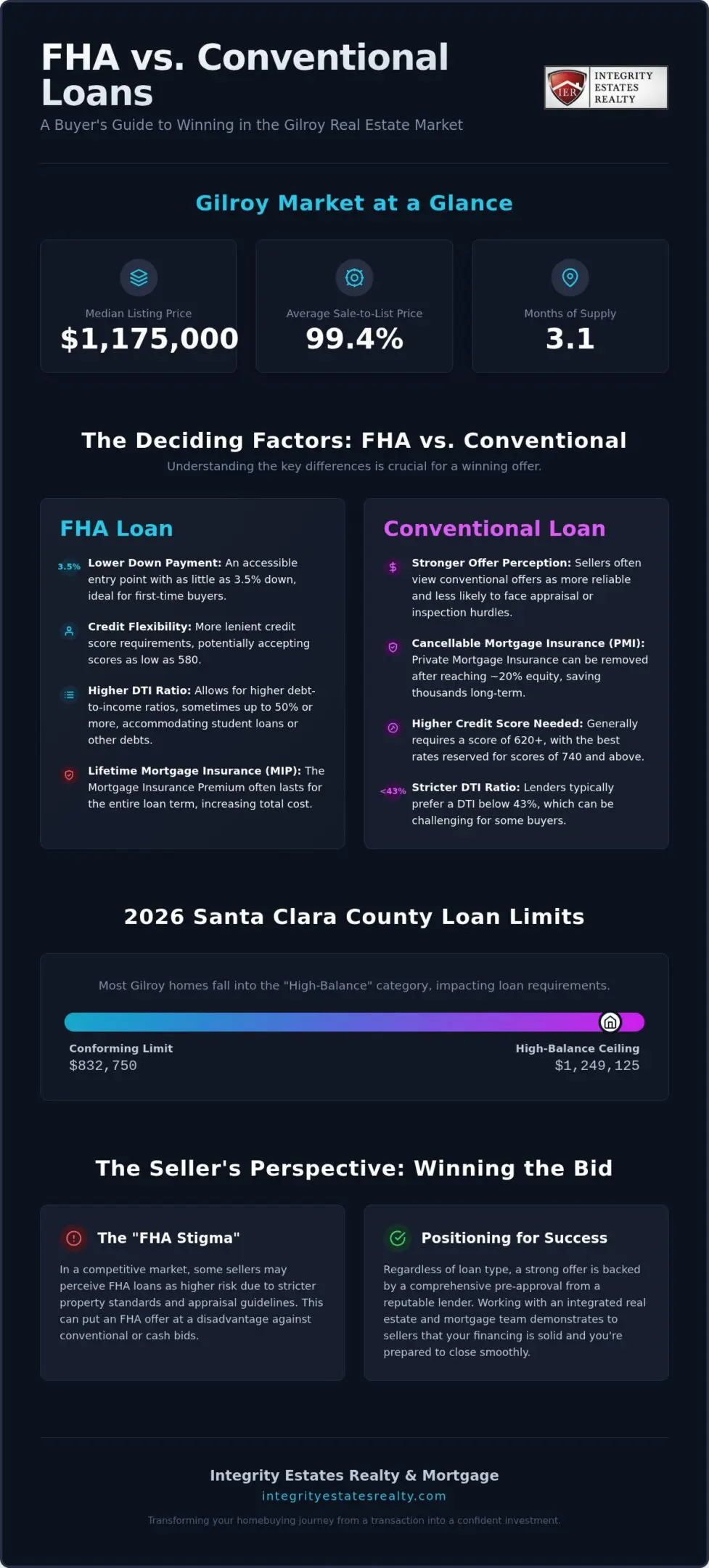
Understanding the technical requirements is your first step toward a successful purchase in South County. When evaluating an fha loan vs conventional gilroy, credit scores are often the primary gatekeeper. FHA loans generally allow for a score as low as 580 with a 3.5% down payment, providing a more accessible entry point for those building their financial profile. In contrast, most conventional programs require at least a 620, though certain first-time buyer initiatives can drop the down payment to 3% for those who qualify. It’s about finding the right fit for your unique financial profile among the different kinds of loans available.
Debt-to-income (DTI) ratios also play a massive role in your qualifying power. FHA guidelines are famously more forgiving of higher debt loads, which is a significant advantage for Gilroy professionals carrying substantial student loans. While conventional lenders typically prefer a DTI below 43%, FHA might allow up to 50% or more in specific cases, provided other financial markers are strong. This flexibility can be the difference between securing a home near Eagle Ridge or remaining in the rental cycle.
2026 Loan Limits: Staying Within the Lines
Santa Clara County’s designation as a high-cost area is a double-edged sword for Gilroy buyers. It allows for higher loan amounts, but it also brings stricter scrutiny from underwriters. The 2026 conforming loan limit for a one-unit property in Santa Clara County is $832,750. Anything above this amount, up to the high-balance ceiling of $1,249,125, falls under high-balance or “super conforming” rules. With Gilroy’s median listing price at $1,174,999, most local transactions sit firmly in this high-balance bracket, making it essential to understand how these limits affect your interest rate and down payment requirements.
Credit and Financial Thresholds
Credit tiers don’t just affect your interest rate; they dictate your overall monthly affordability. FHA loans are often more resilient to credit score dips, maintaining relatively stable rates even for those in the 600s. Conventional loans are much more sensitive. A score of 740 or higher is usually required to unlock the most competitive conventional terms. Beyond the score, you must also consider post-closing reserves. Lenders often want to see that you aren’t “house poor” the moment you get the keys. While FHA might not always require reserves for a single-family home, conventional lenders frequently ask for three to six months of liquid assets to cover your principal, interest, taxes, and insurance. For a deeper look at these nuances, consult our guide for Mortgage Brokers in Santa Clara County: A 2026 Buyer’s Guide to Home Financing. Making the right choice requires a partner who values your long-term success, and you can connect with our team to review your specific numbers.
The Gilroy Factor: Winning the Bidding War
In Gilroy’s competitive market, where homes often sell for 99.4% of their listing price, your loan type is a loud signal to sellers. Choosing between an fha loan vs conventional gilroy shouldn’t feel like a gamble. Many buyers encounter the “FHA stigma,” where sellers worry that FHA appraisals are too rigorous or that the buyer’s financial profile is less stable. To win, you need a strategy that addresses these concerns head-on. Our role as an integrated agency is to bridge that gap, ensuring listing agents see your offer as a guaranteed closing rather than a risk.
Sellers are naturally protective of their timeline, especially when the average home sits on the market for 44 days. They want the path of least resistance. While a conventional loan is often perceived as the “cleaner” option, an FHA loan can be just as competitive when backed by the right representation. It’s about more than just the numbers on the page; it’s about the confidence we instill in the listing agent regarding your ability to cross the finish line.
Navigating the FHA Appraisal in Older Neighborhoods
Gilroy’s established neighborhoods offer charm but often come with minor maintenance needs that can trigger FHA “red flags.” Common issues like peeling paint, missing handrails, or outdated electrical panels can stall an FHA transaction because the program requires the home to meet specific safety and habitability standards. If you are eyeing a property that needs a little love, the “as-is” flexibility of Conventional Mortgage Loans often provides a smoother path. However, FHA buyers don’t have to lose hope. We help you identify these hurdles early and negotiate repair credits or pre-inspections that reassure the seller. Proactive communication ensures that a minor repair won’t be the reason a deal falls through after weeks of escrow.
Positioning Your Offer in Eagle Ridge and Beyond
In high-end enclaves like Eagle Ridge, a conventional loan with a larger down payment is often viewed as a sign of financial fortitude. It suggests you have the liquid assets to handle any appraisal gaps that might arise in a bidding war. If you’re looking for a specific property, check our Homes for Sale in Gilroy, CA: The 2026 Buyer’s Lifestyle & Financing Guide to see how different neighborhoods respond to various financing types. For FHA buyers, the key is “selling” your strength. We personally call the listing agent to highlight your solid credit, your integrated approval process, and our 20-year track record of closing on time. By positioning your financing as a “done deal” through our integrated mortgage and realty services, we help you stand out even against higher-down-payment competitors.
Long-Term Costs: PMI vs. MIP & The Refinance Strategy
Securing a home is only the first step in your financial journey. To truly protect your long-term legacy, you must look beyond the initial monthly payment and calculate the total cost of borrowing over a five to ten year horizon. When evaluating an fha loan vs conventional gilroy, mortgage insurance becomes the most significant variable in your wealth-building equation. While both options allow you to enter the market with less than 20% down, they treat your equity very differently as time passes. Conventional loans offer a clear exit strategy for insurance costs, whereas FHA loans often require a more proactive approach to shed these additional fees.
Mortgage Insurance Nuances
Conventional Private Mortgage Insurance (PMI) is highly sensitive to your credit profile. For buyers with scores of 740 or higher, PMI is often significantly cheaper than the government-backed alternative. One of its greatest advantages is the automatic cancellation rule; once your loan-to-value (LTV) ratio reaches 78% through regular payments or home appreciation, the PMI drops off. FHA loans operate under a different set of rules. They require both an upfront premium, usually 1.75% of the loan amount, and an annual premium. If you put down the minimum 3.5%, that annual Mortgage Insurance Premium (MIP) typically stays for the entire life of the loan. For 2026, the annual Mortgage Insurance Premium for most 30-year FHA loans with a down payment of less than 5% is 0.55%.
Refinancing as a Wealth Tool
Gilroy’s consistent home appreciation provides a unique opportunity for FHA borrowers to pivot their strategy. Many of our clients use the FHA program as a “bridge” to homeownership, then transition to a conventional loan once their home’s value has increased. This FHA-to-Conventional refinance roadmap allows you to eliminate the permanent MIP once you’ve reached 20% equity. Given that the median sale price in Gilroy is $1,248,500, even a modest 5% annual appreciation can build substantial equity in just a few years. You can explore this further in our Refinance Mortgage Gilroy: The 2026 Homeowner’s Guide to Lower Rates & Equity.
We don’t just help you close a deal; we help you manage a multi-year financial plan. By monitoring local market trends and your specific loan balance, we can identify the exact moment when a refinance makes sense for your bottom line. If you’re ready to see how an fha loan vs conventional gilroy comparison looks for your specific 10-year forecast, contact our integrated team today for a personalized cost analysis.
The Integrity Estates Advantage: Integrated Guidance
Deciding between an fha loan vs conventional gilroy strategy shouldn’t happen in a vacuum. Most buyers find themselves bouncing between a real estate agent who understands the neighborhood and a separate lender who understands the numbers. This disconnect often leads to missed opportunities in a market where homes sell for 99.4% of their asking price. At Integrity Estates Realty & Mortgage, we eliminate that friction. By housing residential real estate representation and mortgage brokerage services under one roof, we ensure your financing is perfectly aligned with the specific property you want to win.
Jose M Hernandez has built this firm on over two decades of experience and a commitment to ethical, high-minded dedication. We don’t just process transactions; we curate lifestyles. Whether you are looking at a high-balance conventional loan for an Eagle Ridge estate or an FHA path for a starter home in Las Animas, our integrated approach means we can pivot quickly to meet the demands of any listing agent. We understand that in Gilroy, a “standard” pre-approval often falls short of what is required to win a bidding war.
Our Collaborative Partnership Model
Our model eliminates the communication gaps that often plague high-stakes real estate deals. Because we act as both your agent and your lender, we can personally vouch for your financial strength to listing agents, explaining exactly why your chosen fha loan vs conventional gilroy path is a sure bet for a timely close. This level of transparency creates a “Peace of Mind” guarantee that protects you from the stress of modern competition. We leverage local relationships built over 20 years to ensure your offer is viewed with the respect it deserves, providing a seamless journey from the initial contract to the final close.
Start Your Gilroy Journey Today
Preparing for a Santa Clara County purchase requires more than just a savings account. It requires a roadmap. Our initial consultation focuses on mapping out your 2026 goals, analyzing your credit profile, and identifying any potential hurdles before you ever step foot in an open house. We help you understand the total cost of ownership in Gilroy, from property taxes to long-term equity growth. To get started on your path to homeownership, you can Contact Integrity Estates Realty & Mortgage for a Personalized Loan Comparison. Let us help you secure your financial legacy in the community we are so proud to call home.
Securing Your Future in South County’s Premier Community
Your path to homeownership in Gilroy is a significant milestone that deserves a sophisticated financial strategy. Whether you opt for the flexibility of an FHA loan or the long-term leverage of a conventional mortgage, your decision should align with your broader financial legacy. We have explored how the 2026 high-balance loan limits and the nuances of mortgage insurance impact your bottom line over the next decade. Success in this competitive landscape requires more than just a high bid; it demands a partner who understands the local culture and the technical intricacies of the fha loan vs conventional gilroy debate.
Integrity Estates Realty & Mortgage, led by Jose M Hernandez, provides the integrated real estate and mortgage services you need to navigate this journey with confidence. With over 20 years of Santa Clara County expertise, we serve as your ethical anchor in a high-stakes industry. We are ready to help you curate a lifestyle that bridges the gap between your physical asset and your personal dreams.
Secure your Gilroy home with an expert mortgage strategy—Start here.
The home you have been dreaming of is within reach, and we are honored to guide you through every step of the process.
Frequently Asked Questions
Is an FHA loan better than a Conventional loan for a first-time buyer in Gilroy?
Whether an fha loan vs conventional gilroy strategy is better depends on your credit score and available cash. FHA is often the preferred path for first-time buyers with a 3.5% down payment and scores near 580. However, if you have a score above 720, a conventional loan may offer lower monthly costs and the ability to cancel mortgage insurance once you reach 20% equity, saving you thousands over the life of the loan.
What is the minimum credit score for an FHA loan in California for 2026?
For 2026, the minimum credit score for an FHA loan with a 3.5% down payment is 580. While federal guidelines technically allow scores between 500 and 579 with a 10% down payment, many lenders in the competitive Santa Clara County market maintain higher internal requirements. Maintaining a score above 620 will generally provide more favorable terms and a smoother approval process when competing for homes in established Gilroy neighborhoods.
Can I use an FHA loan to buy a high-priced home in Santa Clara County?
Yes, you can use FHA financing for high-priced residences because Santa Clara County is designated as a high-cost area. For 2026, the high-balance FHA loan limit for a one-unit property in the county is $1,249,125. This allows buyers to utilize the 3.5% down payment benefit even on million-dollar properties, which is essential given that the Gilroy median listing price currently sits near $1,174,999 as of August 2026.
Why do some Gilroy sellers prefer Conventional loans over FHA?
Sellers often prefer conventional loans due to perceived certainty and more flexible appraisal standards. FHA appraisals include specific safety requirements, such as checking for peeling paint or functional handrails, which can lead to mandatory repair requests before closing. In a market where homes sell for 99.4% of the asking price, sellers prioritize offers that promise the fewest hurdles. Our integrated team helps bridge this gap by vouching for your financial strength.
How much is the down payment for a Conventional loan in Gilroy?
While many believe a 20% down payment is mandatory, you can secure a conventional loan with as little as 3% down through specific first-time homebuyer programs. For most standard conventional transactions in Gilroy, a 5% down payment is the typical minimum. In high-stakes bidding wars, a larger down payment of 10% or 20% can signal financial stability to a seller, potentially giving your offer an edge over competitors with lower equity stakes.
Can I remove mortgage insurance from an FHA loan without refinancing?
Generally, you cannot remove the Mortgage Insurance Premium from an FHA loan without refinancing if you started with a 3.5% down payment. For those who put down at least 10%, the insurance can be removed after 11 years. Most homeowners choose to transition from an fha loan vs conventional gilroy structure via a refinance once their property has appreciated enough to reach the 20% equity threshold, effectively eliminating the monthly insurance cost.
What are the 2026 FHA loan limits for Gilroy, CA?
For 2026, Gilroy buyers fall under the Santa Clara County loan limits. The low-balance FHA limit is $832,750, while the high-balance limit reaches $1,249,125 for single-family residences. These elevated limits reflect the high-cost reality of the Silicon Valley region. Staying within these boundaries is crucial for utilizing FHA benefits, though any amount exceeding the high-balance ceiling would require a jumbo loan, which typically carries much stricter qualification standards and higher reserve requirements.
How does debt-to-income ratio affect my FHA vs. Conventional eligibility?
Your debt-to-income ratio is often the deciding factor in loan eligibility. FHA loans are notably more flexible, often allowing a ratio up to 50% or higher if you have compensating factors like high cash reserves. Conventional lenders typically prefer a ratio below 43%. If you are carrying student loans or other significant monthly obligations, the FHA path might provide the additional qualifying power needed to secure a home in Gilroy’s million-dollar market.