
What Credit Score is Needed to Buy a House in California? (2026 Financial Guide)
While a 580 credit score might technically open the door to a California home, it’s often a 740 score that actually allows you to afford the monthly payment. In a market where the median home price is nearly $900,000, even a fractional difference in your interest rate can translate to hundreds of dollars saved every month. You’ve likely felt the weight of this pressure, wondering if your current profile is enough to satisfy a lender or if you’ll face a discouraging rejection during the application process.
We at Integrity Estates Realty understand that the path to homeownership in the Golden State feels daunting, especially with shifting rates and differing requirements between FHA and conventional loans. This guide provides the exact 2026 credit benchmarks you need to hit and explains how to improve your credit score to buy a house in California to unlock the best possible terms. Whether you are eyeing a property in Santa Clara County or Monterey County, our goal is to provide the transparency and peace of mind you deserve as you plan your future.
We will explore the specific score requirements for VA, Jumbo, and FHA loans while offering a methodical plan to optimize your financial standing. By the end of this article, you will have the confidence to begin the pre-approval process with a clear target and a strategy to lower your long-term costs.
Key Takeaways
- Identify the specific 2026 credit benchmarks for FHA, VA, and conventional loans to determine exactly where your current profile stands.
- Understand why a 740 FICO score is the optimal target for securing the lowest interest rates and reducing your long-term monthly housing costs.
- Follow a practical 3-to-6-month roadmap on how to improve credit score to buy a house california by addressing high-impact financial factors.
- Learn how lenders evaluate the “Three Cs”-Credit, Capacity, and Collateral-to approve applications even when scores are not perfect.
- Discover the strategic advantage of working with an integrated brokerage that manages both your real estate search and mortgage origination under one roof.
The Baseline: What Credit Score is Needed for California Real Estate in 2026?
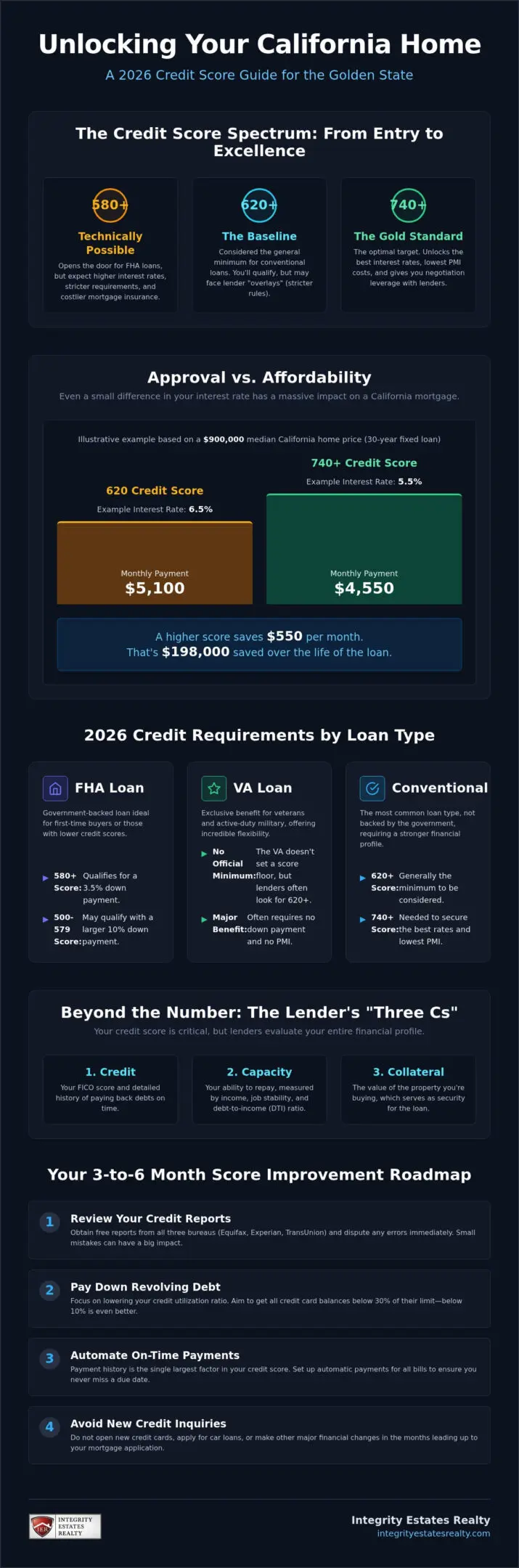
The FICO score remains the primary metric used by roughly 90% of mortgage lenders to assess your financial reliability. Understanding your Credit score in the United States is the essential first step toward securing a home in the Golden State. In the 2026 California market, a score of 620 is generally considered the baseline for stability. However, if you’re aiming for premium interest rates that make a mortgage truly affordable, a 740 or higher is the gold standard. Economic volatility in early 2026 has led many California lenders to implement stricter “lender overlays,” which are additional requirements that go beyond federal guidelines. This means meeting the bare minimum might not be enough to secure a loan from every institution.
Lenders are currently balancing a complex landscape of steady but cautious demand. While mortgage rates have shown a downward trend compared to the peaks of late 2023, they remain sensitive to geopolitical shifts. Because California has a statewide median home price nearing $900,000, lenders are particularly meticulous about credit health. They want to ensure that borrowers can handle significant monthly obligations without default risk. Knowing how to improve credit score to buy a house california is no longer just a “nice to have” strategy; it’s a financial necessity for anyone looking to enter this competitive market.
The Difference Between Minimum and Optimal Scores
Approval doesn’t always equal affordability. While a 620 score might get your application signed, it often comes with a higher interest rate that can drain your monthly budget. A 100-point difference in your score can save you thousands of dollars in interest over a 30-year term. Wholesale lenders in California use risk-based pricing, meaning they essentially “tax” lower scores with higher costs. Learning how to improve credit score to buy a house california before you apply ensures you aren’t stuck with these expensive penalties. A higher score gives you the leverage to choose between lenders rather than being forced to accept whichever one will take you.
Why Your Credit Score Matters More in High-Cost Counties
In areas like Santa Clara County, where home prices frequently hit the 2026 conforming loan limit ceiling of $1,249,125, your credit score carries immense weight. A small rate increase on a $300,000 loan is manageable; on a $1.2 million loan, it’s a significant financial burden. Beyond the interest rate, your score dictates the cost of Private Mortgage Insurance (PMI). Higher scores enjoy significantly lower PMI premiums, which keeps your monthly payment sustainable. Experienced mortgage brokers santa clara county can help you navigate these nuances, ensuring you find a lender whose specific overlays match your unique financial profile.
Credit Score Requirements by Loan Type: FHA, VA, and Conventional
Every mortgage product operates on a tier system, where your three-digit score dictates your entry point into the market. While the federal government establishes baseline Credit score requirements by loan type, individual lenders frequently implement “overlays.” These are internal, stricter standards that go beyond federal minimums to mitigate risk. In California’s high-balance markets, these overlays are especially prevalent. If you’re wondering how to improve credit score to buy a house california, the first step is identifying which loan “bucket” your current profile fits into.
FHA and VA Loans: Pathways for Lower Credit Scores
Government-backed loans provide a vital bridge for those with less-than-perfect credit. For instance, fha home loans gilroy allow for a 3.5% down payment with a credit score as low as 580. If your score sits between 500 and 579, you might still qualify with a 10% down payment. VA loans offer even more flexibility for veterans and active-duty members. The Department of Veterans Affairs doesn’t actually set a minimum score, but most lenders look for a functional 620 to ensure stability. These programs focus heavily on your residual income, providing a more holistic view of your ability to pay than a standard credit report might suggest.
Conventional and Jumbo Loans: The 2026 Standards
Conventional loans remain the standard for many buyers, requiring a minimum score of 620. However, the price of entry is steep if your score isn’t in the “excellent” range. To avoid high interest rates and expensive Private Mortgage Insurance, a 740 or higher is ideal. The stakes rise significantly with Jumbo loans. In high-cost counties where loan amounts exceed $1,249,125, lenders typically demand a 700 to 720 floor. These high-balance products also come with stricter documentation requirements. Lenders will often verify significant cash reserves, sometimes requiring 12 months of liquid assets to ensure you can weather any financial storm. Navigating these complex requirements is easier with a guide who understands the local landscape. You can consult with our advisory team to evaluate your specific loan eligibility.
Beyond the Number: How Lenders View Your Total Financial Profile
Underwriting isn’t a one-dimensional process. While your FICO score is the lead actor, it’s supported by a cast of other financial indicators. Lenders evaluate what we call the “Three Cs”: Credit, Capacity, and Collateral. Capacity refers to your earning power and job stability, while Collateral focuses on the property’s appraised value. If you’re currently researching how to improve credit score to buy a house california, remember that even a perfect score won’t compensate for a lack of verifiable, consistent income. Lenders look for a harmonious balance across these three pillars to ensure you’re a safe bet for a long-term loan.
Sometimes, a borrower with a 600 score gets approved while someone with a 700 score doesn’t. This often comes down to “compensating factors.” These are strengths in your profile that offset a lower credit score. High cash reserves, a long history with the same employer, or a significant increase in income can all tip the scales in your favor. It’s about presenting a narrative of reliability that extends beyond a simple three-digit number. We believe in looking at the person behind the paperwork, ensuring your unique financial story is told accurately to potential lenders.
The Debt-to-Income (DTI) Ratio Factor
The Debt-to-Income (DTI) ratio is often the silent deal-breaker in the 2026 California market. Most lenders look for a back-end DTI, which is the percentage of your gross income going toward all monthly debt, between 43% and 50%. In high-cost regions, the front-end DTI, specifically covering housing costs like taxes and insurance, is also scrutinized. Sometimes, paying down a high-interest car loan or credit card balance is more effective than chasing a few extra points on your credit report. This strategy directly increases your purchasing power by freeing up monthly cash flow, making you a more attractive candidate for a mortgage.
Cash Reserves and Down Payment Strength
Strong assets act as a safety net for both you and the lender. If your score is on the lower end of the spectrum, showing six to twelve months of mortgage payments in a liquid account can significantly reassure a lender of your financial health. A larger down payment of 10% to 20% also shifts the risk profile in your favor. Loan-to-value ratio is the relationship between the loan amount and the home’s appraised value. A lower LTV often allows for more flexible credit requirements because the lender has a larger equity cushion if the market shifts. When you understand how to improve credit score to buy a house california alongside these other factors, you build a profile that is difficult for any lender to ignore.
Practical Steps to Improve Your Score for a Competitive California Market
Securing a home in a market as fast paced as ours demands a proactive approach. Ideally, you should begin your financial preparations three to six months before you intend to house hunt. This window provides the necessary time for lenders to see a pattern of responsible behavior and for reporting cycles to catch up with your improvements. When you are learning how to improve credit score to buy a house california, the most immediate impact comes from managing your existing debt rather than seeking new credit.
Avoid common pitfalls that can derail a pre-approval. Many buyers mistakenly close old credit card accounts thinking it cleans up their profile, but this actually shortens your credit history and can lower your score. Similarly, opening new lines of credit for furniture or a car right before a home purchase is a significant risk. These hard inquiries and new debt obligations can shift your debt-to-income ratio and lower your score at the exact moment you need it to be at its peak. We recommend a complete credit freeze on new applications until your keys are in hand.
The 30% Utilization Rule and Rapid Rescoring
Credit utilization accounts for a massive portion of your FICO calculation. Keeping your balances below 30% of your total limits is the most efficient way to gain points quickly. If you find a dream property but your score is just a few points shy of a better rate tier, we can utilize professional Rapid Rescoring. This process allows a mortgage broker to update your credit profile in days by providing proof of paid-off balances directly to the bureaus. Under 2026 credit reporting laws, many old medical debts and small collections no longer carry the same weight, but it is vital to have a professional review these items before you pay them off. Paying an old collection can sometimes inadvertently restart the clock on its reporting period.
Audit Your Credit Report for California-Specific Errors
Discrepancies on your report are more common than you might think. Since lenders typically use the middle of your three scores to determine your rate, one error on a single bureau report can have expensive consequences. You should audit reports from Equifax, Experian, and TransUnion to ensure every detail is accurate. Interestingly, the same principles found in a mortgage refinance checklist apply here; whether you are buying or refinancing, your credit health is the foundation of your success. If you’re ready to see where you stand and develop a personalized plan, connect with our team for a comprehensive credit review today.
Expert Guidance: How Integrity Estates Realty Simplifies the Financing Process
Choosing a home is a deeply personal journey, but the financial architecture behind that choice requires a high level of technical precision. Integrity Estates Realty operates as a dual-service brokerage, meaning we provide both expert residential real estate representation and professional mortgage loan origination. This integrated model eliminates the friction often found between agents and lenders, ensuring your financial profile is perfectly aligned with your property search from day one. If you’re still determining how to improve credit score to buy a house california, our team acts as a steadfast guide, translating complex data into a clear, actionable roadmap.
Our mortgage specialists don’t just offer a single set of terms. We shop multiple wholesale lenders to find the specific institution whose risk appetite matches your credit tier. This is a critical advantage in the 2026 market, as different lenders have varying overlays for FHA, VA, and Jumbo loans. We invite you to begin with a Soft Pull credit consultation. This allows us to view your current standing and provide personalized advice without triggering a hard inquiry that could potentially lower your score. It’s a transparent, risk-free way to gain peace of mind before you enter the competitive Santa Clara County market.
A Collaborative Approach to Homeownership
We believe in a partnership model where our real estate agents and mortgage brokers work in total synchronization. This collaboration ensures that when you find the right property, your financing is already structured to support a winning offer. Our focus remains on your long-term financial health rather than a quick transaction. This philosophy is championed by Maria Elena Nena Arriaga, who brings over 20 years of local expertise to every client relationship. Founded in 2004, our brokerage has weathered decades of market shifts, providing us with the deep-rooted knowledge necessary to navigate the nuances of Gilroy, San Jose, and the surrounding regions.
Start Your Journey in Santa Clara County Today
While much of this guide focuses on the specific needs of Northern California buyers, those looking toward the Southern California coast can find similar specialized support; for example, Robert Neff, Ph.D., Realtor® offers expert guidance for those navigating the competitive coastal markets of the region.
Even if your credit score isn’t at the “premium” 740 level yet, we can help you build a plan to get there. The California landscape is diverse, and there are many pathways to homeownership for those willing to take a methodical approach to their finances. Understanding the local context is just as important as knowing your FICO score. You can explore the Gilroy Real Estate Market Trends to see how current property values and inventory levels might impact your timing. When you’re ready to move beyond research and into action, we’re here to provide a personalized mortgage assessment that respects your goals and your budget. Let’s work together to turn your personal narrative into a successful homeownership story.
Your Roadmap to California Homeownership Starts Here
Securing a home in the 2026 California market is a significant milestone that requires both a clear target and a steady partner. We’ve explored how a 580 or 620 score might get you through the door, but reaching for a 740 is what truly unlocks long-term affordability and peace of mind. By focusing on the “Three Cs” and understanding the specific requirements for FHA, VA, or Jumbo loans, you position yourself as a reliable candidate in a competitive landscape.
Knowing how to improve credit score to buy a house california through strategic utilization and report auditing can transform your financial trajectory in just a few months. Integrity Estates Realty brings over 20 years of California real estate and mortgage experience and access to dozens of wholesale lenders to help you find the perfect match for your credit profile. Whether you’re in Gilroy or the heart of Santa Clara County, we’re here to bridge the gap between your financial logic and your personal dreams.
Get Your Personalized California Mortgage Assessment Today and take the first step toward your new home with confidence.
Frequently Asked Questions
Can I buy a house in California with a 580 credit score?
Yes, you can buy a home in California with a 580 credit score using an FHA loan, which requires a 3.5% down payment. If your score falls between 500 and 579, you may still qualify but will typically need a 10% down payment. It’s important to remember that individual lenders in areas like Gilroy often apply their own “overlays,” which are stricter than federal minimums. Our team can help you navigate these specific lender requirements.
How much does a 100-point credit score difference affect my monthly mortgage payment?
A 100-point difference can significantly alter your financial landscape, often saving you hundreds of dollars every month. For a $900,000 home in San Jose, moving from a 640 to a 740 score could lower your interest rate by more than 1%. This reduction decreases your lifetime interest costs by tens of thousands of dollars. Understanding how to improve credit score to buy a house california is essential for keeping your monthly housing expenses manageable and sustainable.
Does checking my credit score for a mortgage pre-approval hurt my rating?
A formal mortgage pre-approval involves a “hard pull,” which typically lowers your score by five points or less. However, credit bureaus treat multiple mortgage inquiries within a 14 to 45 day window as a single event to encourage rate shopping. To protect your rating, Integrity Estates Realty offers a soft pull credit consultation. This allows us to review your profile and provide expert guidance without impacting your score at all during the initial planning stages.
What is the minimum credit score for a Jumbo loan in San Jose or San Francisco?
For Jumbo loans in high-cost regions like San Francisco or San Jose, most lenders require a minimum credit score of 700 to 720. Because these loans exceed the 2026 conforming limit of $1,249,125 in high-cost counties, they carry higher risk for the lender. In addition to a strong score, you will likely need to demonstrate significant cash reserves and a low debt-to-income ratio. Our brokerage specializes in these high-balance products for the California market.
Will a lender accept a co-signer if my credit score is too low?
Yes, many lenders accept a co-signer to help you qualify, though the impact on your credit score requirement varies by loan type. For an FHA loan, a non-occupant co-signer can help bridge the gap in income, but the lender still considers your individual credit history. If your score is the primary reason for a rejection, a co-signer might not always override a very low FICO score. We recommend a personalized assessment to see which program fits.
How long do I have to wait to buy a house after a bankruptcy or foreclosure in California?
The waiting period depends on the loan type and the nature of the financial event. For an FHA loan, you typically wait two years after a Chapter 7 bankruptcy and three years after a foreclosure. Conventional loans often require a longer wait of four to seven years. These timelines can sometimes be shortened if you can prove “extenuating circumstances.” Regardless of the wait, focusing on how to improve credit score to buy a house california during this time is vital.
Can I use a gift for a down payment if I have a lower credit score?
You can absolutely use gift funds for a down payment, even with a lower credit score. FHA loans are particularly flexible, allowing 100% of your down payment to come from a family member or employer. You will need a signed gift letter and a clear paper trail showing the transfer of funds. This is a common strategy in expensive markets like San Leandro or Hayward, where saving for a down payment is often the biggest hurdle.
What is the difference between a FICO score and the score I see on free apps?
Mortgage lenders almost exclusively use FICO scores, specifically versions 2, 4, and 5, while free apps often provide a VantageScore. These models weigh data differently, meaning the number you see on your phone might be 20 to 50 points higher or lower than what a lender sees. Because 90% of lenders rely on FICO, it is the only metric that truly matters for your pre-approval. We provide accurate FICO data during our comprehensive financial consultations.