
Conventional Loan Requirements in California: A 2026 Homebuyer’s Guide
What if the 20% down payment you’ve been saving for isn’t actually the barrier standing between you and a California home? Many buyers assume they’re priced out, but understanding the specific conventional loan requirements ca mandates in 2026 can change your entire outlook. It’s no secret that the Golden State presents a unique set of financial hurdles. With the median home price reaching $855,300 this year, the anxiety surrounding strict debt-to-income ratios and complex high-balance loan limits is completely understandable.
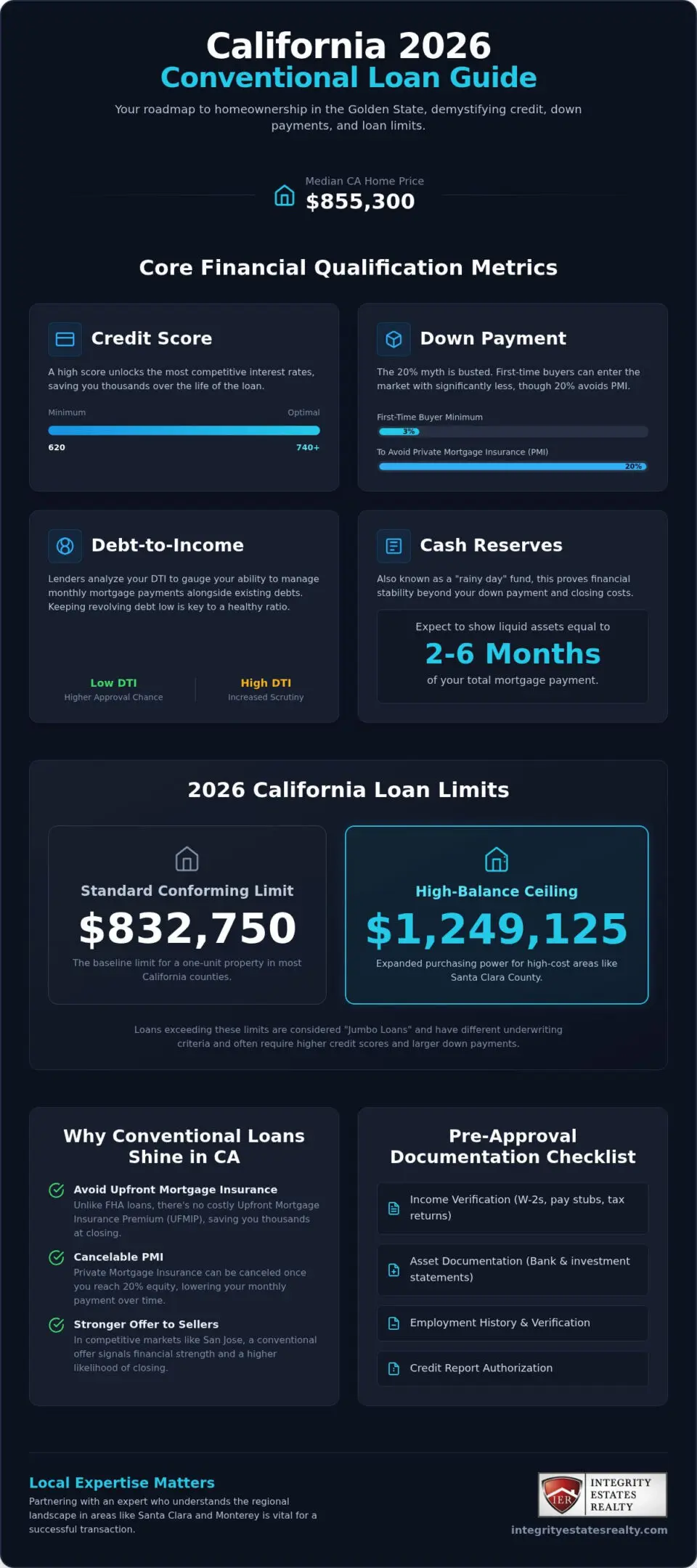
We’re here to act as your steadfast guide, providing the clarity you need to move forward with absolute confidence. You’ll master the exact credit, income, and down payment standards required to secure a mortgage in today’s sophisticated market. This guide offers a clear checklist of qualification metrics and a breakdown of the 2026 loan limits for your specific county, ranging from the $832,750 baseline to the $1,249,125 high-cost ceiling. By the time you finish reading, you’ll have the technical knowledge and the peace of mind to begin your pre-approval process with a sense of purpose.
Key Takeaways
- Master the specific conventional loan requirements ca has established for 2026, from the 620 credit score floor to the debt-to-income ratios that make homeownership attainable.
- Differentiate between standard conforming limits and the high-balance exceptions that provide expanded purchasing power in California’s most expensive counties.
- Identify the financial advantages of conventional financing, including the ability to avoid upfront mortgage insurance and reduce your long-term borrowing costs.
- Streamline your pre-approval process by gathering the essential income and asset documentation needed to navigate today’s rigorous underwriting standards.
- Learn why partnering with a local expert who understands the regional landscape in areas like Santa Clara and Monterey is vital for a successful transaction.
What is a Conventional Loan in the 2026 California Market?
A conventional loan is a private mortgage that operates independently of government insurance programs like the FHA or VA. In the 2026 California market, these loans represent the gold standard for buyers with solid credit and established savings. Because they aren’t backed by a federal agency, lenders assume a higher level of risk, which is why meeting the conventional loan requirements ca lenders set is so vital for a smooth approval process.
California homebuyers often prefer this path because it offers greater long term financial efficiency. Unlike FHA loans, conventional mortgages do not require an Upfront Mortgage Insurance Premium (UFMIP). This can save you thousands of dollars at the closing table, a significant advantage when you’re purchasing in high-value regions like Monterey or Santa Clara County. To better prepare for your purchase, you might explore Mortgage Brokerage Commission and Origination Fees to understand the full breakdown of potential costs. The entire framework for these loans is supported by Fannie Mae and Freddie Mac, the two government-sponsored enterprises that provide the necessary liquidity to keep our local housing market stable and accessible.
When comparing conventional options to FHA loans, the difference in property standards is often a deciding factor. FHA appraisals are notoriously strict regarding minor safety and cosmetic issues. Conventional appraisals tend to be more focused on fair market value, giving you more flexibility if you’re eyeing a property in San Jose or Gilroy that might need a few minor updates.
The Difference Between Conforming and Non-Conforming
Most conventional mortgages fall into the category of a conforming loan, meaning they adhere to the dollar limits set annually by the Federal Housing Finance Agency (FHFA). For 2026, the baseline limit is $832,750 for a one-unit property. If your home search takes you beyond the local high-balance ceiling for your specific county, you’ll enter the territory of non-conforming or Jumbo loans. Conforming loans are generally the preferred choice because they offer the most competitive interest rates and standardized underwriting criteria, making the journey to homeownership more predictable.
Why Conventional Loans Dominate Santa Clara County
In competitive hubs like San Jose, a conventional offer often carries more weight with sellers. Listing agents frequently view these offers as a sign of financial strength. Since conventional loan requirements ca participants must meet are often more rigorous, sellers feel more confident that the transaction will close on time. Furthermore, the ability to eventually cancel Private Mortgage Insurance (PMI) once you reach 20% equity provides a clear path to lower monthly payments that government-backed loans simply don’t offer.
Core Financial Requirements: Credit, Debt, and Down Payments
Securing a home in the Golden State requires more than just a vision; it demands a precise financial profile. While the baseline conventional loan requirements ca lenders follow might seem straightforward, the nuances of the local market often dictate a higher standard for success. We view this process as a partnership, helping you refine your financial narrative to meet the expectations of modern underwriters while maintaining your peace of mind.
A credit score of 620 is the technical floor for a conventional mortgage in 2026. However, in a high-interest environment, this minimum rarely secures the most favorable terms. To unlock the most competitive rates, aiming for a score of 740 or higher is the strategic choice. Mastering the conventional loan requirements ca has in place for 2026 is the first step toward a successful closing, as the gap between a minimum score and an ideal one can result in significant monthly savings.
Many buyers still believe a 20% down payment is mandatory to enter the market. In reality, first-time buyers can often secure a fixed-rate mortgage with as little as 3% down. While this increases accessibility, lenders often balance this lower entry point by requiring substantial reserves. You should expect to show between two and six months of mortgage payments in liquid assets. This “rainy day” cash proves you can maintain your lifestyle even if unexpected expenses arise during your transition to a new home.
The Reality of Credit Scores in California
Your credit score acts as a financial passport in cities like Gilroy or Salinas. High credit card balances can quickly erode your eligibility, even if your payment history is perfect. We recommend “polishing” your credit at least six months before applying by reducing revolving debt and avoiding new credit inquiries. This preparation ensures you present the strongest possible case, allowing you to move through the pre-approval process with absolute confidence.
Calculating Your Debt-to-Income (DTI) Ratio
Lenders focus heavily on your back-end DTI, which combines your new mortgage payment with existing monthly obligations like student loans or car notes. While manual underwriting typically looks for a 36% ratio, automated systems often allow for a DTI up to 45% or higher with compensating factors like high credit scores or significant cash reserves. If your ratio is leaning toward the limit, consider paying down a small installment loan to lower your monthly debt load. If you’re ready to see how your specific numbers align with today’s standards, it’s wise to consult with a mortgage expert to build a custom plan for your future.
2026 California Loan Limits: Standard vs. High-Balance
The distinction between standard and high-balance loans is where many California homebuyers find their greatest opportunity for savings. For 2026, the Federal Housing Finance Agency (FHFA) has adjusted the baseline conforming limit to $832,750. This figure represents the maximum loan amount for a one-unit property in most regions. However, because our state features some of the nation’s most expensive real estate, the “High-Balance” exception becomes a critical component of the conventional loan requirements ca buyers must understand to maximize their purchasing power.
A high-balance loan is still a conforming loan, meaning it follows Fannie Mae and Freddie Mac guidelines, but it’s specifically designed for designated high-cost counties. This “middle ground” allows you to borrow significantly more than the national baseline without immediately triggering the stricter requirements of a Jumbo mortgage. In a market where a standard single-family home can easily exceed $1 million, knowing which limit applies to your specific zip code is the first step toward a successful pre-approval.
County-by-County Limit Breakdown (Estimates for 2026)
Limits are not uniform across the state. In Santa Clara County, the high-cost ceiling reaches $1,249,125, reflecting the intense demand in the Silicon Valley market. Monterey and San Benito Counties also frequently qualify for these elevated tiers, providing much-needed flexibility for families looking to settle near the coast. Conversely, counties like Fresno and Merced typically adhere to the standard $832,750 limit. This tiered system ensures that financing remains accessible even as local home prices fluctuate between the Central Valley and the coast.
High-Balance Conventional vs. Jumbo Loans
Choosing a high-balance conventional loan over a Jumbo mortgage offers several strategic advantages. High-balance loans often feature lower interest rates and more flexible down payment options, sometimes as low as 5% to 10%. In contrast, Jumbo loans typically demand a 20% down payment and more rigorous reserve requirements. Staying within the conforming high-balance limit can preserve your liquid capital while still allowing you to compete for premium properties. If you’re exploring options in the Bay Area, connecting with experienced Mortgage Brokers in Santa Clara County can help you navigate these thresholds with precision. This local expertise ensures you don’t over-leverage yourself while pursuing conventional loan requirements ca lenders expect in high-stakes markets.
The Application Process: Your Documentation Checklist
Organizing your financial records is the bridge between a dream and a deed. In the competitive California market, being paperwork ready is a strategic advantage. It signals to sellers that you’re a serious contender who has already cleared the primary conventional loan requirements ca lenders demand. This preparation alleviates the stress of the underwriting process, allowing you to focus on the excitement of your new home rather than the anxiety of a missing statement.
Your documentation file should be comprehensive. Lenders typically require your W-2s, pay stubs, and full federal tax returns for the last two years. You’ll also need to provide 60 days of consecutive bank statements for every account you own. If you’re receiving a gift for your down payment, which is common for first time buyers in high cost areas, you must provide a clear paper trail. This includes a signed gift letter and proof of the fund transfer to satisfy anti-money laundering protocols. Finally, stay steady in your role; lenders will perform a verbal verification of employment roughly 10 days before your scheduled closing.
Special Considerations for Self-Employed Californians
The gig economy and tech consulting are staples of our local landscape, but they require extra scrutiny during a mortgage application. Business owners and 1099 contractors generally face a two year rule, meaning you must show a consistent two year history of self employment in the same field. Your mortgage broker will need to see year to date Profit and Loss (P&L) statements to verify your current trajectory. Be mindful of your tax strategy. While aggressive write-offs reduce your tax liability, they also lower the qualifying income used to determine your loan amount. We work closely with our clients to ensure their reported earnings align with the conventional loan requirements ca underwriters use for 2026.
The Pre-Approval vs. Pre-Qualification Distinction
In a fast moving market like Gilroy, a simple pre-qualification is rarely enough to win a bidding war. A pre-qualification is merely an estimate based on unverified information. A true pre-approval involves a deep dive into your credit and a formal run through the Desktop Underwriter (DU) system. This DU approval is the gold standard for conventional loans, providing a level of certainty that sellers find irresistible. To understand how this fits into the broader journey, explore our guide on the 10 Steps to Buying a House in Gilroy, CA. When you are ready to move from browsing to buying, connect with our team to secure a robust pre-approval and start your search with absolute confidence.
Why Local Expertise Matters for California Financing
The person standing behind your pre-approval letter is just as vital as the numbers on it. While national online lenders offer a glossy interface, they often lack the regional nuance required to navigate the conventional loan requirements ca sellers expect to see satisfied in a competitive bid. At Integrity Estates Realty, we operate as an integrated dual-service brokerage. This means your real estate representative and your mortgage processor are in constant communication, eliminating the friction that often delays high-stakes closings.
Sellers in competitive hubs like San Jose and Gilroy place immense value on local reputation. When a listing agent sees a pre-approval from a local expert who has been a staple in the community since 2004, it carries a weight that an automated PDF from an out-of-state call center simply cannot match. We understand the local escrow customs and the precise timing required to meet strict contract deadlines. This “ethical anchor” approach ensures that we prioritize your long-term financial stability over a quick transaction; we’re building a partnership that lasts well beyond the day you get your keys.
The Value of a Multi-County Perspective
California’s landscape is diverse, and your financing should reflect that variety. Our team serves a broad reach from the tech-centric Bay Area to the agricultural heart of the Central Valley. Whether you’re evaluating a San Francisco condo or searching for property near Salinas farmland, we understand the specific variables at play. This includes navigating local property tax nuances and identifying Mello-Roos assessments in newer developments. By applying our deep knowledge of conventional loan requirements ca across different counties, we ensure your loan structure is perfectly tailored to the specific property type and location you’ve chosen.
Next Steps: Your Path to Homeownership
The journey to homeownership is a collaborative effort. By combining your property search with a sophisticated financing strategy, you position yourself as a formidable buyer in any market condition. We invite you to schedule a personal consultation with Jose M Hernandez to discuss your unique goals. Our team is ready to review your documentation and provide a clear, actionable roadmap for your purchase. We don’t just process loans; we curate the lifestyle you’ve been working toward. Contact Integrity Estates Realty today for a personalized mortgage review.
Securing Your Future in the California Housing Market
Mastering the nuances of the 2026 landscape is the key to unlocking the door to your new home. By understanding the specific conventional loan requirements ca lenders demand, you’ve already gained a significant advantage in this competitive market. We’ve explored how a strong credit profile, a clear documentation trail, and an awareness of county-specific loan limits create a solid foundation for your purchase. Whether you’re eyeing a residence in the tech hubs of Santa Clara or the coastal beauty of Monterey, your financial preparation is the bridge to your lifestyle goals.
Since 2004, Integrity Estates Realty & Mortgage has served as a steadfast guide for buyers across Santa Clara, Monterey, and Fresno Counties. Our integrated real estate and mortgage services ensure that your journey is seamless, transparent, and rooted in ethical conduct. We don’t just process transactions; we curate a partnership that prioritizes your long term peace of mind. When you’re ready to move from planning to action, we’re here to help you navigate every detail with precision. Start Your California Mortgage Pre-Approval with Integrity Estates Realty today. Your dream of California homeownership is within reach, and we’re honored to help you achieve it.
Frequently Asked Questions
What is the minimum credit score for a conventional loan in California in 2026?
A minimum credit score of 620 is required for a conventional loan in California for 2026. While this is the baseline floor, lenders often prefer higher scores to offer the most competitive interest rates. If your score sits at the 620 mark, you might face stricter debt-to-income limits or higher reserve requirements. We recommend reviewing your credit report early to ensure you meet the conventional loan requirements ca lenders look for when approving mortgages.
Can I get a conventional loan with only 3% down in California?
Yes, you can secure a conventional loan with as little as 3% down in California, provided you are a first-time homebuyer. This 97% loan-to-value option is a powerful tool for those entering the market in cities like Gilroy or Hollister. You’ll still need to meet credit and income standards, and private mortgage insurance will be required. It’s a strategic way to preserve cash for home improvements while still securing a fixed-rate mortgage.
What are the 2026 conforming loan limits for Santa Clara County?
For 2026, the conforming loan limit for a one-unit property in Santa Clara County is $1,249,125. This elevated ceiling reflects the high cost of living in the San Jose and Silicon Valley region. Staying within this limit allows you to utilize conventional financing rather than moving into Jumbo loan territory, which often carries more rigorous down payment and reserve requirements. Understanding these local thresholds is essential for planning your purchase strategy in the Bay Area.
Do I have to pay PMI on a conventional loan in CA?
You are typically required to pay Private Mortgage Insurance (PMI) on a conventional loan if your down payment is less than 20%. This insurance protects the lender, not the borrower, in case of default. The benefit of conventional financing is that PMI can be cancelled once you reach 20% equity in your home. This differs from FHA loans, where mortgage insurance often remains for the life of the loan, providing a long-term cost advantage.
How does a conventional loan differ from an FHA loan in Gilroy?
The primary difference in Gilroy lies in appraisal standards and insurance costs. FHA loans are government-insured and often more flexible with credit scores but require an upfront mortgage insurance premium. Conventional loans have stricter conventional loan requirements ca but offer more lenient property condition appraisals. Sellers in Gilroy often prefer conventional offers because they suggest a stronger financial profile and a smoother path toward a successful closing without the rigid safety inspections required by the FHA.
What is a ‘High-Balance’ conventional loan?
A ‘High-Balance’ conventional loan is a conforming mortgage that exceeds the national baseline limit but stays within the high-cost area ceiling. In many California counties, this allows you to borrow up to $1,249,125 while still benefiting from standardized underwriting rules. These loans bridge the gap between standard conforming and Jumbo financing. They are particularly useful in high-value markets like San Francisco or Hayward, where home prices frequently exceed the national $832,750 baseline.
How long does the conventional loan approval process take in California?
The conventional loan approval process in California typically takes between 30 and 45 days from application to closing. This timeline can vary based on the complexity of your financial profile and the efficiency of the appraisal process. Having all your documentation ready, such as W-2s and bank statements, can significantly speed up the underwriting phase. At Integrity Estates Realty, we focus on a methodical approach to ensure every milestone is met without any unnecessary stress.
Can I use a conventional loan to buy an investment property in Salinas?
You can certainly use a conventional loan to purchase an investment property in Salinas or the surrounding Monterey County area. Unlike primary residence loans, investment properties usually require a higher down payment, often ranging from 15% to 25%. Lenders will also look for higher credit scores and more significant cash reserves to offset the risk of a non-owner-occupied property. Conventional financing remains the gold standard for building a local real estate portfolio with predictable rates.