
Buying Commercial Property in Madera, CA: The 2026 Investor’s Guide
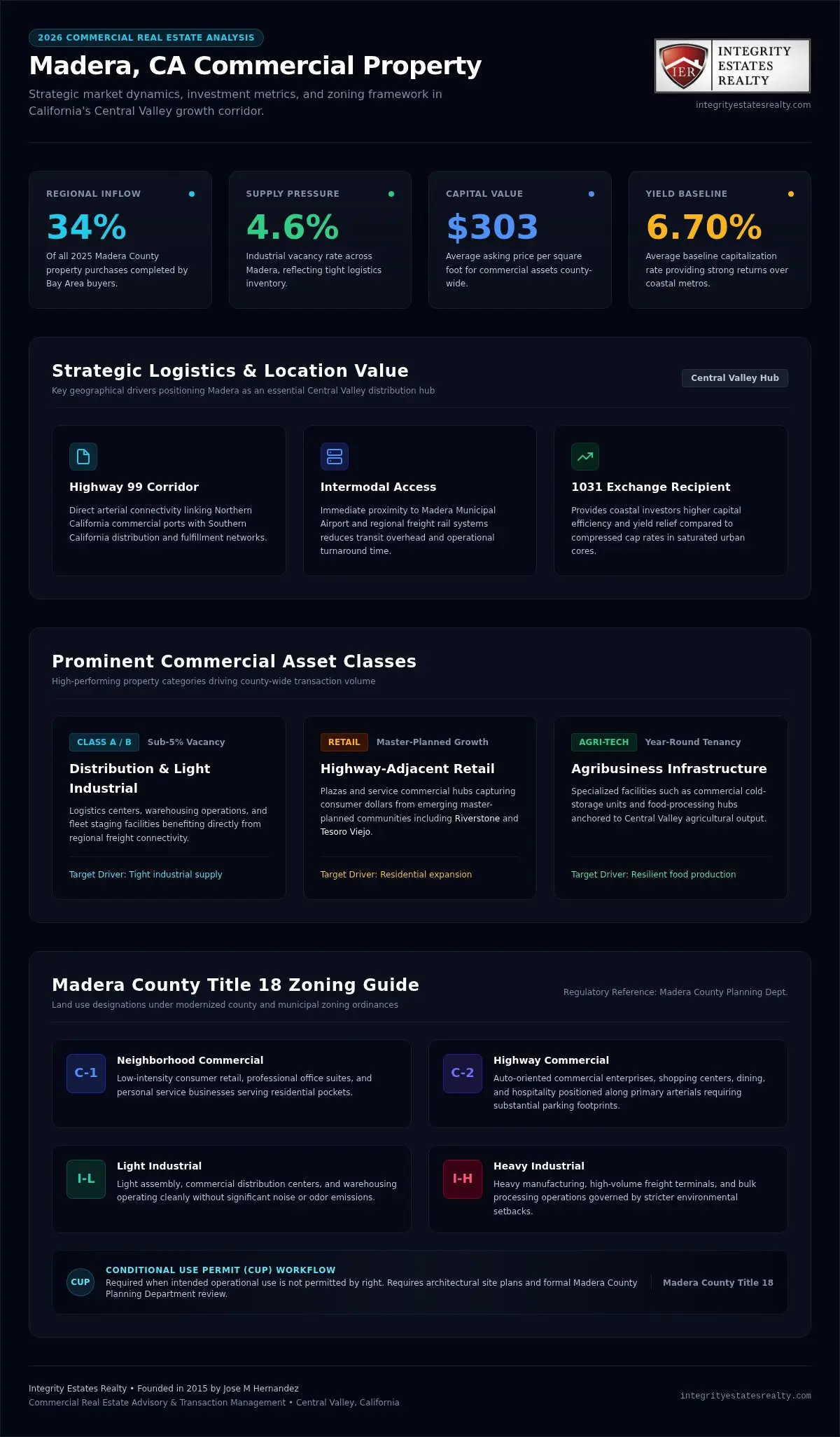
Bay Area buyers accounted for 34% of Madera County property purchases in 2025, turning this historic agricultural hub into one of California’s most compelling commercial frontiers. If you are considering buying commercial property in Madera, CA, you are stepping into a market defined by rapid residential expansion and an industrial vacancy rate sitting at just 4.6%.
Yet, capitalizing on this momentum is rarely straightforward. Between Madera County’s ongoing Title 18 zoning updates, regional water regulations, and the challenge of finding transparent local market data, expanding into the Central Valley can feel daunting. You deserve more than speculation; you need an ethical, clear-eyed roadmap that protects your balance sheet and aligns with your long-term vision.
This 2026 guide walks you through every stage of the acquisition process, from identifying high-yield opportunities along emerging growth corridors to securing advantageous commercial financing and completing environmental due diligence. Here is everything you need to know to navigate the local landscape and close your transaction with confidence.
Key Takeaways
- Understand why Madera’s strategic position along the Highway 99 corridor delivers unmatched capital efficiency and logistics value compared to neighboring metro areas.
- Learn how to evaluate Madera County’s updated zoning classifications to ensure your target parcel supports your intended operational footprint and parking requirements.
- Master the structured roadmap for buying commercial property in Madera, CA, including competitive letter of intent drafting and regional due diligence protocols.
- Identify tailored commercial financing solutions and owner-occupied lending programs that optimize your debt service and preserve working capital.
- Discover the operational advantages of partnering with an integrated Central Valley brokerage that aligns local market negotiations with mortgage financing capabilities.
Why Buying Commercial Property in Madera, CA Makes Strategic Sense
Strategically situated in the heart of the Central Valley, Madera, California is transitioning from a traditional agricultural center into an essential regional distribution network. Investors buying commercial property in Madera, CA find an appealing combination of expanding infrastructure, pro-growth municipal planning, and resilient tenant demand. As coastal capital seeks relief from compressed yields, this corridor offers the physical room and economic momentum needed to build long-term value.
Highway 99 Corridor and Logistics Connectivity
Highway 99 serves as the primary economic artery of the Central Valley. Madera sits directly along this high-volume freight corridor, offering seamless transit between Northern California ports and Southern California distribution hubs. Proximity to the Madera Municipal Airport and regional freight rail systems gives local businesses a clear logistical edge. For warehousing operators, agricultural transport providers, and light industrial firms, this positioning keeps transit times short and fleet overhead manageable.
Comparative Value Against Primary California Metro Markets
Capital efficiency defines Madera’s investment thesis. With asking prices averaging around $303 per square foot and average cap rates resting near 6.70%, Madera yields stronger baseline returns than saturated coastal metros. You won’t find this level of balance in primary coastal cities, which is why many investors deploy 1031 exchanges out of high-density markets into Central Valley assets. To see how these returns compare to adjacent regional markets, explore our strategic guide to commercial real estate in Gilroy.
Prominent Commercial Asset Classes Driving Local Growth
Local demand spans several high-performing property categories across the county:
- Distribution and Light Industrial: Logistics facilities and fleet staging centers benefit directly from Madera’s sub-5% industrial vacancy rates and trucking connectivity.
- Highway-Adjacent Retail: Plazas and service centers positioned near major interchanges capture consumer dollars from growing master-planned communities like Riverstone and Tesoro Viejo.
- Agribusiness Infrastructure: Specialized commercial facilities, including cold-storage plants and food-processing hubs, support the region’s agricultural output with dependable year-round tenancy.
Navigating Madera County Zoning Laws and Land Use Regulations
Securing a physical parcel is only half the battle; ensuring your operational model is legally permissible on that land protects your entire capital outlay. When buying commercial property in Madera, CA, you must evaluate both incorporated municipal boundaries and unincorporated county territories. Madera County has actively modernized its Title 18 Zoning Ordinance to streamline development standards, making it essential to consult local guidelines and resources provided by the Madera County Economic Development Commission before finalizing any purchase agreement.
Core Commercial and Industrial Zoning Classifications
Land use codes determine daily business viability. In Madera, commercial and industrial designations balance economic growth with community needs:
- C-1 (Neighborhood Commercial): Designed for low-intensity consumer retail, professional suites, and personal services located near residential pockets.
- C-2 (Highway Commercial): Tailored for auto-oriented businesses, retail centers, dining, and hospitality positioned along primary arterials requiring extensive parking footprints.
- I-L (Light Industrial): Permits light assembly, warehousing, and commercial distribution centers operating without significant noise or odor emissions.
- I-H (Heavy Industrial): Accommodates heavy manufacturing, freight terminals, and bulk processing operations subject to stricter environmental setbacks.
Conditional Use Permits and County Approval Workflows
If your intended use is not strictly permitted by right, you will need a Conditional Use Permit (CUP) through the Madera County Planning Department. This process requires architectural site plans, public environmental notices, and formal hearings before the Planning Commission. Timelines for CUP approvals often span several months. Knowing these municipal requirements in advance helps you structure realistic escrow contingencies that protect your earnest money deposit.
Environmental Due Diligence, CEQA, and Water Rights
Due diligence in the Central Valley requires addressing regional environmental standards. Under the California Environmental Quality Act (CEQA), development projects must account for localized traffic impacts, regional emissions, and habitat preservation. Simultaneously, California’s Sustainable Groundwater Management Act (SGMA) places strict reporting standards on groundwater sustainability agencies across Madera County. When purchasing properties with private wells or heavy industrial processing needs, confirming sustainable water allotments is critical.
Completing a comprehensive Phase I Environmental Site Assessment (ESA) helps identify historical soil or groundwater contamination from prior agricultural operations. If you are reviewing complex parcels across the Central Valley, connecting with a seasoned local commercial brokerage through integrityestatesrealty.com provides the on-the-ground market insight needed to identify regulatory hurdles before you remove contract contingencies.
The Step-by-Step Acquisition Process for Madera Commercial Assets
Purchasing commercial real estate requires an organized, disciplined approach to manage risk and protect capital. When buying commercial property in Madera, CA, treating every phase methodically prevents costly surprises down the line. With 45 commercial properties actively listed across 7.8 million square feet of county inventory, establishing clear transaction milestones keeps your deal on schedule from initial screening to key handover.
Phase I: Criteria Definition and Deal Sourcing
Define your operational framework early. Determine whether you require an owner-user property or an income-generating asset backed by stabilized leases. Target specific micro-markets suited to your sector: retail corridors along Cleveland Avenue, revitalize-ready parcels in Downtown Madera, or heavy industrial logistics centers surrounding the Madera Municipal Airport. Working with a dedicated regional commercial brokerage grants access to private listings before they reach broad listing portals.
Phase II: The Due Diligence Period and Risk Mitigation
Once your Letter of Intent is accepted, the critical investigation window begins. Take full advantage of your contingency periods to evaluate the asset thoroughly:
- Physical Assessments: Inspect primary building envelopes, structural load capacities, commercial HVAC systems, and roofing integrity with certified regional inspectors.
- Financial and Lease Audits: Scrutinize certified historical rent rolls, common area maintenance reconciliations, and tenant payment histories to confirm baseline income stability.
- Title and Municipal Encumbrances: Review preliminary title documents for unexpected access easements, mechanics’ liens, and local deed restrictions.
- Economic Development Coordination: Consult the Madera County Economic Development Commission to review local incentive zones, employment resources, and area master plans that could impact your asset.
Phase III: Escrow Closing and Operational Transition
The closing stage shifts focus toward legal accuracy and accounting clarity. You will coordinate with California title officers to finalize ALTA commercial title insurance policies, safeguarding against ownership challenges. Property taxes must be prorated accurately across California’s dual tax cycle, accounting for the City of Madera’s 1.1700% district rate. After completing final walkthroughs, execute formal assignments for service contracts, vendor relationships, and tenant security deposits to guarantee uninterrupted daily operations from your first day of ownership.
Financing Strategies for Commercial Real Estate in Madera
Structuring the right capital stack is just as critical as finding the right parcel. When buying commercial property in Madera, CA, securing debt requires demonstrating that the property and the borrower can withstand changing market conditions. Commercial lenders evaluate both your balance sheet and the property’s operational cash flow to ensure the investment supports itself over time.
SBA 504 and 7(a) Loans for Owner-Occupied Properties
Business owners seeking a permanent operational footprint often find federal programs offer the most accessible path to property ownership. Small Business Administration (SBA) 504 loans allow qualified owner-users to purchase facilities with equity down payments as low as 10%, preserving critical working capital for daily business growth. These loans pair a conventional first mortgage with a fixed-rate debenture, providing predictable debt service over 20 to 25 years. Keep in mind that SBA regulations require your operating business to occupy at least 51% of existing square footage.
Conventional Commercial Mortgages and Portfolio Lending
If you are acquiring income-producing assets such as multi-tenant retail centers or leased distribution facilities, conventional commercial debt is the standard path. These loans typically structure amortizations over 20 to 25 years with balloon maturities or refinance windows occurring at 5-, 7-, or 10-year intervals. Regional lenders in the Central Valley place heavy emphasis on the Debt Service Coverage Ratio (DSCR). In most cases, lenders look for a minimum DSCR between 1.20x and 1.35x, meaning net operating income must comfortably exceed debt service payments.
Capital Preparation and Pre-Approval Requirements
Securing competitive financing begins long before entering escrow. Lenders expect organized documentation that proves sustained financial strength:
- Tax and Income Documentation: Provide three full years of federal business and personal tax returns alongside current year-to-date profit and loss statements.
- Asset Performance Audits: Present trailing twelve-month operating statements and detailed rent rolls to verify historical income streams.
- Sponsor Financial Health: Submit updated personal financial statements illustrating liquidity reserves and overall net worth.
Unifying your property search with your debt strategy eliminates unexpected underwriting obstacles before negotiations begin. To evaluate loan options and streamline your next acquisition, connect with Integrity Estates Realty & Mortgage for integrated brokerage and mortgage financing support.
Maximizing Investment Success with Integrity Estates Realty
Executing a successful acquisition requires more than analyzing cap rates; it demands a partner who understands the local economic fabric. When buying commercial property in Madera, CA, collaborating with an experienced regional advisory team helps you avoid regulatory pitfalls, protect your balance sheet, and capitalize on emerging growth corridors before parcels reach broad public awareness.
In-Depth Local Market Intelligence and Off-Market Access
Founded in 2004, Integrity Estates Realty & Mortgage brings over two decades of California transaction experience to the Central Valley. Independently owned and operated under the leadership of Jose M Hernandez, our firm maintains deep regional ties across Madera, Fresno, Santa Clara, and Monterey counties. These local connections grant our clients access to unlisted opportunities and practical insights into municipal planning priorities, ensuring your asset selection matches the city’s broader economic momentum.
Integrated Commercial Brokerage and Financing Representation
Traditional acquisitions often suffer from communication disconnects between independent sales brokers and third-party lenders. Integrity Estates Realty bridges this divide by providing dual commercial real estate brokerage and mortgage financing capabilities under one roof. By aligning property due diligence directly with conventional loan processing and capital structures, we eliminate administrative bottlenecks. This cohesive approach gives you greater leverage when negotiating purchase contracts and keeps your closing timeline strictly on schedule.
Ethical Advocacy and Dedicated Negotiation
Long-term relationships remain the cornerstone of our practice. When buying commercial property in Madera, CA, you deserve a steadfast partner focused on risk reduction rather than transactional volume. Our advisory team defends your equity through rigorous contract structuring, strict contingency tracking, and transparent market guidance every step of the way. Schedule a consultation with Integrity Estates Realty today to evaluate current Central Valley commercial opportunities and structure an acquisition plan built for lasting success.
Securing Your Commercial Foothold in the Central Valley
Madera’s strategic position along Highway 99 presents a rare balance of logistical efficiency, competitive acquisition costs, and expanding regional demand. Successfully buying commercial property in Madera, CA requires aligning your operational footprint with updated zoning frameworks, executing meticulous due diligence, and locking in debt financing that protects your cash reserves.
You don’t have to navigate these high-stakes milestones alone. Founded in 2004 with over two decades of California market expertise, Integrity Estates Realty & Mortgage provides full-service commercial real estate brokerage and mortgage advisory under one roof. Our deep localized service across Madera, Fresno, Santa Clara, and Monterey counties ensures your interests remain defended from property selection through final loan funding.
Position your business and portfolio for sustainable growth in one of California’s most dynamic commercial frontiers. Partner with Integrity Estates Realty for your Madera commercial real estate investments and step forward with complete clarity and confidence.
Frequently Asked Questions
What is the primary difference between buying commercial property in Madera versus Fresno?
Madera offers lower price-per-square-foot entry points, higher average cap rates, and greater land availability compared to Fresno’s denser, more established market. While Fresno provides a larger immediate metropolitan population, buying commercial property in Madera CA appeals to investors seeking capital efficiency, expanding logistics access along Highway 99, and rapid housing-driven growth across master-planned residential communities.
How do I check the specific zoning classification for a Madera County parcel?
You can verify parcel zoning by looking up the Assessor’s Parcel Number (APN) through the Madera County Planning Department’s online GIS mapping portal, or through the city planning division for incorporated parcels. County Title 18 zoning updates are accessible via the GoCodebook platform. Working with an experienced commercial brokerage ensures you accurately interpret allowable uses, parking minimums, and setback restrictions before waiving contingencies.
Can out-of-area investors complete a 1031 exchange into Madera commercial real estate?
Yes, out-of-area investors frequently use Section 1031 like-kind exchanges to redeploy capital from high-cost coastal markets into Central Valley commercial assets. California exchange rules require identifying replacement properties within 45 days and closing within 180 days. Investing in Madera allows investors to transition equity out of compressed-yield Bay Area holdings into higher-yielding industrial, retail, or agricultural support facilities with favorable price fundamentals.
What environmental assessments are mandatory before purchasing commercial land in Madera?
While lenders routinely mandate a Phase I Environmental Site Assessment (ESA) before funding commercial loans, municipal agencies may also require California Environmental Quality Act (CEQA) reviews for new construction. Given the Central Valley’s agricultural background, a Phase I review checks historical pesticide, petroleum, and fertilizer residues. If potential contamination appears in the property history, a Phase II assessment with soil testing becomes necessary to protect buyer liability.
What down payment is typically required for a commercial real estate purchase in California?
Down payment requirements depend heavily on whether you are acquiring the parcel as an owner-user or an investor. Conventional commercial mortgages for multi-tenant retail or industrial assets typically require 20% to 35% down, depending on the asset’s debt service coverage ratio. In contrast, owner-operators buying commercial property in Madera CA using an SBA 504 program can often secure financing with equity down payments starting as low as 10%.
How does the Sustainable Groundwater Management Act affect commercial properties in Madera?
The Sustainable Groundwater Management Act (SGMA) empowers regional Groundwater Sustainability Agencies (GSAs) to regulate pumping volumes and enforce water allocations across the county. Commercial facilities with heavy water demands, food-processing operations, or dedicated agricultural support wells face strict monitoring and potential extraction fees. Due diligence must confirm whether a target parcel relies on municipal water connections or private groundwater wells subject to local sustainability mandates.
What are the advantages of using an SBA 504 loan for a Madera commercial property?
An SBA 504 loan provides small-to-midsize business owners with long-term, fixed-rate financing that protects operating budgets against interest rate volatility. The program pairs a private commercial lender with a Certified Development Company, reducing required down payments to 10% or 15%. This financing structure allows local businesses to purchase, construct, or modernize commercial facilities in Madera while preserving working capital to fund daily operations and future hiring.