
Risks of Buying a Foreclosure in Hayward: A 2026 Buyer’s Guide
What if the biggest risk in a Hayward foreclosure isn’t the condition you can see, but the one you can’t verify before committing? The risks of buying a foreclosure in hayward vary by purchase path. Limited inspection access, title concerns, unpaid taxes, or occupants can turn an attractive opportunity into a complicated transaction.
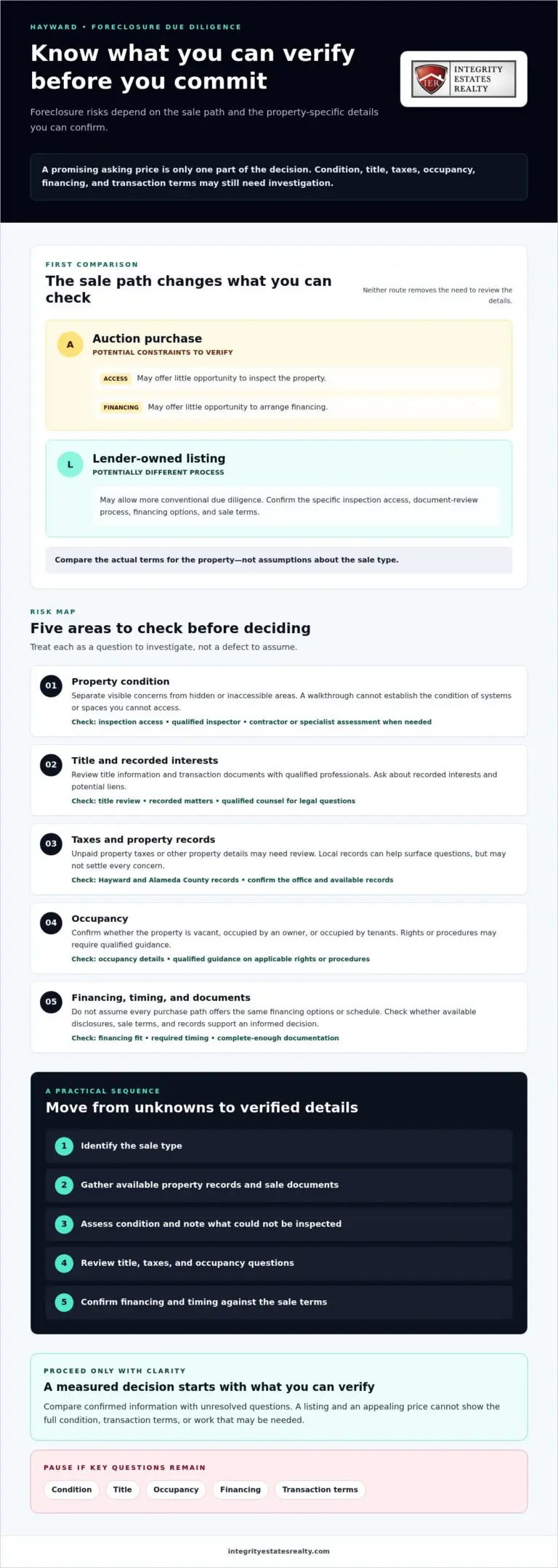
It’s reasonable to want clarity before making a high-stakes decision. Auction purchases and lender-owned listings follow different processes. Auctions may offer little opportunity to inspect or arrange financing, while lender-owned properties may allow more conventional due diligence. Neither route removes the need to check the details.
This guide explains the most consequential risks and offers a practical framework for evaluating a property before you commit. We’ll compare auction and lender-owned purchases, consider condition, title, tax, financing, and occupancy questions, and outline Hayward and Alameda County records and professional guidance to include in your due diligence. With a measured approach, you can assess what’s known, identify what remains uncertain, and make a more informed decision.
Key Takeaways
- The risks of buying a foreclosure in hayward depend on the sale type and the property-specific information you can verify before committing.
- Separate visible condition concerns from issues that may require review by qualified inspectors, contractors, or other professionals.
- Compare auction and lender-owned sale terms carefully. Inspection access, document review, and financing options can differ.
- Use a due-diligence sequence: identify the sale type, gather records, assess condition, review title, and confirm your financing before deciding.
- Pause if important questions about condition, title, occupancy, financing, or transaction terms remain unresolved.
What Are the Main Risks of Buying a Foreclosure in Hayward?
A foreclosure can catch a buyer’s attention because the asking price may appear appealing. But a lower price isn’t guaranteed, and the listing alone can’t show the full condition, transaction terms, or work needed to make the property suit your plans. The risks of buying a foreclosure in hayward are uncertainties to investigate for the specific property and the way it’s being sold.
If you’re new to the process, this overview of what is foreclosure explains general terminology and different foreclosure approaches. For a purchase decision, broad background is only a starting point. The sale documents, property records, access, and timing all matter.
Why a Foreclosure Is Not Automatically a Bargain
Compare verified information, not just the asking price. Deferred maintenance can make repair needs difficult to estimate, while limited access may prevent you from seeing parts of the property before deciding. A price that initially seems attractive may not reflect those uncertainties or the sale conditions. Consider what you can confirm, what remains unknown, and whether the available information is enough to evaluate the property.
Which Risks Should Hayward Buyers Evaluate First?
Start with distinct categories rather than treating “foreclosure” as one uniform risk. Ask:
- Condition: What is visible, and what needs assessment by a qualified inspector or contractor?
- Title and recorded interests: Are there liens, tax concerns, or other recorded matters to review?
- Occupancy: Is the property vacant, occupied by an owner, or occupied by tenants? Confirm the details and get qualified guidance on rights or procedures that may apply.
- Financing and timing: Can your financing align with the sale terms and required schedule? Don’t assume every purchase path allows the same options.
- Documentation: Are the available disclosures, sale terms, and property records complete enough to support an informed decision?
Foreclosure risk varies by purchase path and property, so verify the details before you commit.
Hayward and Alameda County records can help you identify questions about taxes, permits, or other property details. A record may still need professional interpretation and may not settle every concern. A real estate representative can help organize property-specific questions and transaction steps. Integrity Estates Realty provides residential real estate representation and mortgage loan origination. For legal questions about title or foreclosure procedure, consult qualified counsel.
How Property Condition, Title, and Occupancy Risks Affect Hayward Foreclosures
A foreclosure listing can leave important questions unanswered. Deferred maintenance, limited access, incomplete records, or uncertainty about who occupies the home may affect your plans. These are items to investigate, not defects to assume. The risks of buying a foreclosure in hayward depend on what can be confirmed about the individual property and transaction.
What Can Buyers Learn About a Foreclosed Property’s Condition?
First, find out whether the sale allows an inspection and what access is available. A walkthrough may reveal visible concerns such as damaged finishes or signs of water intrusion, but it can’t establish the condition of systems or areas that aren’t accessible.
A qualified inspector can document observable issues and advise whether a contractor or another specialist should assess a particular concern. Treat the inspection as information about what was observable at the time, not as an assurance about hidden, inaccessible, or future conditions. If access is restricted, include that uncertainty in your evaluation rather than assuming the property is sound.
How Should Buyers Check Title, Records, and Occupancy?
Listing descriptions are not a substitute for reviewing the property’s title and transaction documents. Have title information assessed by qualified professionals, and ask about recorded interests, potential liens, unpaid property taxes, and other matters that could affect ownership. For questions about legal rights or foreclosure procedure, consult qualified counsel.
Alameda County and City of Hayward records are potential starting points for property-specific information about taxes, permits, or other records. Confirm which office maintains the information, whether the relevant records are available, and what they do or don’t establish. A public record can inform your questions, but it may not provide a complete picture or a professional interpretation.
Occupancy deserves separate attention. Confirm whether the home is vacant or occupied, and review the sale documents for terms about possession. If occupants are present, don’t assume they can leave immediately or that a listing description settles the matter. Seek qualified local guidance on applicable rights and procedures before deciding whether the timeline works for you.
- Condition: What was inspected, what wasn’t accessible, and what needs specialist review?
- Title and records: What recorded interests, tax information, or permit questions need follow-up?
- Occupancy: Who is in possession, and what do the transaction documents say?
Organizing these questions with a real estate representative can help clarify which steps remain before a decision. Residential real estate representation is one option for structuring property-specific questions and transaction steps.
Hayward Foreclosure Auction or Lender-Owned Home: Which Risks Differ?
An auction and a lender-owned listing can involve very different decision windows. At auction, buyers may have limited opportunity to investigate a property before bidding, and payment arrangements may be restrictive. A lender-owned home, often called an REO, may be offered through a listing and offer process, but that doesn’t guarantee inspection access, complete documents, or particular financing terms. To evaluate the risks of buying a foreclosure in hayward, compare the actual sale terms rather than relying on the label.
| What to compare | Auction purchase | Lender-owned listing |
|---|---|---|
| Condition access | Access before bidding may be limited or unavailable. Confirm what the sale permits. | An inspection may be possible, but availability and access depend on the property and listing terms. |
| Documents and review time | Study official notices and sale documents before bidding. The time available to investigate depends on the sale. | Review listing documents and available disclosures, then confirm the process and deadlines with the buyer’s representative. |
| Financing and payment | Payment terms can be restrictive, and auction purchases may require cash. Verify the exact requirements before participating. | Financing may be considered, but confirm that the offer terms and property fit your lender’s requirements. |
| Offer process | Bids follow the process stated for that sale. | The lender-owned seller may use an offer and negotiation process. Confirm how submissions and responses work. |
What Makes an Auction Purchase Different?
Prepare before you bid. Check the official notices and sale documents for access, payment terms, timing, and bidding requirements. Don’t assume you’ll have the same opportunity to inspect, review records, or arrange financing as in a conventional transaction. Requirements and deadlines can depend on the sale and current procedures, so verify legal questions with qualified California counsel before acting.
What Should Buyers Review for a Lender-Owned Hayward Home?
A listing may offer a different route for submitting an offer and reviewing available documents, but the details remain property-specific. Ask what disclosures are available, whether an inspection can be arranged, and which conditions or timelines apply. Confirm financing conditions and transaction timing with your buyer’s representative and lender before making an offer.
Lender ownership alone doesn’t establish the home’s condition, resolve title questions, or confirm that the available documentation is complete. Treat each item as something to verify. A professional representative can help organize questions and transaction steps, while legal questions about title or foreclosure procedure should go to qualified counsel.
How to Assess Foreclosure Risks Before You Bid or Make an Offer in Hayward
A careful review is easier to manage when you take it in sequence. The risks of buying a foreclosure in hayward can’t be resolved by one document or inspection. Build a property-specific file, verify what you can, and ask the right professionals to interpret what you can’t.
- Clarify the sale type. Determine whether the property is being sold at auction or as a lender-owned listing. Find out which documents govern the transaction, what access is available, and what deadlines or terms apply.
- Gather the available records. Collect sale notices and terms, listing documents, disclosures, inspection findings, and title information. Note missing documents, unanswered questions, and details that don’t match.
- Assess condition and repair assumptions. Arrange an inspection if access is permitted. If findings raise questions about a system or repair, seek an assessment from a qualified professional rather than relying on an unverified estimate.
- Review title and property information. Have title information reviewed by qualified professionals. Check relevant Alameda County and City of Hayward sources for available tax, permit, or property records, and confirm what each record covers.
- Test the financing and terms. Discuss the proposed transaction and property with your lender. Compare the verified information, remaining unknowns, timeline, and terms before deciding whether to proceed.
Which Documents and Local Records Should Buyers Gather?
Keep a single file for the specific property. Include sale documents, available disclosures, inspection reports, title information, and relevant county or city records. Record the source and date of each item so you can follow up if information conflicts. Alameda County and City of Hayward resources can be useful starting points, but availability varies by record. Confirm details with the responsible office and ask qualified professionals about gaps or interpretation.
How Can Buyers Test Financing and Repair Assumptions?
Ask your lender to evaluate the proposed purchase and property against the requirements of the financing being considered. Mortgage guidance can help you assess options, but it can’t promise approval. If inspection findings raise material repair questions, seek a qualified repair assessment and treat preliminary estimates as provisional until the scope is better understood.
For general financing questions, see this Santa Clara County mortgage broker guide. Its county-specific focus provides background, not Hayward property or transaction advice. Legal questions about title, sale procedure, or deadlines should be reviewed with qualified California counsel.
If you’d like help organizing property-specific questions and transaction steps, explore residential real estate representation with Integrity Estates Realty.
When Does a Hayward Foreclosure Make Sense, and When Should You Pause?
A foreclosure may be worth pursuing when the available facts support your decision, the terms fit your plans, and you have a realistic way to address what remains uncertain. An appealing price alone isn’t enough. The risks of buying a foreclosure in hayward may outweigh the apparent opportunity if key questions about condition, title, possession, or financing are still unresolved.
Signs a Buyer May Be Ready to Proceed
Consider moving forward only after reviewing the sale terms and available documents with the appropriate professionals. You should understand what has and hasn’t been verified, including the home’s observable condition, title information, occupancy or possession terms, and financing requirements. The remaining uncertainties should be clear, and the purchase should fit your documented priorities and comfort with risk.
Reasons to Pause and Get More Information
Slow down if material title or occupancy questions remain open, sale requirements aren’t clear, or you don’t have a credible plan to assess repairs and meet financing conditions. An unresolved issue doesn’t automatically make a property unsuitable, but it does mean you may not yet have enough information to make a considered commitment. Direct legal questions about title, foreclosure procedure, or deadlines to qualified counsel before signing or bidding.
Use a buyer’s representative to help organize property questions and transaction steps, and consult a mortgage professional about financing options and lender requirements. Neither replaces legal advice. The goal is to understand which facts are established, which need professional review, and which uncertainties you’re prepared to accept.
How Integrity Estates Realty Can Support the Buying Process
Integrity Estates Realty provides residential real estate representation and mortgage loan origination. Representation can help structure the property review, while mortgage guidance may help you assess financing options. Neither guarantees a particular outcome. For legal questions, consult qualified counsel. Seek relevant professionals for other specialized assessments.
If you’re weighing a specific property, you can discuss a Hayward home purchase with Integrity Estates Realty. Bring the questions you’ve gathered and the information you’ve verified. A measured review can help you decide whether the opportunity aligns with your plans or whether it’s wiser to pause until the remaining facts are clearer.
Make Your Next Move With Clearer Information
The right foreclosure decision isn’t always to proceed. It’s the one you can support with verified information and terms that fit your plans. As you weigh the risks of buying a foreclosure in hayward, focus on what’s confirmed, identify what still needs review, and pause if an important question could change your decision.
Auction and lender-owned purchases can involve different processes, so assess the specific sale rather than relying on assumptions. Review condition, title, occupancy, and financing with the appropriate professionals, and direct legal questions to qualified counsel. A well-organized review can help you distinguish a manageable uncertainty from a reason to wait.
Integrity Estates Realty offers residential real estate representation and mortgage loan origination in California communities including Salinas, Seaside, Soledad, Prunedale, San Jose, Gilroy, Hollister, San Francisco, Hayward, San Leandro, Livermore, Merced, Los Banos, Delhi, Gustine, Stockton, Tracy, Modesto, Turlock, Sacramento, Madera, Fresno, and Clovis. If you’re considering a Hayward purchase, contact Integrity Estates Realty to discuss your home-buying plans.
Frequently Asked Questions
Is buying a foreclosure in Hayward riskier than buying a traditional listing?
Not necessarily. Risk depends on the property, sale type, inspection access, available documents, and your circumstances as a buyer. The risks of buying a foreclosure in hayward can include uncertainties that need closer review, but a traditional listing also requires due diligence. Compare verified facts, such as inspection findings and sale terms, with unresolved questions about condition, title, or occupancy. Decide based on the specific transaction, not the foreclosure label alone.
Can you inspect a foreclosed home in Hayward before buying it?
Possibly, but access depends on the specific property and sale terms. Confirm whether an inspection is permitted and what areas are accessible. If allowed, use a qualified inspector to assess observable conditions and identify concerns that may need specialist review. Treat inaccessible areas as unknown, not as sound by default. Review transaction documents for access conditions, and seek professional guidance before relying on assumptions about the home.
What happens if a foreclosed home in Alameda County has title issues?
The effect depends on the recorded interests involved and the terms of the transaction. Obtain a professional title review before relying on a listing description, and verify relevant property records and sale documents. Don’t assume a foreclosure removes every lien or other encumbrance. Ask qualified California counsel to explain the legal implications of any concern and what it could mean for your intended purchase before you make a commitment.
Can you finance a foreclosure purchase in Hayward with a mortgage?
Possibly. Financing depends on your circumstances, the lender, the property’s condition, the sale type, and the transaction requirements. Discuss the specific property and timeline with a lender early, before assuming a particular loan will work. FHA, VA, and conventional options each require assessment. None is guaranteed for a foreclosure purchase. A mortgage professional can help evaluate available financing, while your lender determines its requirements and any loan decision.
What should I check before bidding on a Hayward foreclosure?
Review the official sale documents, title information, available condition details, occupancy, financing requirements, and applicable deadlines before bidding. Auction terms can vary, so confirm the requirements for that specific sale rather than relying on general expectations about deposits, payment, or timing. Verify current procedures with qualified professionals, and direct legal questions to qualified California counsel. If material facts remain unclear, consider whether you have enough information to bid responsibly.
Are repairs always the buyer’s responsibility when purchasing a foreclosure?
Not always. Repair responsibility and available remedies depend on the contract, disclosures, sale terms, and applicable law. Inspect what you can, review the written documents carefully, and ask qualified inspectors or contractors to assess observable concerns and possible repair needs. If access is limited, include that uncertainty in your decision-making. For questions about legal obligations or remedies, consult qualified California counsel rather than assuming every foreclosure is sold as-is.
How can I verify property and permit information for a Hayward foreclosure?
Start by identifying relevant Alameda County and City of Hayward records for the property. Confirm which office maintains each record, what it covers, and whether the information is current and available. Compare records with the sale documents and ask qualified professionals to help interpret gaps or conflicting details. Public records can inform your review, but they don’t replace a property inspection, title review, or legal advice.