
First-Time Home Buyer in Hayward, CA: A 2026 Checklist for Choosing an Energy-Efficient Home
The right first home in Hayward isn’t simply the one you’re able to buy; it’s the one whose ongoing costs, condition, and comfort fit your plans. A first time home buyer Hayward CA checklist can turn a high-stakes decision into manageable steps, including what to look for in a home’s energy features before you make an offer.
It’s natural to have questions about where to begin, how financing fits your budget, and whether an older home could need energy-related upgrades. Looking beyond the purchase price helps you compare properties and plan for the practical responsibilities of ownership.
This guide covers preparing your finances, coordinating mortgage and real estate guidance, and reviewing windows, insulation, heating and cooling systems, and appliances. It also outlines the steps from evaluating a property and making an offer through closing, so you can make informed choices throughout the process.
Key Takeaways
- A first time home buyer hayward ca checklist helps organize your priorities, preferred locations, timing, and practical needs before you start your search.
- Compare financing options and use pre-approval to plan your budget, while remembering it isn’t a final loan commitment.
- Review a home’s energy features alongside its overall condition to make a more complete comparison before offering.
- Use an organized offer-to-closing plan, and track the deadlines and contingencies specific to your transaction.
- Coordinating buyer representation and mortgage guidance can help clarify your next steps.
First-Time Home Buying in Hayward: Start With a Clear Plan
A first purchase brings questions: how much home fits your budget, what to look for during a tour, and what needs to happen before making an offer. A clear plan makes the process easier to manage. For a first time home buyer hayward ca, start with personal priorities and financial readiness, then compare properties, coordinate financing, and prepare for closing.
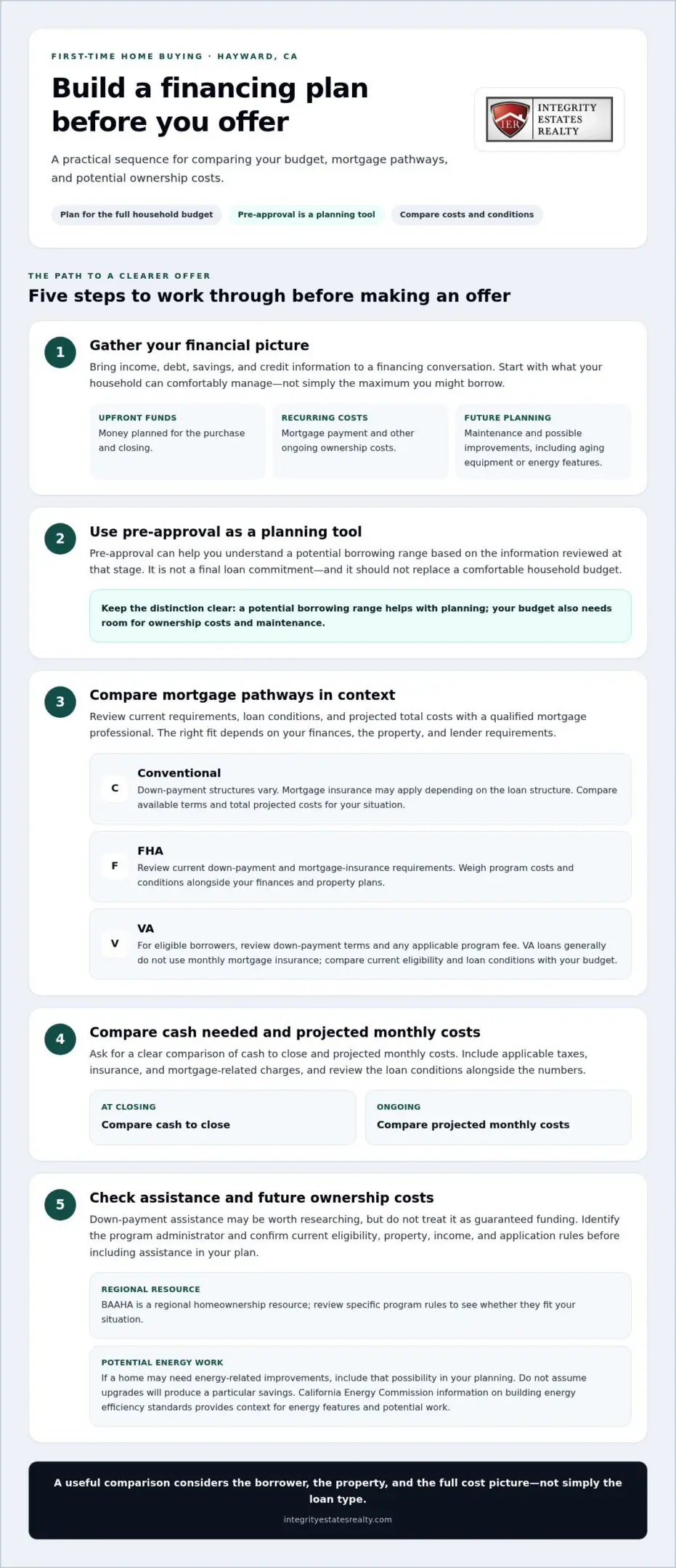
Sort costs into three practical groups. Upfront funds include the money you plan to use toward the purchase and closing. Recurring expenses include your mortgage payment and other ongoing ownership costs. Future planning covers maintenance and possible improvements, such as replacing aging equipment or upgrading energy features. This approach helps you look beyond the asking price without assuming every home needs the same work.
What should a first-time buyer prepare before touring homes?
Write down your must-haves, flexible preferences, commute needs, and household plans. Gather income, debt, savings, and credit information for a financing conversation. Set a comfortable overall budget that leaves room for ownership costs and maintenance, rather than treating the maximum amount you might borrow as a spending target.
A short priority list also makes comparisons more consistent. Separate features your household needs from those you’d simply enjoy, and note where you’re willing to compromise. Include energy efficiency alongside the home’s visible condition, layout, and location. ENERGY STAR is a familiar reference for efficient homes and appliances; read this overview of ENERGY STAR certified homes to learn more about the program.
How can Hayward location and lifestyle shape the search?
Compare daily travel, nearby services, and neighborhood character using current, property-specific information. Think about what your routine requires, from access to work or transit to the services you use regularly. A citywide description can’t tell you what a particular property offers, especially for schools, transit, or amenities. Let your own priorities guide location trade-offs instead of relying on a generic neighborhood ranking.
Before touring, decide which locations and features are essential and which are flexible. A longer commute might be acceptable for a home that better suits your household, while convenient access to services may matter more than a particular feature. Evaluate each property on its own: compare location and condition with your needs, and treat energy features as one part of the decision.
Financing a First Home in Hayward: Compare Options Before You Offer
Before touring homes with an offer in mind, use mortgage pre-approval as a planning tool. It can help you understand a potential borrowing range based on the information reviewed at that stage, but it isn’t a final loan commitment. A first time home buyer hayward ca should compare financing options with the full household budget, not just the amount available to borrow.
What should buyers compare when reviewing mortgage options?
Review projected monthly payment components, cash needed upfront, and loan conditions with a qualified mortgage professional. The right fit depends on your finances, the property, and current lender requirements. Compare conventional, FHA, and VA pathways in context:
| Loan pathway | Down-payment and insurance considerations | Trade-off to explore |
|---|---|---|
| Conventional | Down-payment structures vary; mortgage insurance may apply depending on the loan structure. | Compare available terms and total projected costs for your situation. |
| FHA | Review current down-payment and mortgage-insurance requirements. | Consider the program’s costs and conditions alongside your finances and property plans. |
| VA | For eligible borrowers, review down-payment terms and any applicable program fee; VA loans generally don’t use monthly mortgage insurance. | Compare current eligibility and loan conditions with your overall budget. |
Ask for a clear comparison of cash to close and projected monthly costs, including applicable taxes, insurance, and mortgage-related charges. The right choice depends on the borrower and transaction, not simply the loan type.
How can Hayward buyers research assistance programs?
Down-payment assistance may be worth researching, but don’t count on a program as guaranteed funding. Identify its administrator and review current eligibility, property, income, and application rules before including it in your purchase plan. BAAHA is a regional homeownership resource; review the specific program rules to determine whether they fit your situation.
Keep future ownership costs in view. If a home may need energy-related improvements, include that possibility in your planning rather than assuming upgrades will produce a particular savings. The California Energy Commission’s information on California’s Building Energy Efficiency Standards provides context for understanding energy features and potential work.
For a broader overview of financing conversations and mortgage pathways, read this mortgage guide for Santa Clara County buyers. Coordinating mortgage discussions with your home search can help you assess each property with a clearer view of both financing and condition.
Evaluate a Hayward Home’s Energy Features Before Making an Offer
Energy efficiency is one part of a home’s overall value and fit, not a promise of lower utility bills or guaranteed savings. For a first time home buyer hayward ca, a consistent review can help identify which features are in place, what needs more investigation, and what might become a future project. Consider these observations alongside the property’s condition, location, layout, and your plans for the home.
Which energy-related features should buyers look at?
During a property review, note what you can see and record questions about anything you can’t verify visually. Focus on:
- Heating and cooling: Identify the equipment and ask about its age, maintenance history, and operation.
- Insulation: Look for visible indicators in accessible areas, while recognizing that a viewing may not reveal coverage or performance throughout the home.
- Windows: Note their condition and operation, and ask whether documentation is available for any efficiency claims.
- Lighting: Observe the fixtures and bulbs currently installed, without assuming they indicate the efficiency of the home as a whole.
- System records: Look for available manuals, maintenance records, or other documentation that can help explain equipment and past work.
Keep observations separate from conclusions. A newer-looking system or upgraded window doesn’t establish an efficiency rating by itself. Use available documents and the appropriate property review to understand condition and performance before treating a feature as a verified advantage.
How should buyers weigh upgrades against move-in priorities?
Sort what you learn into three categories: immediate concerns that warrant closer attention, future projects you may plan for, and optional improvements that could wait. For each item, consider how it could affect move-in timing, cause disruption, and fit your budget. Avoid relying on generalized project-cost estimates; the home’s condition and the scope of work matter.
Compare each property using the same notes. This makes trade-offs clearer without letting energy features overshadow location, condition, or household needs. If an improvement or incentive could affect your decision, review current requirements and program details before including it in your plan. The California Energy Commission’s information on California energy rebate programs is a useful starting point for reviewing program status and eligibility details.
A measured review helps distinguish a home’s existing features from its possibilities. Keep questions specific, document what supports each conclusion, and weigh potential improvements against the priorities you set before touring.
From Offer to Closing: A First-Time Buyer’s Hayward Checklist
An accepted offer begins a coordinated phase; it isn’t the end of the work. For a first time home buyer hayward ca, staying organized helps you track transaction milestones, financing requests, property findings, and decisions that need attention before closing. The exact sequence and timing depend on the purchase agreement and transaction.
What happens after a seller accepts an offer?
Use this as a general coordination guide, then follow the transaction documents and agreed schedule:
- Review the accepted offer. Keep the signed documents together and note the deadlines and contingencies stated in the transaction paperwork.
- Coordinate the deposit. Follow the instructions and timing provided for the transaction, and keep a record of the payment.
- Arrange property inspections. Review the findings and available records to understand the home’s condition and identify questions that may need further attention.
- Coordinate the appraisal and loan processing. Respond to mortgage-related requests and share documents promptly with the mortgage team. An appraisal and a property inspection serve different purposes, so track each separately.
- Prepare for closing. Stay in communication with your real estate and mortgage team, review the documents provided, and confirm outstanding transaction tasks are moving forward.
Deadlines, contingencies, and contract terms are specific to the transaction and require careful review. If the wording or its implications are unclear, raise the question with the appropriate professional rather than relying on a general checklist to interpret it. Keeping a shared record of dates, requested documents, and completed tasks can make communication clearer.
How should inspection findings affect the decision?
Separate condition or safety concerns from elective energy improvements. Use findings from qualified professionals and available system records rather than assuming hidden equipment, insulation, or other components are in good condition based on appearance alone. If a finding raises a question about a system, keep the report and related documentation together so the issue can be discussed as part of the transaction.
Before making decisions, revisit your budget and priorities. A repair that affects your move-in plans may deserve different attention from an efficiency upgrade you could consider later. Note the likely timing and disruption of potential work, and don’t treat an improvement as essential or affordable until you understand its scope. Weigh documented condition against your plans for the home, rather than letting one feature determine the entire purchase decision.
Clear coordination supports sound decisions at each stage. Coordinate your Hayward home purchase with residential real estate and mortgage guidance as you move from accepted offer toward closing.
Choose Your Next Step With a Hayward Buyer’s Support Team
With your priorities, financing questions, and property-review framework in place, bring them together into a search plan. Clarify your goals and preferred locations, review financing, shortlist homes, then assess each property’s condition and energy features against your needs. This gives a first time home buyer hayward ca a grounded way to move forward without treating any single feature as the whole decision.
What should a first meeting with a buyer’s representative cover?
Share your budget range, preferred Hayward locations, timing, household needs, and questions about the purchase process. Integrity Estates Realty provides residential buyer representation, guiding your search, offer preparation, and transaction coordination. Mortgage discussions can be coordinated alongside the home search, helping you consider financing and property decisions together.
Jose M Hernandez is the founder and owner of Integrity Estates Realty, founded in 2004. The firm’s approach centers on a collaborative relationship and considered guidance, so your priorities shape the search rather than being reduced to a generic checklist. Bring questions even if you’re still sorting out what matters most. A first conversation can help organize them into practical next steps.
How can buyers move forward without rushing?
Gather the financial documents you’re comfortable sharing and write down questions about financing, location, timing, and property condition. Include energy priorities, such as whether you prefer a home with features already in place or are open to improvements over time. Reviewing these factors together can help you compare options without assuming loan approval, savings, or a particular purchase outcome.
A measured process leaves room to revisit priorities as you learn more. Your financing picture may shape the homes you shortlist; property findings may lead you to reconsider timing or future improvements. Make each decision with a clear view of how it connects to your plans and budget.
If you’re ready to discuss your goals and organize your next steps, talk with Integrity Estates Realty about your first home. A focused conversation can help you begin the Hayward buying process with a clearer sense of direction.
Take Your Hayward Home Search Forward With Confidence
A thoughtful first purchase starts with clear priorities, a realistic financing plan, and a consistent way to compare each home’s condition and energy features. For a first time home buyer hayward ca, keeping those considerations connected can make the path from preparing an offer to closing more manageable.
Integrity Estates Realty provides residential buyer representation and mortgage loan services through lender relationships, supporting buyers in Hayward and communities across California, including Salinas, Seaside, Soledad, Prunedale, San Jose, Gilroy, Hollister, San Francisco, Hayward, San Leandro, Livermore, Merced, Los Banos, Delhi, Gustine, Stockton, Tracy, Modesto, Turlock, Sacramento, Madera, Fresno, and Clovis. Jose M Hernandez founded and owns the company. Organize your questions, clarify what matters most, and consider how financing and property choices fit your plans.
Talk with Integrity Estates Realty about your first home and take the next step toward your Hayward home search.
Frequently Asked Questions
How do I buy my first home in Hayward, California?
Start by setting your priorities and a comfortable budget, then review financing options before touring homes. A first time home buyer hayward ca can compare properties by location, condition, energy features, and fit with household needs. After you choose a home, the process generally moves through offer preparation, transaction deadlines, inspections, loan processing, and closing. A buyer’s representative can help coordinate the property search and purchase steps.
Are there first-time homebuyer programs available in Hayward?
Potential assistance may come through state, county, or regional programs, but availability and eligibility can change. Review the administering organization’s current rules for income, property, application timing, and other requirements before relying on assistance in your budget. BAAHA is one regional resource for homeownership information; review specific program requirements to see how they apply to your plans.
How much money should a first-time home buyer save before buying?
There isn’t one savings amount that fits every buyer. Plan for upfront funds such as your down payment and closing expenses, then account for recurring ownership costs and a reserve for maintenance or unexpected needs. The amount depends on the property, loan structure, and your finances. Review projected cash needs and monthly expenses with a mortgage professional, and set a budget that leaves room for ongoing responsibilities.
Can first-time home buyers in Hayward use FHA or VA financing?
FHA or VA financing may be options, depending on the buyer, property, and current program and lender requirements. VA financing is for eligible borrowers; FHA financing has its own terms and requirements. Compare projected payments, cash needed, insurance or other applicable charges, and loan conditions with a mortgage professional. Integrity Estates Realty provides FHA and VA loan origination, but pre-approval is not a final loan commitment.
What energy-efficient features should I look for when buying a home?
Review heating and cooling equipment, insulation indicators, windows, lighting, and available system records. Ask about equipment age, maintenance, and operation, and separate visible observations from verified performance claims. A feature’s appearance alone doesn’t establish its efficiency rating. Consider energy features alongside the home’s condition, location, and overall fit, and use available documentation or a qualified assessment to better understand systems that aren’t fully visible during a tour.
Should I make energy upgrades before moving into a new home?
Not necessarily. First distinguish condition or safety concerns from optional efficiency improvements, then consider which work is essential before move-in and what can wait. Weigh potential disruption, timing, and affordability against your plans and budget. Base decisions on property findings and available records rather than assumptions about hidden systems or guaranteed savings. Review current incentive details and requirements before including a rebate or program in your calculations.
What happens after my offer is accepted on a Hayward home?
After acceptance, buyers commonly coordinate the deposit, inspections, appraisal, loan processing, and requested documentation. The order, contract terms, deadlines, and contingencies depend on the specific transaction, so keep purchase documents organized and review dates carefully. Share updates with your real estate and mortgage team, respond to requests promptly, and use inspection findings and available records to inform questions about the home’s condition before closing.
Is Hayward a good place for a first-time home buyer?
Hayward may suit a first-time buyer whose budget, commute, household needs, and preferred lifestyle align with the specific home and location. Compare daily travel, nearby services, property condition, and ongoing ownership responsibilities rather than relying on a broad citywide ranking. Visit areas relevant to your routine and evaluate each property individually. Integrity Estates Realty provides residential buyer representation in Hayward and other California communities, with mortgage loan services through lender relationships.