
ADU Financing Options in Hayward, CA: A Guide from Jose M Hernandez, Founder and Owner Since 2015
What if the best way to fund an ADU isn’t the option with the lowest initial payment, but the one that fits your equity, project timeline, and comfort with repayment? For homeowners comparing ADU financing options hayward ca, that distinction can help bring a complex decision into focus.
You may be weighing whether home equity or refinancing could cover the project, whether your budget can accommodate the work, and how a lender may assess your finances or potential rental income. The right approach depends on your financial situation, project scope, and property. Start with a realistic estimate of costs and timing, then compare how each financing structure would affect your household budget.
This guide compares common financing approaches, outlines what to organize before a mortgage conversation, and explains how to coordinate funding decisions with Hayward’s permitting process. Jose M Hernandez, founder and owner of Integrity Estates Realty, brings a perspective that connects mortgage options with broader real estate goals.
Key Takeaways
- Compare ADU financing options hayward ca based on available equity, income documentation, project readiness, and repayment structure.
- Keep mortgage approval separate from City of Hayward project review. Each process has its own requirements and timeline.
- Lenders may assess projected rental income differently. Don’t assume expected rent will qualify the same way with every financing option.
- Define the project as clearly as you can, then gather mortgage, debt, income, property, and preliminary project information.
- Compare loan structures against the project’s expected expenses and your repayment preferences before choosing a path.
ADU financing in Hayward: what homeowners should understand first
Funding an accessory dwelling unit involves more than choosing a loan. ADU financing is funding used to build a secondary dwelling, convert existing space, or pay for related project expenses. An ADU loan is borrowed money that must be repaid under its terms; a grant is awarded assistance, not a loan balance to repay. Identify which type of funding you’re considering before including it in your project budget.
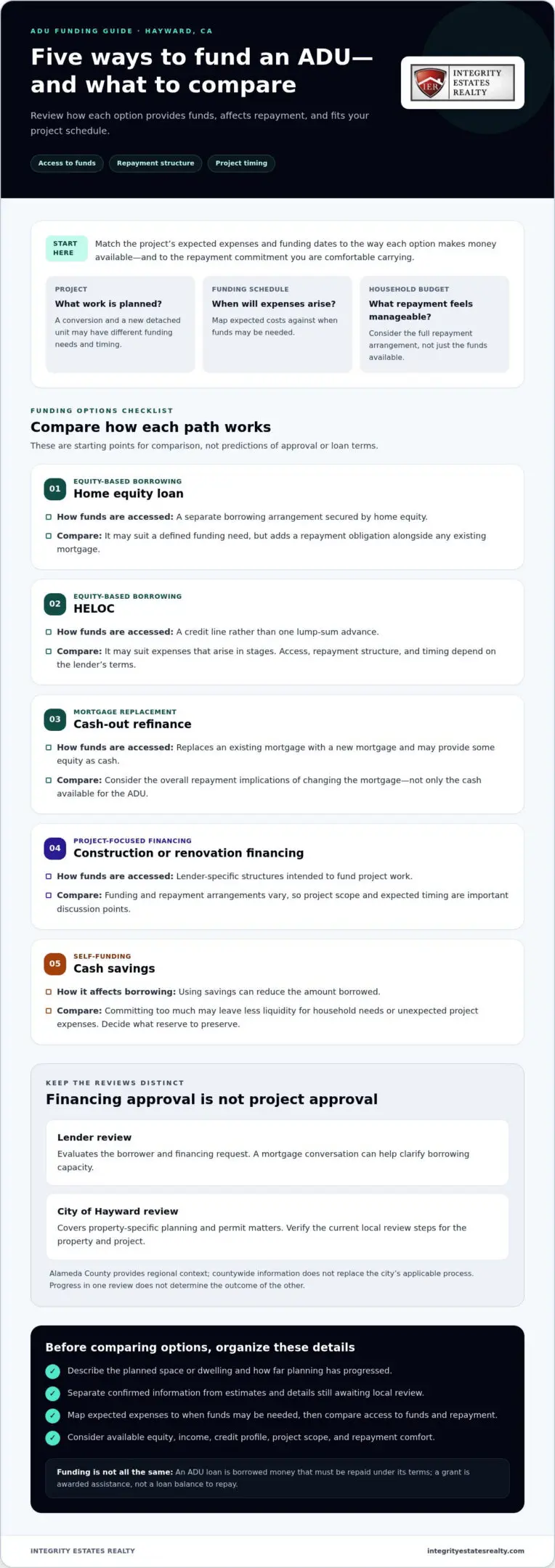
Keep two processes in view. A lender evaluates the borrower and financing request; the City of Hayward reviews property-specific planning and permit matters. Progress in one process does not determine the outcome of the other. A mortgage conversation can help clarify borrowing capacity, while local review helps establish what may be possible on the property and which steps apply. Keeping the processes distinct makes it easier to identify assumptions before they shape your budget.
The right financing path depends on available home equity, income, credit profile, project scope, and the repayment commitment that feels manageable. Converting existing space may involve different funding needs and timing from building a new detached unit. That distinction can help narrow the options worth comparing, but it does not point to one universal solution. ADU financing options hayward ca should be assessed against your circumstances, not just a headline rate or rough project estimate.
What makes an ADU financing decision different?
Unlike buying a finished home, an ADU project may require funds while construction or conversion is underway. The planned work, how clearly it is defined, and when expenses are expected can shape the financing conversation. For example, a project with multiple stages may raise different funding-timing questions from a straightforward conversion. Lender requirements and their treatment of a proposed project vary, so don’t assume a particular document, income source, or loan structure will apply to every borrower.
How Hayward location shapes early planning
The City of Hayward is the local authority for property-specific planning and permit information. Alameda County provides regional context, but countywide information does not replace the city’s applicable process. Verify current local review steps for your property and project before relying on a requirement or timeline. This early check can help you coordinate planning assumptions with your financing conversation without treating loan approval as a substitute for municipal review.
Start by describing the project in plain terms: what space or dwelling you’re considering, how far planning has progressed, and when you expect to need funds. Pair that outline with a realistic view of household finances and repayment comfort. Distinguish confirmed information from estimates and details still awaiting local review. You don’t need every project detail settled to organize useful questions, but knowing what is firm and what is provisional will make comparisons more meaningful.
ADU financing options: understand equity, refinancing, and construction loans
There isn’t one financing structure that fits every ADU project. Homeowners may compare borrowing against home equity, refinancing, construction or renovation financing, and cash savings. Each approach differs in how funds are accessed and repaid. Begin with the project’s funding needs and your comfort with the resulting obligations, rather than assuming one option is automatically preferable.
The options below are a starting point for comparison, not a prediction of approval or loan terms. Lender terms and qualification vary by borrower, so consider each structure in light of your financial picture and project plan.
- Home equity loan: This generally creates a separate borrowing arrangement secured by home equity. It may suit a project with a defined funding need, but it adds a repayment obligation alongside any existing mortgage.
- HELOC: A home equity line of credit provides access to a credit line rather than one lump-sum advance. It may suit expenses that arise in stages, but access, repayment structure, and timing depend on the lender’s terms.
- Cash-out refinance: This replaces an existing mortgage with a new mortgage and may allow a borrower to access some equity as cash. It also changes the mortgage arrangement, so compare the overall repayment implications instead of focusing only on the cash available for the ADU. Homeowners weighing this path can review this mortgage refinance guide for related considerations.
- Construction or renovation financing: These lender-specific structures are intended to fund project work. Funding and repayment arrangements vary, making the project scope and expected timing important parts of the discussion.
- Cash savings: Using savings can reduce the amount borrowed, but committing too much may leave less liquidity for household needs or unexpected project expenses. Decide what reserve you want to preserve before choosing how much cash to contribute.
These distinctions make it easier to compare ADU financing options hayward ca without treating them as interchangeable. Map expected expenses against when funds may be needed, then compare that schedule with how each option makes funds available and handles repayment.
When home equity or refinancing may enter the comparison
Home equity options and refinancing connect the project to the property’s existing financing or equity. A home equity loan is generally a separate borrowing arrangement; a HELOC offers a credit-line structure; and a cash-out refinance replaces the existing mortgage. Their effects differ, including whether you add a separate payment or change your current mortgage. Compare the full repayment picture and how it fits your household budget.
Construction financing, savings, and grant questions
Construction or renovation financing is lender-specific, so don’t assume every structure releases funds or handles repayment in the same way. Grants differ from loans and may have eligibility rules. As of October 2026, the CalHFA ADU Grant Program is not accepting new applications. Its funding was fully allocated on December 28, 2023, and no new funding round has been announced. Treat the grant as unavailable for a current financing plan unless CalHFA announces a change.
As you compare these paths, a mortgage perspective can help connect financing structure with your property goals and project timeline. Explore mortgage guidance as one part of forming a well-informed plan.
Compare ADU financing choices by qualification, repayment, and project fit
A financing option can look workable on paper but still be a poor fit for the project or household budget. Compare each path using the same factors: available equity, income documentation, repayment structure, timing of funds, and how clearly the project is defined. A side-by-side comparison is more useful than focusing on one feature in isolation.
For each option, note what you know and what still needs to be established:
- Equity and property: Consider how much equity may be available and how the property’s value enters the lender’s review. Your estimate is not the same as a lender’s determination.
- Income and debt: Organize income records and a clear picture of existing debts. These help frame your financial profile, though lenders may assess the details differently.
- Repayment: Compare whether the structure adds a separate obligation or changes your existing mortgage. Consider how the payment fits alongside regular household expenses.
- Funding timing: Match expected project expenses with when and how funds could be accessed. Staged work may raise different timing questions from a project with a more defined scope.
- Project readiness: A preliminary plan, scope, and supporting documentation can make it easier to discuss the project, but they do not guarantee approval.
Keep construction estimates separate from loan qualification. An estimated project budget helps describe the funding need; it does not establish how much a lender will approve or which financing structure may be available. For ADU financing options hayward ca, compare the property, borrower profile, project plan, and repayment capacity without assuming they will lead to a particular decision.
What lenders may review when evaluating an ADU project
A lender may consider income, existing debts, credit profile, available equity, and property value alongside project documentation. The financing program’s rules also matter. These factors can interact: the project scope may inform the amount and timing of funding under discussion, while borrower finances help frame repayment capacity. Qualification decisions and the treatment of potential ADU rent depend on lender-specific underwriting, so don’t assume one lender’s approach applies everywhere.
How to weigh rental income and repayment comfort
Build two household budget scenarios. First, consider whether the expected payment feels manageable without future rental income. Then assess how possible rent could affect the picture while allowing for vacancy, ongoing expenses, or project delays. These are planning considerations, not predictions, and each lender may evaluate projected rent differently.
Projected rent should not be treated as guaranteed loan qualification. Consider whether repayment remains workable if rental income is delayed or lower than expected. This conservative comparison can help you distinguish a project that depends on optimistic assumptions from one that better fits your repayment comfort.
Prepare for ADU financing in Hayward with a practical checklist
A focused preparation sequence can make a financing conversation more productive and keep assumptions visible. Define a preliminary project scope, review household finances, research the local process for your property, and compare financing structures against the information you gather. This sequence does not guarantee approval or a particular timeline. It helps you ask clearer questions and identify what remains to be established.
Keep information sources distinct. Hayward is in Alameda County, and the City of Hayward is the place to check current planning and permit information for a specific property and project. Alameda County provides regional context but does not replace city-specific review. For general mortgage concepts, this Santa Clara County mortgage broker guide may provide broader background; its county context is not a substitute for Hayward or Alameda County information.
Documents and project details to organize
Gather useful materials before comparing options. A clear folder, even with preliminary estimates, makes it easier to distinguish documented facts from open questions. Include:
- Mortgage details: Current balance, payment, and other available information about your existing home loan.
- Household finances: Income records, a summary of existing debts, and a budget that reflects current obligations.
- Property information: Basic details about the home and property that may help frame the proposed project.
- Project outline: The ADU type you’re considering, intended use, preliminary scope, and any early cost estimates or documents already available.
Label estimates clearly. A preliminary scope or budget can support an initial conversation, but it may not be a confirmed bid or documentation a lender will require. That distinction helps prevent an early planning figure from being mistaken for a final funding need.
Coordinate local research with financing conversations
Check current City of Hayward planning and permit information for your specific property and proposed work. Separately, discuss with Integrity Estates Realty’s mortgage team how financing may treat project documents, disbursements, and potential rental income. Local approval and loan approval are distinct processes: city review addresses the project under applicable local procedures, while underwriting evaluates the borrower and financing request.
Use the same project description in both conversations, updating it as details become clearer. If the scope changes, note what changed and revisit how that affects the estimated funding need or timing. This can reduce confusion between planning assumptions and the information used in a financing review.
With your financial records and project outline in hand, you can compare ADU financing options hayward ca against a more complete picture. Discuss your ADU financing plans with Integrity Estates Realty to connect borrowing questions with your property goals and project readiness.
Plan your Hayward ADU financing with Integrity Estates Realty
An ADU decision connects a property plan with a significant financial commitment. Integrity Estates Realty provides real estate representation and mortgage services, bringing both perspectives into the conversation as homeowners consider financing questions alongside property goals. Mortgage services include FHA, VA, jumbo, and refinance loan origination, as well as conventional loan processing.
This integrated perspective can help frame a discussion around your home, proposed ADU, and broader housing goals. It does not replace the City of Hayward’s review of a project or guarantee a loan outcome. It can help you organize financing questions alongside property considerations so your next steps are grounded in the details you know.
Homeowners considering projects in Salinas, Seaside, Soledad, Prunedale, San Jose, Gilroy, Hollister, San Francisco, Hayward, San Leandro, Livermore, Merced, Los Banos, Delhi, Gustine, Stockton, Tracy, Modesto, Turlock, Sacramento, Madera, Fresno, and Clovis should also base local planning on the requirements for their specific property and city.
What a mortgage and real estate conversation can clarify
Bring the questions that matter most to your decision: which financing structures may be worth comparing, what information a lender may need, and how the project fits your plans for the property. You can also consider how your preferred repayment approach relates to other housing goals. Available terms and qualification depend on individual circumstances and lender review, so focus on understanding the options rather than assuming approval.
Before you meet, write down what is settled and what remains an estimate. For example, distinguish a preliminary ADU scope from final project documents, and note whether expected rent is part of your long-term plan or simply a possibility. This makes it easier to discuss open questions without treating early assumptions as firm financing decisions.
Choose a considered next step
If you’re ready to discuss your property objectives and financing considerations, connect with Integrity Estates Realty. Use the conversation to clarify which questions to examine and how your property goals relate to potential financing paths. It is a way to develop a clearer picture, not a promise of a particular loan, approval, or terms.
For Hayward homeowners, a sound plan matches the financing structure to project readiness, available equity, and repayment comfort. Keep those factors at the center as you weigh next steps. A deliberate comparison can help you make an informed decision that fits both the property you have and the plans you’re considering.
ADU financing options hayward ca are most useful to compare when you know what the project needs, what your finances can support, and what payment commitment feels sustainable. With those points organized, you can approach a mortgage discussion with clear priorities and a realistic sense of what remains to be determined.
Move forward with a clear next step
Your ADU plan doesn’t need every detail resolved at once. Choose the next question that will most improve your decision: clarifying the project scope, estimating what funds may be needed and when, or assessing what repayment would feel sustainable. Revisit your financing comparison as the property and project information becomes clearer. This measured approach can help keep early estimates from becoming assumptions and make each conversation more purposeful.
The right ADU financing options hayward ca are the ones that align with project readiness and your household’s financial priorities, not simply the options that appear easiest at first glance. Bring your questions, financial picture, and property goals into the same conversation, while remembering that financing terms and approval depend on individual circumstances and lender review.
Discuss your property goals and financing options with Integrity Estates Realty as you consider your next step. A thoughtful plan can turn a complex decision into a clearer path forward, one informed choice at a time.
Frequently Asked Questions
What are the main financing options for building an ADU in Hayward?
Homeowners commonly compare a home equity loan, a HELOC, cash-out refinancing, construction or renovation financing, and personal cash savings. These options differ in how funds are accessed and how repayment relates to an existing mortgage. For example, a homeowner with expenses expected in stages might compare a credit line with a lump-sum structure. The best fit depends on lender review, project timing, and what repayment the household can sustain.
Can I use a HELOC to finance an ADU in Hayward?
A HELOC may be an option to discuss if you have home equity and want a credit-line structure for project expenses. It does not guarantee access to a specific amount or establish that a lender will approve the application. Consider how the project’s expected spending schedule lines up with the line’s terms, and how repayment would fit alongside your current mortgage and household budget.
Does an ADU’s expected rental income help me qualify for financing?
Possibly, but lenders may treat projected rent differently under their underwriting rules. Don’t assume it will count or be counted the same way everywhere. Ask how the lender evaluates the estimate and what supporting information it considers. For planning, test whether the proposed repayment still feels manageable if rent begins later than expected, the unit is vacant, or rental income does not qualify as anticipated.
Is the CalHFA ADU grant available in 2026?
No. As of October 2026, the CalHFA ADU Grant Program is not accepting new applications. Its funding was fully allocated on December 28, 2023, and no new funding round has been announced. Treat the grant as unavailable for a current financing plan unless CalHFA announces a change. Build your comparison around funding you can pursue rather than assuming grant money will cover part of the project.
How do I prepare to apply for ADU financing?
Start with a short project brief: the ADU type, intended use, current planning stage, and approximate funding schedule. Gather mortgage information, income records, debt details, and a household budget, then mark which project figures are preliminary. This gives the lender a clearer starting point and helps you identify missing information. For ADU financing options hayward ca, keep property-specific questions separate from financial estimates.
Do I need City of Hayward approval before applying for an ADU loan?
Not necessarily before beginning a financing conversation. City project review and lender underwriting are separate processes, and lenders may differ in what project documents they require and when. You can discuss financing while also checking the City of Hayward’s current planning and permit information for your property. Don’t treat an early loan discussion as city approval or assume a lender’s review replaces local project review.
Is a cash-out refinance better than a home equity loan for an ADU?
Neither is automatically better. A cash-out refinance replaces your existing mortgage and may provide funds from home equity; a home equity loan generally creates a separate borrowing arrangement. Compare the full repayment impact, how each structure fits your current mortgage, and whether the funds align with project timing. Your existing loan and financial circumstances matter, so compare the options side by side rather than choosing based on the name alone.