
Conventional Loan Requirements in California: The 2026 Mortgage Guide
The 2026 California mortgage market has officially redefined what it means to be a standard borrower. If you’re currently exploring a conventional loan gilroy, you’ve likely realized that local limits in Santa Clara County now reach $1,249,125, a figure that demands a sophisticated approach to financing. We recognize that the gap between a physical asset and a personal dream is often filled with anxiety over high property values and complex credit requirements. It’s natural to feel a sense of pressure, yet the most successful transitions are rooted in methodical preparation and reliable data.
This guide serves as your authoritative resource to master the specific credit, income, and down payment standards necessary for California’s unique landscape. We promise to provide the clarity you need to manage conforming versus high-balance limits without the usual stress. We’ll walk through a comprehensive checklist of qualification metrics, detail the updated 2026 loan limits, and map out a transparent path to pre-approval. By the end of this journey, you’ll have the financial logic and confidence required to secure your home in today’s competitive market.
Key Takeaways
- Learn why a 620 credit score is the starting point and how your debt-to-income ratio impacts your borrowing power in high-cost regions.
- Identify the 2026 high-balance thresholds for Santa Clara County to determine if your conventional loan gilroy fits within conforming guidelines.
- Explore low down payment programs starting at 3%, allowing you to preserve capital while still securing a premier property.
- Master the nuances of Private Mortgage Insurance and the strategic steps required to remove it as your home equity grows.
- Gain a competitive edge by partnering with a local expert who integrates real estate brokerage with specialized loan processing.
What Defines a Conventional Loan in California for 2026?
A conventional loan is a private mortgage that isn’t insured or guaranteed by the federal government. Unlike FHA, VA, or USDA loans, these are funded by private lenders and usually sold to Fannie Mae or Freddie Mac. In the competitive 2026 market, securing a conventional loan gilroy represents more than just a financing choice; it serves as a signal to sellers that you’re a high-intent, qualified buyer. It’s a mark of financial stability. Since 2004, our team has seen how these loans provide a reliable foundation for families planting roots in the region.
Sellers often view these offers as the gold standard. They typically involve fewer property condition requirements and a more streamlined closing process than government alternatives. Currently, interest rates have stabilized around 6.70% for a 30-year fixed mortgage, making conventional financing an attractive option for those looking to lock in long-term value. While government loans have their place, the flexibility of conventional guidelines allows for a wider range of property types, from modern condos to historic Gilroy estates.
Conventional vs. Government-Backed Loans
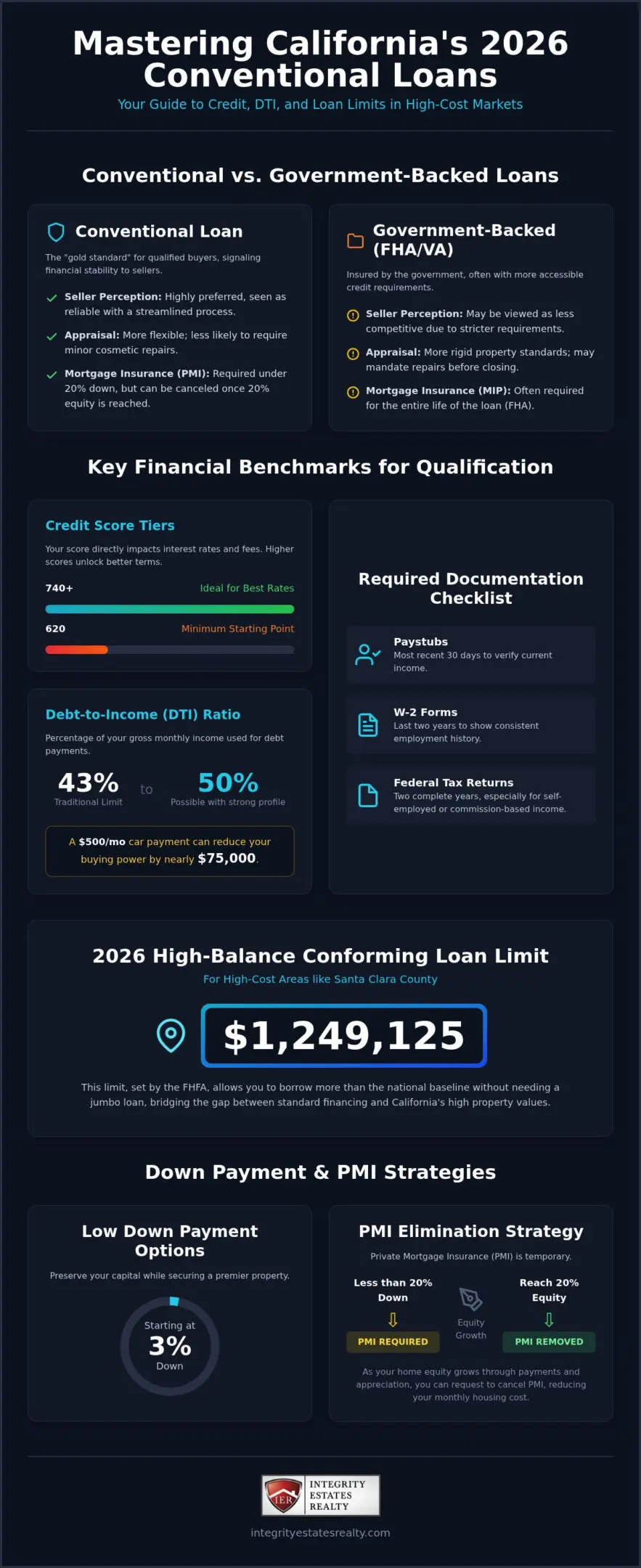
The distinction between these loan types often comes down to cost and property standards. With a conventional loan, you’ll pay Private Mortgage Insurance (PMI) if your down payment is under 20%, but this can be canceled once you reach 20% equity. In contrast, FHA loans require a Mortgage Insurance Premium (MIP) that often lasts for the life of the loan. Additionally, conventional appraisals are generally less rigid regarding minor cosmetic issues. FHA appraisals may require repairs for small defects before the loan can close. This flexibility is vital when you’re bidding on homes in a fast-moving market where speed and simplicity win contracts.
The Role of the FHFA in California Lending
The Federal Housing Finance Agency (FHFA) acts as the architect of the conventional lending world. Each year, they adjust conforming loan limits based on changes in average home prices. For 2026, the limit in Santa Clara County has reached $1,249,125. This high-balance threshold is specifically designed for high-cost areas, allowing you to borrow more than the national baseline without moving into a jumbo loan. These limits matter deeply in our local market because they bridge the gap between standard financing and the reality of California property values. Understanding these figures is the first step in ensuring your financing aligns with the local landscape.
The Financial Benchmarks: Credit Score and DTI Requirements
Securing a conventional loan gilroy requires more than just meeting a minimum threshold. It requires a profile that conveys reliability to lenders. While a 620 credit score is technically the floor, it rarely unlocks the most favorable terms in California’s high-stakes environment. Lenders look for a consistent narrative of financial responsibility. This narrative is built through the “Big Three” documents: your most recent 30 days of paystubs, the last two years of W2s, and two years of complete federal tax returns. For those who are self-employed or rely on commissions, lenders typically require a two-year history to average your earnings, ensuring your income is stable enough to support a long-term mortgage.
Credit Score Tiers and Pricing Impacts
A score of 740 or higher is the ideal benchmark for securing the lowest possible interest rates in regions like San Jose and Gilroy. Higher credit scores directly reduce Loan Level Price Adjustments (LLPAs), which are risk-based fees that lenders add to your interest rate or closing costs. If your score is currently lower, consider paying down revolving credit card balances to below 30% of their limits or requesting a credit limit increase to lower your utilization ratio. These small adjustments can move you into a better pricing tier within weeks. If you aren’t sure where your profile stands, you can review your financial readiness with a local expert to identify specific areas for improvement.
Managing Debt-to-Income in High-Cost CA Markets
Your Debt-to-Income (DTI) ratio is the percentage of your gross monthly income that goes toward paying debts. Lenders look at two numbers: the front-end ratio, which covers only your future housing payment, and the back-end ratio, which includes all monthly obligations like student loans and car payments. While 43% is the traditional limit, many conventional programs allow for a DTI up to 50% if you have significant cash reserves or a high credit score. In California, where home prices are elevated, even a modest car payment of $500 can reduce your buying power by nearly $75,000. Managing these recurring debts before you apply for a conventional loan gilroy is essential for maximizing your potential loan amount.
Navigating California Conforming Loan Limits: County-by-County
The Federal Housing Finance Agency (FHFA) designates specific ceilings for what counts as a conforming loan, and these figures change significantly based on where you plan to live. In high-cost regions like Santa Clara County, which includes Gilroy, the 2026 conforming loan limit has reached $1,249,125. This elevated ceiling allows local buyers to access standard financing terms for properties that would be considered luxury assets in other states. Understanding these regional thresholds is vital for anyone seeking a conventional loan gilroy. While the national baseline provides a starting point, it doesn’t reflect the reality of the Silicon Valley outskirts.
As you move away from the coast, these limits shift to match local economic conditions. Monterey County often shares these higher limits due to its proximity to major job centers, but moving further inland to Fresno County reveals a different landscape. In the Central Valley, limits typically align closer to the national baseline because median home prices are more modest. This geographic variation means your qualification strategy must be tailored to the specific county line where your new front door will sit. If your desired home price exceeds these local caps, your financing will transition from a conforming loan into the territory of jumbo financing.
Conforming High-Balance Loans Explained
High-balance loans act as the middle ground between standard conventional financing and jumbo loans. They still follow the general rules set by Fannie Mae and Freddie Mac, but they’re specifically designed for federally designated high-cost areas. While they offer the same protections as standard conventional loans, they sometimes carry slightly higher interest rates or stricter reserve requirements. For buyers in cities like San Francisco or Hayward, these loans are the primary tool used to compete in a market where even entry-level homes often push past the million-dollar mark. They provide a sophisticated way to manage high-stakes transactions without the complex hurdles of non-conforming products.
Jumbo Loans: When Conventional Limits Aren’t Enough
When a property’s price tag moves beyond the $1,249,125 threshold in Santa Clara County, you’ll likely need a jumbo loan. These loans aren’t backed by Fannie Mae or Freddie Mac, which means lenders take on more risk and, consequently, require more from the borrower. You’ll often need a larger down payment, sometimes 20% or more, and significant cash reserves to prove you can handle the debt. In the luxury markets of Silicon Valley, jumbo loans are a common reality for many families. To navigate these choices, it’s helpful to consult with Mortgage Brokers in Santa Clara County: A 2026 Buyer’s Guide to Home Financing for a detailed look at how these products differ in practice. We’ve spent over two decades helping clients determine which path offers the most long-term value for their specific lifestyle goals.
Down Payment Options and PMI Strategies for CA Buyers
The assumption that you’ll need a 20% down payment is perhaps the most persistent myth in real estate. While a larger deposit reduces your monthly obligation, many modern programs allow you to secure a conventional loan gilroy with as little as 3% or 5% down. This flexibility is essential in California. Saving $250,000 for a down payment can take a decade. By utilizing lower entry points, you can enter the market sooner and begin building equity in a region known for consistent long-term appreciation. It’s about getting your foot in the door while prices are still within reach.
Beyond your own savings, gift funds from family members or down payment assistance programs are frequently used to bridge the gap. California specifically offers CalHFA programs that can be paired with conventional financing, a strategic detail often overlooked by national lenders. You should also prepare for reserve requirements. This is the liquid cash you have left in the bank after the down payment and closing costs are paid. In high-cost markets like Santa Clara County, having three to six months of mortgage payments in reserve can significantly strengthen your application and provide much-needed peace of mind.
Conventional 97 and HomeReady/HomePossible Programs
The Conventional 97 program is a premier option for first-time buyers in Gilroy and Salinas, requiring only a 3% down payment. Similarly, Fannie Mae’s HomeReady and Freddie Mac’s HomePossible programs offer reduced interest rates and lower PMI costs for those who meet specific income limits. These specialized products are designed to make homeownership accessible without sacrificing the benefits of conventional financing. If these requirements feel too stringent for your current situation, you might also explore FHA Home Loans in Gilroy, CA: Your 2026 Guide to Affordable Home Financing to see which path fits your financial profile best.
The Cost of PMI in California
Private Mortgage Insurance (PMI) is the trade-off for a lower down payment. It protects the lender, but it doesn’t have to be a permanent burden. Your credit score heavily influences the cost. A borrower with a 760 score will pay significantly less than someone at 680. Some clients opt for Lender Paid Mortgage Insurance (LPMI), where the interest rate is slightly higher but the monthly PMI fee is eliminated entirely. The path to 20% equity is clear. Once your loan balance reaches 80% of the original home value, you can request termination. If you wait, it automatically cancels at 78%. If you’re ready to calculate your potential savings, contact our team for a personalized loan analysis today.
Securing Your California Loan with Integrity Estates Realty
Big-box lenders often treat California’s complex market as a standard data entry task. They don’t understand the nuances of a conventional loan gilroy or the specific high-balance requirements of Santa Clara County. We’ve spent over two decades as a local anchor in this community. Since 2004, we’ve seen market cycles come and go. This deep-rooted experience allows us to anticipate obstacles before they threaten your earnest money deposit. We aren’t just processing a file; we’re protecting your future investment. Our local pride is reflected in every transaction we handle, ensuring you aren’t just a number in a national database.
The 2026 market moves quickly. Sellers in Gilroy and San Jose expect offers that are backed by reliable, local professionals who can guarantee a smooth close. By choosing a local brokerage, you gain a partner who understands the local culture and the specific property types that make this region desirable. We bridge the gap between financial logic and your personal dream by providing an ethical anchor in a competitive industry. Our goal is to alleviate the stress of high-stakes transactions through transparency and steady, purposeful guidance.
Integrated Real Estate and Mortgage Services
Communication breakdowns are the leading cause of delayed closings in high-stakes markets. When your real estate agent and mortgage broker operate under different roofs, vital details can get lost in translation. At Integrity Estates Realty, we provide a streamlined, one-stop-shop experience. This integration means your loan processing and property search happen in tandem. It creates a faster, more transparent journey for the cautious buyer. Having your agent and broker together ensures a stress-free documentation process. For a deeper look at the local inventory, explore Homes for Sale in Gilroy, CA: The 2026 Buyer’s Lifestyle & Financing Guide.
Your Next Steps: Pre-Approval and Strategy
Your journey begins with a purposeful consultation. When you meet with Jose M Hernandez, we don’t just hand you a pre-approval letter. We build a personalized strategy. You’ll need to bring your “Big Three” documents: paystubs, W2s, and tax returns. From there, we’ll analyze how a conventional loan gilroy fits your specific lifestyle goals in neighborhoods like Eagle Ridge or downtown San Jose. We prioritize long-term relationships over quick transactions. This ethical approach ensures you move forward with peace of mind. Contact Integrity Estates Realty today to craft your 2026 loan strategy and turn your personal narrative into a physical asset.
Moving Toward Your 2026 Homeownership Goals
Securing a home in the 2026 California market requires a blend of financial precision and local insight. You now understand that the high-balance conforming limits in Santa Clara County provide significant room for maneuver, and that a 20% down payment isn’t the only path to your front door. By mastering your credit profile and debt-to-income ratios, you’ve already taken the most important steps toward a successful conventional loan gilroy. These benchmarks are the foundation of a sophisticated homebuying strategy that prioritizes long-term value over short-term stress.
Integrity Estates Realty stands as your ethical anchor throughout this complex journey. As a family-owned brokerage with over 20 years of experience, we offer localized expertise that stretches from the neighborhoods of Gilroy to the heart of San Jose. We prioritize transparent, reliable guidance to ensure your earnest money is protected and your transition is seamless. Your dream of a California lifestyle is within reach, and we are here to provide the steady partnership you deserve. It’s time to bridge the gap between financial logic and your personal narrative.
Start Your California Conventional Loan Pre-Approval with Integrity Estates Realty and move forward with confidence today.
Frequently Asked Questions
What is the minimum credit score for a conventional loan in California in 2026?
The minimum credit score generally required to qualify is 620. While this serves as the baseline, most lenders recommend a score of 740 or higher to secure the most competitive interest rates. Higher scores reduce risk based fees, which can lower your monthly payment significantly. If your score is on the edge, small adjustments like reducing credit card utilization can help you qualify for better pricing tiers before you finalize your application.
Can I get a conventional loan with only 3% down in California?
Yes, first time homebuyers can often qualify for a conventional loan with a 3% down payment. Programs like the Conventional 97 or HomeReady are designed to help local families enter the market without needing a massive upfront investment. This is a popular path for a conventional loan gilroy because it allows you to preserve cash for reserves or home improvements while still benefiting from the stability of a private mortgage.
What are the 2026 conforming loan limits for Santa Clara County?
The 2026 conforming loan limit for Santa Clara County is $1,249,125. This high balance limit reflects the elevated property values across Gilroy and the Silicon Valley region. Because this threshold is significantly higher than the national baseline, it allows many buyers to avoid the stricter requirements of jumbo financing. Staying within this limit ensures you can follow standard Fannie Mae or Freddie Mac guidelines for your purchase and closing process.
How do I remove Private Mortgage Insurance (PMI) from my conventional loan?
You can request PMI removal once your loan balance reaches 80% of the home’s original value. Lenders are legally required to cancel it automatically when the balance hits 78%. If your property has appreciated rapidly, you might also qualify for early removal by ordering a new appraisal to prove you’ve reached 20% equity. This process is one of the primary financial advantages conventional loans have over government insured alternatives like FHA loans.
Is it harder to qualify for a conventional loan than an FHA loan in CA?
Conventional loans generally have stricter standards for credit scores and debt to income ratios than FHA loans. While FHA programs allow scores as low as 580, conventional lenders look for at least a 620. However, conventional financing offers more flexibility regarding property types and long term insurance costs. For many buyers, the slightly higher qualification bar is worth the potential savings found in lower monthly mortgage insurance premiums over the life of the loan.
What is the maximum debt-to-income ratio for a conventional mortgage?
The standard maximum debt to income (DTI) ratio is 43% for most conventional loans. However, some lenders allow ratios up to 50% if you have compensating factors like a high credit score or substantial cash reserves. In expensive markets, balancing your recurring debts like car payments or student loans is crucial. Managing these obligations ensures your income is sufficient to support a conventional loan gilroy while maintaining a comfortable lifestyle for your family.
Can self-employed borrowers in California qualify for conventional financing?
Self employed borrowers can certainly qualify if they provide a clear, two year history of stable income. Lenders typically average the net income reported on your last two years of federal tax returns to determine your borrowing power. It’s helpful to work with a local broker who understands how to interpret business write offs. This expertise ensures your application accurately reflects your financial strength and your ability to manage a long term mortgage commitment.
What is the difference between a high-balance conventional loan and a Jumbo loan?
A high balance loan is a conforming loan designed for federally designated high cost areas, following Fannie Mae and Freddie Mac rules. A jumbo loan is a non conforming product used when the loan amount exceeds the local high balance ceiling. Jumbo loans usually require larger down payments, higher credit scores, and more extensive cash reserves. High balance loans offer a middle ground, allowing for larger loan amounts without the complex hurdles of jumbo financing.