
Down Payment Assistance San Jose: The 2026 First-Time Buyer’s Strategic Guide
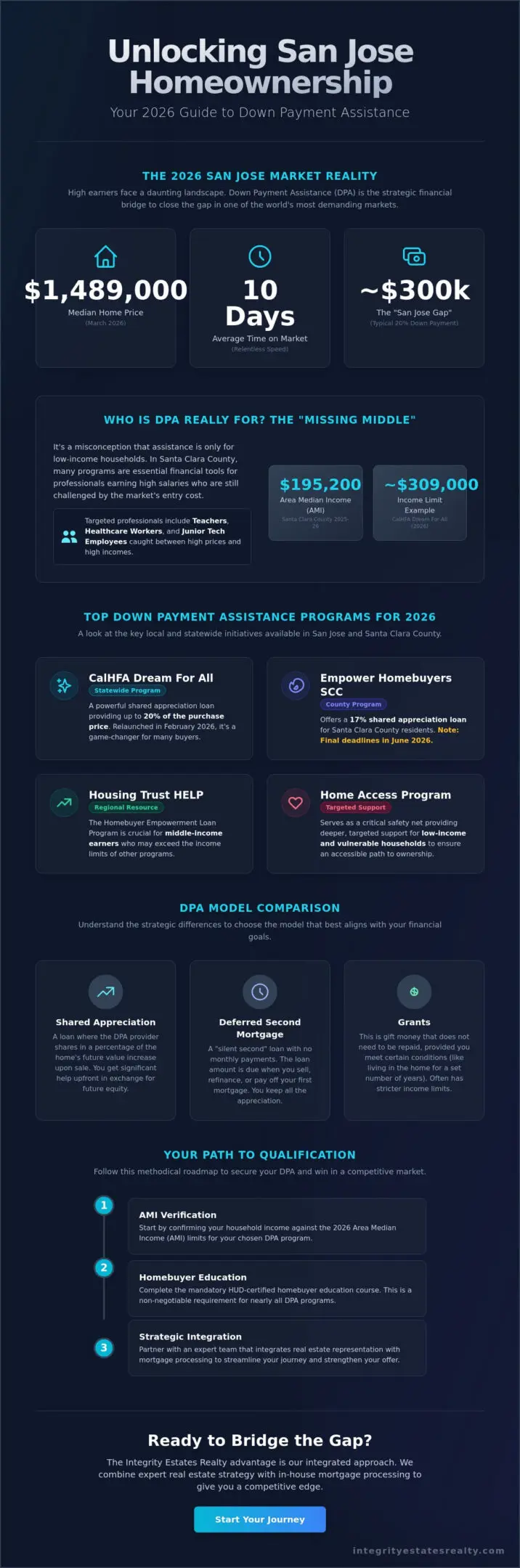
With the median home price in San Jose reaching $1,489,000 in March 2026, many professionals earning well over $200,000 still feel priced out of the neighborhoods they love. It’s exhausting to watch your savings grow while the market moves even faster; you’re likely feeling the pressure of a landscape where homes sell in an average of just 10 days. You deserve a partner who understands that securing the right down payment assistance san jose isn’t about seeking a handout. It’s about utilizing a sophisticated financial bridge to cover that 17 to 20 percent gap in one of the world’s most demanding real estate markets.
This guide will help you unlock homeownership by demystifying the complex financial tools available to you this year. You’ll learn how to leverage the February 2026 relaunch of the CalHFA Dream For All program, which offers up to 20 percent of the purchase price, and understand the final deadlines for local programs like Empower Homebuyers SCC before they sunset in June. We’ll clarify the nuances of shared appreciation and income limits so you can move forward with the confidence of an expert who is ready to win.
Key Takeaways
- Bridge the “San Jose Gap” by identifying whether a secondary loan or grant model best aligns with your personal financial narrative and long-term wealth goals.
- Navigate the specific eligibility requirements for the Housing Trust Silicon Valley’s HELP program, an essential resource for middle-income buyers who may exceed standard income limits.
- Master the strategic differences between shared appreciation models and deferred second mortgages to ensure your down payment assistance san jose remains a sustainable bridge to ownership.
- Secure your path to qualification by following a methodical roadmap that includes 2026 Area Median Income verification and mandatory HUD-certified homebuyer education.
- Discover how a collaborative approach that integrates residential real estate representation with expert mortgage processing can streamline your journey in a competitive landscape.
Navigating the San Jose Housing Market: Why Down Payment Assistance is Vital in 2026
High-earning professionals in Silicon Valley often face a startling contradiction. While their salaries place them in the top percentiles of earners nationally, the local market’s entry requirements remain elusive. In this context, down payment assistance san jose serves as a sophisticated financial tool rather than a traditional subsidy. These programs provide secondary loans or grants that bridge the divide between your available liquid savings and the capital required to secure a premier property. They act as a strategic layer of financing, allowing you to compete in a market that moves with relentless speed.
Before diving into specific programs, it’s vital to understand what a down payment is and why it carries such weight in a competitive offer. In San Jose, a 20 percent down payment on a median-priced home is nearly $300,000. For many, this “San Jose Gap” is the primary barrier to entry. Even with a high household income, the time required to save such a sum while paying local rents can feel like chasing a moving target. Assistance programs effectively freeze that target, giving you the leverage to act now rather than years from today.
The 2026 San Jose Economic Reality
The market reached a significant milestone in March 2026. The median home sale price hit $1,489,000, representing a steady climb in value that rewards current owners but challenges new participants. Combined with an average 30-year fixed mortgage rate of 6.23 percent as of April 2026, the monthly carry costs have shifted the strategy for many buyers. Utilizing down payment assistance san jose allows you to transition from a minimum entry point to a more robust 20 percent position. This shift doesn’t just help you win the bid; it fundamentally alters your loan-to-value ratio, often eliminating private mortgage insurance and lowering your monthly obligation.
Who is Down Payment Assistance Really For?
There is a common misconception that assistance is reserved only for low-income households. In Santa Clara County, the 2025-2026 Area Median Income (AMI) is $195,200. This means “moderate income” programs often cater to households earning well over $200,000. For example, the CalHFA Dream For All program set its 2026 income limit at approximately $309,000 for our region. These programs are now essential tools for the “missing middle.” This group includes teachers, healthcare professionals, and junior tech workers who find themselves caught between high prices and high incomes. We view these options as a partnership in your long-term wealth creation, ensuring you can build equity in the city where you live and work.
Top Down Payment Assistance Programs in San Jose and Santa Clara County
Identifying the right down payment assistance san jose requires a meticulous review of both local and state initiatives. The landscape is shifting in 2026. Some veteran programs are concluding their mission while new statewide opportunities are expanding to meet the needs of the Silicon Valley workforce. You’ll find that the City of San José homebuyer assistance portal provides a vital directory for municipal grants and silent second mortgages. These city-level tools often work in tandem with regional efforts like the Homebuyer Empowerment Loan Program (HELP) from Housing Trust Silicon Valley. HELP is particularly valuable for those who find themselves just above the income limits for standard low-income subsidies but still need a significant bridge to reach a 20 percent down payment.
- Empower Homebuyers SCC: A 17% shared appreciation loan for Santa Clara County residents.
- CalHFA Dream For All: A statewide 20% assistance program that resumed in February 2026.
- Housing Trust HELP: Specifically designed for middle-income earners who exceed other program limits.
- Home Access Program: Targeted support for low-income and vulnerable households.
The Home Access Program serves as a critical safety net for low-income and vulnerable households. It ensures that the path to ownership remains accessible even as market dynamics become more complex. This initiative often provides deeper subsidies than moderate-income programs, though it usually carries stricter long-term residency requirements. Understanding how these local grants interact with broader financing options like FHA home loans in Gilroy or San Jose is essential for a successful closing.
Empower Homebuyers SCC: The 17% Solution
This flagship program has long been a cornerstone for Santa Clara County residents. It offers a shared appreciation loan of up to 17 percent of the purchase price. You only need to provide a 3 percent contribution from your own funds. It’s important to act quickly if this aligns with your goals. The Empower Homebuyers SCC program, funded by the Measure A bond, is officially sunsetting on June 30, 2026. It requires no monthly payments, making it a powerful tool for cash flow management. This program integrates seamlessly with conventional financing or jumbo products within San Jose proper.
CalHFA and Statewide Options
As local programs like Empower transition out, statewide initiatives are stepping in to fill the gap. The California Dream For All program resumed accepting applications in February 2026. It provides up to 20 percent in assistance, which is a transformative amount in a market where the median price sits near $1.5 million. These statewide loans are often structured as deferred payments, allowing you to prioritize your primary mortgage. They do come with strict 2026 income limits; in Santa Clara County, this is capped at approximately $309,000. If you’re feeling overwhelmed by these moving parts, our team provides residential real estate representation that balances financial logic with your personal housing dreams.
Strategic Comparison: Grants vs. Shared Appreciation vs. Second Mortgages
Selecting the most effective down payment assistance san jose isn’t just about the initial check. It’s about the long-term impact on your net worth. You’ll encounter three primary structures: grants, deferred second mortgages, and shared appreciation loans. Each model offers a different balance of immediate relief and future obligation. While grants might seem like the obvious choice, the limited availability often makes shared appreciation or deferred loans the more practical path for competitive buyers in 2026.
The grant model is essentially a forgivable loan. These are often described as “free money,” but they typically require you to remain in the home as your primary residence for a set period, often five to ten years. If you move or sell earlier than the agreed term, you’ll likely owe a prorated portion back to the agency. In contrast, a deferred second mortgage is a traditional loan where the principal and interest payments are pushed to the end of the term. These don’t affect your monthly cash flow today, but the balance remains a fixed debt that you must eventually settle.
Understanding Shared Appreciation
Shared appreciation is a formal equity-partnership where the lender provides upfront capital in exchange for a percentage of your home’s future value increase.
This model is a powerful tool because it allows you to access a significantly larger down payment without adding to your monthly debt-to-income ratio. The primary trade-off is that you’ll see a lower profit when you eventually sell the property. Imagine you purchase a home for $900,000 using a 20 percent shared appreciation loan of $180,000. If you sell that home years later for $1,200,000, you’ve gained $300,000 in appreciation. Under a typical agreement, you’d owe the original $180,000 plus 20 percent of that $300,000 gain, which is $60,000. Your total repayment would be $240,000, leaving you with the remaining equity and your initial 3 percent contribution.
Repayment Triggers: When Do You Pay it Back?
Understanding exactly when these loans become due is vital for your long-term financial planning. Most programs require full repayment if you sell the home or if it’s no longer your primary residence. Maturity dates also exist; typically, if you haven’t sold the home after 30 years, the loan must be paid in full. It’s also essential to consider how future mortgage changes affect your assistance. If you consider refinancing your mortgage in Gilroy or San Jose to secure a lower rate, be aware that this action often triggers the full repayment of your assistance loan. We always recommend reviewing the specific subordination guidelines of your program before making any changes to your primary financing.
Evaluating the true cost over a 10-year period requires a sophisticated look at market trends. A grant is the most cost-effective but has the strictest residency rules. A deferred loan is predictable and stable. Shared appreciation can be more expensive if the San Jose market sees another decade of explosive growth, yet it provides the highest level of entry leverage for those who would otherwise be locked out of the market entirely.
Qualifying for DPA in San Jose: A Step-by-Step Roadmap
Securing down payment assistance san jose is a methodical process that requires early preparation and a high degree of financial transparency. Because these programs involve public funds or institutional equity, the scrutiny applied to your application is often more rigorous than a standard mortgage. Success in 2026 depends on your ability to present a pristine financial profile while moving through the mandatory administrative checkpoints. It’s a precise orchestration. You’ll need to align your personal timeline with the availability of program funds, particularly as popular local options approach their sunset dates.
- Step 1: Verify your 2026 Area Median Income (AMI) status against the Santa Clara County benchmark of $195,200 and audit your credit health.
- Step 2: Enroll in and complete a mandatory HUD-certified homebuyer education course through a recognized provider.
- Step 3: Obtain a formal pre-approval from a lender specifically approved to originate the DPA program you’ve selected.
- Step 4: Partner with a real estate professional who understands how to draft offers that account for the longer closing timelines often required by assistance programs.
- Step 5: Submit your formal program application to secure a fund reservation before you enter a binding contract.
Financial Readiness and Education
Your Debt-to-Income (DTI) ratio is frequently the “make or break” factor in your eligibility. Most programs require a DTI that does not exceed 43 to 45 percent, even if your primary lender is willing to go higher. You must provide a clear paper trail of your financial history, including federal tax returns, recent paystubs, and documented gift letters if family members are contributing to your initial 3 percent requirement. Beyond the numbers, education is a non-negotiable requirement. Organizations like Project Sentinel offer the necessary San Jose-approved homebuyer classes. These courses ensure you understand the long-term obligations of shared appreciation or deferred debt before you sign the final documents.
The Role of the Mortgage Broker
Navigating these waters alone is difficult. You need mortgage brokers in Santa Clara County who specialize in “layered financing.” This involves coordinating two separate lenders simultaneously: the primary mortgage provider and the agency providing the assistance. This complexity is where many applications fail during underwriting. A specialist ensures that the secondary loan’s guidelines don’t conflict with the requirements of your FHA, VA, or conventional loan. They help you avoid common pitfalls, such as failing to document a minor bank transfer, which could lead to a rejection in the final days of escrow.
If you’re ready to begin this journey with a team that prioritizes your long-term financial health, we invite you to explore our residential real estate representation services to see how we integrate these complex tools into a winning home-buying strategy.
The Integrity Estates Realty Advantage: Strategic Real Estate & Mortgage Integration
Success in the Silicon Valley market requires more than just finding a property; it demands a synchronized financial strategy. Most buyers are forced to coordinate between a real estate agent and a separate lender, a gap where critical details regarding down payment assistance san jose often slip through the cracks. At Integrity Estates Realty, we’ve eliminated this friction. Our dual-expertise model ensures that your residential real estate representation and mortgage processing happen under one roof. This integrated approach is essential when managing the layered financing and strict compliance hurdles of 2026 assistance programs.
Our commitment to local ethics and transparency means we prioritize your long-term wealth over a quick closing. We understand the nuances of the Gilroy and Santa Clara County real estate market, where inventory remains tight and competition is fierce. By leveraging our established network of wholesale lenders who are specifically approved for San Jose DPA programs, we provide you with access to conventional and FHA loan origination that works in perfect harmony with your assistance funds. Integrity Estates Realty acts as your ethical anchor, ensuring you understand every clause of your agreement before you commit to a 30-year journey.
Streamlining the Competitive San Jose Offer
In a market where homes sell in an average of 10 days, sellers are often wary of offers involving assistance programs due to perceived delays. We solve this through proactive communication and integrated mortgage processing. We don’t just submit an offer; we present a comprehensive financial package to the listing agent. By demonstrating that the down payment assistance san jose is already vetted and paired with a solid pre-approval, we provide the reassurance sellers need to choose your bid in a multi-offer environment. This strategic positioning reduces closing times and levels the playing field against all-cash competitors.
Your Partner for Life, Not Just a Transaction
Our relationship doesn’t end when you receive the keys. We view ourselves as your personal advisors for the duration of your homeownership journey. Whether you’re planning for a future move-up or evaluating when it’s the right time for refinancing services, we’re here to guide you through the implications for your assistance loan. Our “Integrity First” promise is a recurring thematic commitment to every client in Santa Clara County. Integrity Estates Realty values the human narrative behind every property and strives to make your dream of a San Jose home a sustainable reality.
If you’re ready to bridge the gap between your current savings and your future home, we’re prepared to lead the way. Schedule a DPA strategy session with Jose M Hernandez today to build a customized roadmap for your 2026 purchase.
Your Strategic Path to San Jose Homeownership
The 2026 market doesn’t wait for anyone. With median prices holding steady near $1.5 million and vital programs like Empower Homebuyers SCC sunsetting in June, timing is your most valuable asset. You’ve seen how shared appreciation and deferred loans can bridge the gap between your current savings and the competitive reality of Silicon Valley. Navigating these options requires more than just a property search; it requires a deep understanding of 2026 income tiers and the complexities of layered financing discussed throughout this guide.
Our team at Integrity Estates Realty brings over 20 years of California real estate expertise to your side. As specialists in Santa Clara County first-time buyer programs, we provide the unique advantage of being dual-licensed in both residential real estate representation and mortgage brokerage. This ensures your search for down payment assistance san jose is backed by technical precision and a commitment to your long-term wealth. We invite you to Check Your Eligibility for San Jose Down Payment Assistance today. Your dream of a permanent home in the heart of the tech world is within reach, and we’re honored to be your steadfast guide.
Frequently Asked Questions
Is San Jose down payment assistance a grant that I don’t have to pay back?
Most programs in the region are structured as deferred loans or shared appreciation agreements rather than traditional grants. While some municipal grants exist for very low income households, the majority of professionals using down payment assistance san jose will utilize a secondary loan. These funds typically require repayment when you sell the property, refinance the primary mortgage, or no longer occupy the home as your principal residence.
What are the income limits for Santa Clara County down payment assistance in 2026?
Income limits vary significantly depending on the specific program and your household size. For the California Dream For All program, the 2026 limit for Santa Clara County is approximately $309,000. Other regional initiatives may benchmark against the Area Median Income of $195,200, often setting caps at 120 percent or 150 percent of that figure to accommodate the high cost of living in Silicon Valley.
Can I use down payment assistance with an FHA loan in San Jose?
Yes, you can layer assistance with FHA financing. Many buyers combine these tools to minimize their initial out of pocket costs while benefiting from the flexible credit requirements of an FHA product. It’s essential to work with a lender who understands the specific subordination and compliance rules required to coordinate both the primary loan and the assistance layer simultaneously.
How long does it take to get approved for the Empower Homebuyers SCC program?
The approval process typically requires 30 to 45 days from your initial application to the final fund reservation. Because the Empower Homebuyers SCC program is officially sunsetting on June 30, 2026, you should begin the education and pre-approval steps immediately. This ensures your file is processed and your funds are secured before the program concludes its mission in Santa Clara County.
Do I have to be a first-time homebuyer to qualify for these programs?
Generally, yes; most programs define a first-time buyer as someone who hasn’t owned a principal residence in the last three years. There are occasional exceptions for certain targeted census tracts or for veterans using specific loan products. However, the three-year rule remains the standard benchmark for the majority of state and local initiatives available in the San Jose market.
What happens to my down payment assistance if I decide to refinance my home?
Refinancing your primary mortgage usually triggers the immediate repayment of your assistance loan balance. Most down payment assistance san jose programs do not automatically allow for subordination to a new loan. If you plan to refinance to secure a lower interest rate, you must be prepared to pay off the assistance loan in full as part of that transaction.
Are there specific credit score requirements for San Jose DPA programs?
Credit score requirements generally start at a minimum of 660, though 680 is the preferred benchmark for many flagship programs. Even if your primary mortgage allows for a lower score, the secondary assistance layer often maintains its own strict overlays. Maintaining a healthy credit profile is vital for ensuring your application moves smoothly through the multi-layered underwriting process.
Can I use DPA for a condo or townhouse, or only single-family homes?
You can absolutely use these programs for condos and townhouses as long as the property serves as your primary residence. The home must meet specific safety and habitability standards during the appraisal process. In the competitive San Jose market, townhomes are a frequent and strategic choice for buyers utilizing assistance to secure a home in a desirable neighborhood.