
Down Payment Assistance Santa Clara County: 2026 Homebuyer Guide
With Santa Clara County median home prices hovering near $1.5 million, even a healthy six-figure household income is often not enough to secure an entry-level home on your own. Leveraging the right down payment assistance Santa Clara County programs can bridge that daunting affordability gap, transforming steady earnings and disciplined savings into true competitive leverage.
You’ve done the hard work of building credit and preparing for ownership, yet watching all-cash buyers win multiple-offer standoffs while you untangle dense financing rules is deeply discouraging. You shouldn’t have to endure program delays or wonder if a shared equity structure will quietly erode your financial future. In this 2026 guide, you’ll discover how targeted local and state assistance options help qualified buyers establish lasting roots. We’ll examine updated Area Median Income thresholds, break down the critical differences between shared appreciation loans and deferred second mortgages, and reveal how unified loan and realty representation helps your purchase offer stand out.
Key Takeaways
- Understand how specialized local and statewide programs provide the down payment assistance Santa Clara County buyers need to overcome steep initial cash barriers.
- Demystify the operational trade-offs between shared-appreciation equity models and deferred-payment subordinate liens to preserve long-term family wealth.
- Learn how updated 2026 Area Median Income benchmarks determine your eligibility tier across regional purchase options.
- Identify the mandatory qualification prerequisites, from HUD-certified coursework to specialized secondary-financing underwriting, required before entering the market.
- Discover how unified mortgage origination and real estate negotiation eliminate communication delays, giving your financed purchase offer true competitive strength against all-cash bids.
Understanding Down Payment Assistance in Santa Clara County
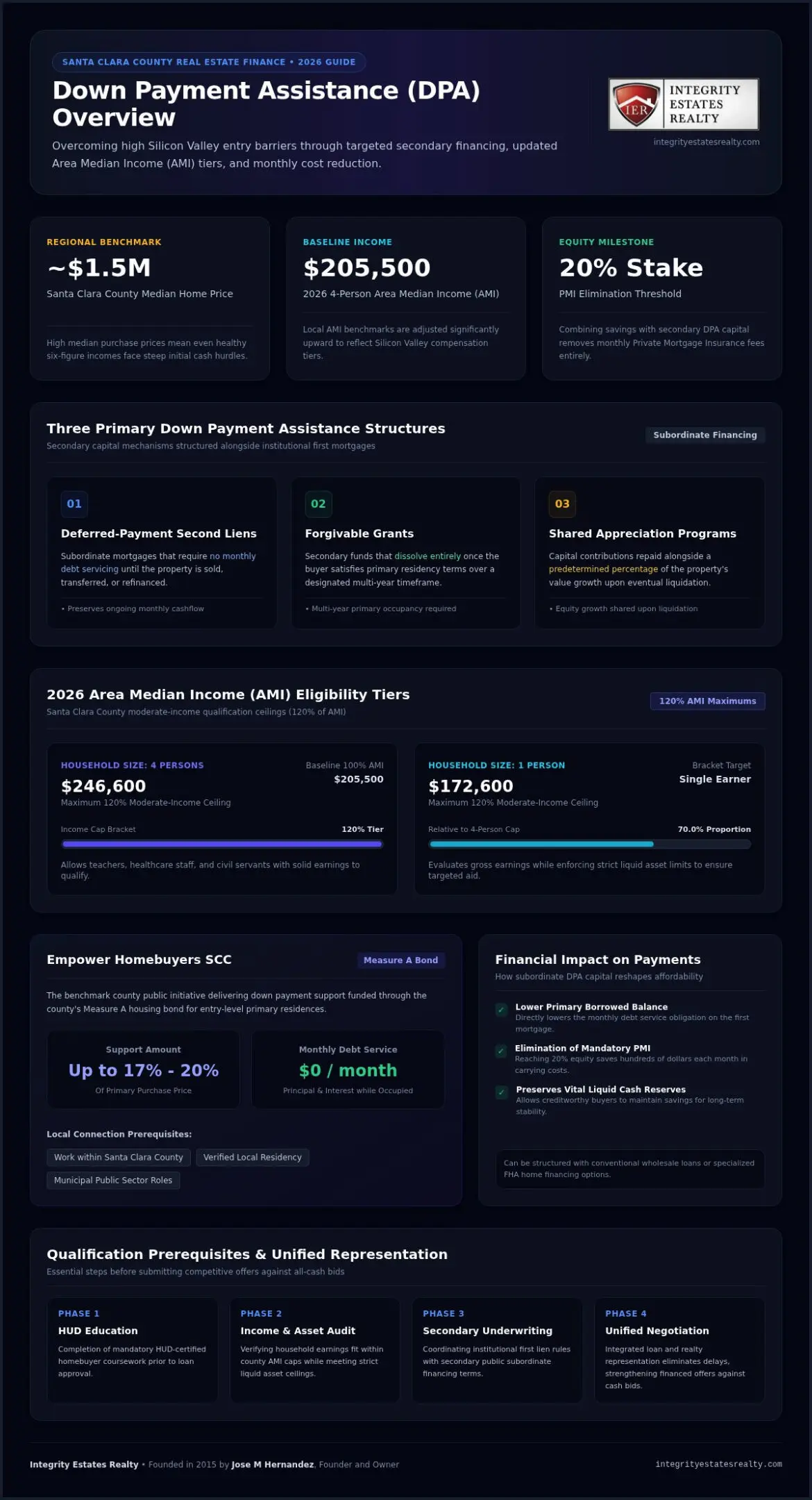
Down payment assistance operates as a financial bridge, providing subordinate second loans or grants that cover essential upfront transaction costs. In standard transactions, a traditional down payment represents an immediate capital hurdle that prevents creditworthy professionals from owning property. By infusing secondary capital into your purchase structure, down payment assistance Santa Clara County programs allow prospective buyers to maintain vital reserves while meeting strict lender equity requirements.
These capital mechanisms generally take one of three distinct forms:
- Deferred-payment second liens: Subordinate mortgages that require no monthly servicing until the property is sold, transferred, or refinanced.
- Forgivable grants: Secondary funds that dissolve entirely once you satisfy primary residency terms over a designated multi-year timeframe.
- Shared appreciation programs: Capital contributions repaid alongside a predetermined percentage of the home’s value growth upon eventual liquidation.
Rather than standing alone, these secondary resources coordinate directly with institutional first liens. You can structure them alongside conventional wholesale products or pair them with specialized FHA home loans in Gilroy to build an accessible, resilient path into homeownership.
The Silicon Valley Affordability Gap and Area Median Income
Area Median Income (AMI) serves as the baseline benchmark calculated annually by housing authorities to determine local program eligibility tiers across high-cost California markets. Because regional compensation metrics reflect Silicon Valley tech dynamics, qualification ceilings sit significantly higher here than standard national averages. That adjustment means middle-class earners, including teachers, healthcare providers, and civil service employees earning solid six-figure wages, routinely qualify for local assistance structures. Even with steady monthly cashflow, accumulating substantial liquid equity remains difficult while paying local rental rates. Expanded AMI thresholds bridge this exact divide, transforming stable income into realized home equity.
How DPA Restructures Monthly Mortgage Payments and Eliminates PMI
Infusing secondary funds directly lowers your primary borrowed balance, resulting in smaller monthly debt service obligations throughout your loan term. When combined with your personal savings to reach a twenty percent equity stake, subordinate assistance eliminates private mortgage insurance (PMI) charges altogether. Removing mandatory mortgage insurance instantly reduces carrying costs by hundreds of dollars each month. Those ongoing monthly savings protect your personal cashflow, ensuring comfortable budget management and accelerated long-term wealth creation.
Empower Homebuyers SCC: The Primary Santa Clara County Program
Funded through the county’s Measure A housing bond, Empower Homebuyers SCC has served as the benchmark public initiative for local entry-level buyers. The program delivers up to 17% or 20% in down payment support toward a primary residence, requiring zero monthly principal or interest payments while you occupy the property. Qualification requires working within county boundaries, establishing verified local residency, or serving in municipal public sector roles. Because county allocations shift and specific program phases sunset, buyers frequently compare these regional parameters against statewide resources like the CalHFA MyHome Assistance Program to secure reliable funding options.
2026 Area Median Income Eligibility Tiers
Eligibility scales directly with household size relative to Santa Clara County benchmarks, where the 2026 four-person Area Median Income sits at $205,500. Moderate-income brackets reach 120% of AMI, allowing a four-person household earning up to $246,600 to qualify, while a single-person household can earn up to $172,600. Beyond gross salaries, administrators examine overall household assets. Strict liquid reserve limitations prevent over-capitalized applicants from accessing public assistance, ensuring down payment assistance santa clara county funds support buyers who maintain steady earnings but lack substantial inherited or saved capital.
The Shared Appreciation Model and Repayment Rules
Under a shared appreciation structure, you repay the original principal balance alongside a share of your property’s market value growth that directly mirrors the percentage of financing you initially received. If assistance covered 20% of your initial purchase price, the county receives 20% of your realized equity appreciation upon resale. Refinancing your primary lien down the road requires formal subordination consent from program administrators, which standardly restricts cash-out transactions to protect public capital. Loan maturity triggers including owner vacancy, property title transfer, or final thirty-year term expiration demand full loan settlement. Partnering with Integrity Estates Realty helps you model shared equity outcomes clearly before committing to a purchase contract.
Evaluating Your Options: County DPA vs. CalHFA State Programs
Statewide initiatives administered through the California Housing Finance Agency deliver structured subordinate financing across every municipality in California. In contrast, local programs concentrate capital exclusively on properties within the borders of Silicon Valley. Choosing between these paths directly dictates your primary mortgage terms, as certain secondary programs require specialized first-lien pricing models. Working with experienced mortgage brokers in Santa Clara County ensures you evaluate which structure optimizes borrowing capacity without restricting long-term financial mobility.
Empower Homebuyers SCC vs. CalHFA Dream for All
While local county programs historically relied on rolling municipal allocations, the CalHFA Dream For All program operates through defined statewide lottery windows. Eligibility standards also diverge sharply. Empower Homebuyers SCC targets general first-time purchasers within standard moderate-income boundaries. Dream For All specifically requires at least one borrower to be a first-generation homebuyer, paired with a higher county income ceiling near $309,000. Both frameworks utilize shared appreciation repayment models, but the state program caps total appreciation payouts, whereas local programs link repayments strictly to your funded equity percentage.
Regional Alternatives: Navigating Bay Area First-Time Buyer Programs
Assistance mechanics change considerably across county lines. San Francisco relies heavily on below-market-rate inclusionary housing lotteries with perpetual deed restrictions that cap future resale prices. Santa Clara County down payment assistance models, alongside targeted San Jose municipal grants, favor market-rate home purchases that preserve private property rights. Buyers assessing relocations between the Peninsula, the South Bay, and northern Monterey County must evaluate how local deed covenants impact their future equity growth before committing to a specific municipality.
Layering First Mortgages with Low-Down-Payment Programs
Pairing secondary assistance with an institutional mortgage requires careful calibration of wholesale underwriting guidelines. First-lien selection determines which secondary tools you can access. Conventional loans readily pair with silent second liens, while government-backed options feature unique Combined Loan-to-Value (CLTV) maximums that can reach up to 105%. Structuring these layered instruments effectively prevents primary lender rate penalties. By calculating the blended capital cost across all recorded liens, qualified buyers maximize down payment assistance santa clara county benefits while preserving clean underwriting approvals.
Qualifying and Applying: Step-by-Step DPA Roadmap for 2026
Securing secondary financing demands a methodical sequence to ensure your purchase offer commands serious attention from sellers. Shopping for real estate before confirming your eligibility often leads to missed contract deadlines or sudden cancellations. Navigating down payment assistance Santa Clara County guidelines requires a proactive four-step framework:
- Step 1: Complete HUD-certified coursework. Every borrower listed on title must finish an approved eight-hour homebuyer education course.
- Step 2: Obtain primary institutional pre-approval. Secure underwriting validation from an approved wholesale lender capable of issuing matching first liens.
- Step 3: Secure formal program clearance. Submit your verified financial file to program administrators to verify asset limits and income brackets before touring active listings.
- Step 4: Draft a coordinated purchase contract. Craft an offer that aligns standard transaction contingencies with secondary-lien processing turnarounds.
Prerequisite Homebuyer Education and Income Documentation
Underwriting teams scrutinize your financial profile well beyond simple credit scores. You’ll supply two consecutive years of federal tax returns, recent W-2 statements, thirty days of pay stubs, and two months of complete bank statements. Program auditors verify that your liquid reserves stay within regulatory thresholds. A frequent compliance trap involves unverified private family gifts. If family members intend to contribute toward closing expenses, those funds must be fully documented with clear gift letters and paper trails to satisfy strict public audit guidelines.
Managing Underwriting Timelines and Contingencies in Competitive Bids
In a fast-moving South Bay market where homes sell in roughly three weeks, listing agents often view subordinate government financing with skepticism. You can neutralize that concern with disciplined escrow planning. Secondary programs require secondary file reviews, meaning purchase agreements should realistically incorporate a 30 to 45-day closing window. A properly structured loan contingency safeguard protects your initial earnest money deposit while administrative underwriters complete their final lien documentation. Clear, direct communication from your lending team to the listing agent proves your funding is rock solid. To structure your financing and submit a winning offer with confidence, connect with the team at Integrity Estates Realty.
Navigating Santa Clara County Real Estate with Integrated Guidance
Navigating layered mortgage structures alongside fast-paced Silicon Valley contract negotiations demands complete operational alignment. Traditional transactions often stall because an outside mortgage officer and an independent real estate agent fail to synchronize crucial loan documentation. Founded in 2015 and independently owned and operated by Jose M Hernandez, Integrity Estates Realty unites licensed residential brokerage representation with wholesale mortgage origination under one roof. This integrated model eliminates costly communication gaps, ensuring your utilization of down payment assistance Santa Clara County programs operates with total speed and transactional precision.
The Strategic Advantage of Unified Realtor and Mortgage Broker Representation
Single-team accountability prevents missed escrow deadlines during multi-tiered underwriting stages. When your buyer representative directly manages your loan packaging, they can speak authoritatively to the seller’s agent about exact funding milestones. That direct dialogue dissolves doubts regarding subordinate liens, proving your purchasing power is rock solid. In addition, centralized document processing accelerates fund releases from administrative agencies, protecting your earnest money deposit while preserving an aggressive closing schedule.
Securing Your Home Across Gilroy, San Jose, and Beyond
Housing dynamics vary widely across the county, from bustling commercial districts in San Jose to the scenic, expansive properties further south. Aligning your borrowing capacity with hyper-local market behavior is vital to submitting winning offers. If you are seeking relative affordability, larger lot sizes, and established neighborhoods, explore curated homes for sale in Gilroy tailored to subordinate and low-down-payment lending options.
Whether you are competing against all-cash bids in central Silicon Valley or establishing family roots in South County, pairing local market insight with wholesale lending resources positions you for success. Take the next step toward confident ownership: Connect with Integrity Estates Realty to review your financing options and begin your home search today.
Step Confidently into Santa Clara County Homeownership
Navigating entry-level real estate in Silicon Valley doesn’t mean facing steep upfront capital hurdles alone. By aligning your household finances with expanding Area Median Income guidelines and selecting the right subordinate structure, you can protect your liquid reserves while purchasing a home your family loves. Securing the right down payment assistance santa clara county program turns an intimidating price landscape into a manageable, long-term wealth-building opportunity.
Your success ultimately hinges on flawless transaction execution. Founded in 2015 and led by experienced broker Jose M Hernandez, Integrity Estates Realty & Mortgage unites residential representation and loan origination under one roof. Backed by deep transactional expertise across Santa Clara, Monterey, and surrounding counties, we ensure your layered financing is cleanly structured, your offers stand out against competing bids, and your escrow closes without surprise delays. Take the definitive step toward local ownership: connect with Integrity Estates Realty & Mortgage to structure your down payment assistance plan today.
Frequently Asked Questions
Do I have to be a first-time homebuyer to qualify for Santa Clara County assistance?
Yes, most local programs require applicants to meet the standard federal definition of a first-time buyer, meaning you haven’t owned a principal residence within the last three years. Displaced homemakers or single parents who previously only owned a home with a former spouse often qualify under designated exceptions. State-level programs like CalHFA Dream For All impose stricter rules, requiring at least one borrower to be a first-generation homebuyer.
What is the maximum income allowed for Empower Homebuyers SCC in 2026?
Income eligibility caps at 120% of the Area Median Income based on household size. For 2026, the moderate-income limit for a four-person household is $246,600, while a single-person household caps at $172,600. Note that Empower Homebuyers SCC reached its sunset date on June 30, 2026, meaning new buyers seeking down payment assistance santa clara county must now target active state alternatives like CalHFA or municipal initiatives.
Can down payment assistance be used to purchase condominiums or townhomes?
Yes, program guidelines permit buyers to acquire single-family residences, townhomes, and condominiums throughout the county. The property must serve as your owner-occupied primary residence. If you purchase a condominium, the development must meet specific lender warrantability standards and structural reserve criteria before subordinate funds receive approval. Manufactured homes on permanent foundations may also be permitted under select state and local guidelines.
How does shared appreciation repayment work when I sell the property?
When you sell your home, you repay the original principal balance alongside a percentage of the home’s market growth. This appreciation share matches the initial financing percentage you received. For example, if assistance funded 20% of your original purchase price, the program receives 20% of the net equity increase upon resale. If your property value remains unchanged or declines, you only owe the initial borrowed principal.
Is down payment assistance compatible with conventional and FHA mortgages?
Most secondary programs pair seamlessly with conventional wholesale mortgages and government-insured loans. However, compatibility depends entirely on primary lender underwriting guidelines. Conventional products often feature specific combined loan-to-value limits, while FHA loans accommodate subordinate liens provided total housing ratios meet standard criteria. A knowledgeable loan originator coordinates both liens simultaneously, ensuring your secondary funding structure complies with primary wholesale mortgage guidelines.
Can I refinance my primary home loan later if I utilize county assistance?
You can refinance your first mortgage, but the secondary lienholder must formally agree to subordinate their loan. Subordination allows your new primary lender to take first position while keeping your assistance lien recorded in second position. Most public programs permit rate-and-term refinances that lower your monthly interest expense. However, cash-out refinances are generally restricted because extracting home equity triggers mandatory repayment of the assistance balance.
How long does it take to get full approval for Santa Clara County DPA programs?
Securing full secondary approval typically requires three to four weeks from initial file submission. Because administrative staff must verify tax filings, reserve accounts, and homebuyer education certificates, secondary-lien reviews add an extra review layer. Structuring a realistic 30 to 45-day escrow window ensures your transaction moves forward smoothly. Completing your financial packaging before submitting purchase offers prevents underwriting bottlenecks during escrow.
Will home sellers reject my purchase offer if I use down payment assistance?
Sellers don’t reject purchase contracts simply because a buyer uses down payment assistance santa clara county programs. Listing agents primarily worry about prolonged escrow timelines or surprise financing cancellations. You overcome that hesitation by submitting fully underwritten pre-approvals and having your mortgage broker contact the listing agent directly. Demonstrating verified funds and tight escrow management reassures sellers that your financing is dependable.