
Financing a Rental Property in Turlock: A 2026 Buyer’s Guide
The loan with the lowest quoted rate may not be the one that makes a Turlock rental property workable. When financing a rental property in turlock, look beyond the rate: your financial profile, the property, and whether realistic rental income can support its full ownership costs all matter.
It’s reasonable to want clarity before making an offer, especially when loan requirements and rent assumptions can vary. This guide explains how to compare potential financing routes, what lenders may assess about you and the property, and how to prepare a buying plan based on property-specific information.
We’ll cover conventional financing, owner-occupied options for eligible buyers, and investor-focused alternatives. Availability and terms must be confirmed with lenders. You’ll also learn what documents and property details to gather, and how to assess rent alongside expenses such as insurance, taxes, maintenance, and potential vacancies. Conditions can differ across North Turlock, Downtown, and the CSU area, so start with verified information for the specific property you’re considering.
Key Takeaways
- Compare financing a rental property in turlock by looking beyond the quoted rate to your finances, the property, and realistic rental assumptions.
- Discuss potential financing pathways with lenders, and confirm current availability and qualification requirements before relying on them.
- Assess the deal separately from loan approval by weighing plausible rent against mortgage obligations and verified operating expenses.
- Prepare for lender conversations by organizing your financial information and gathering details about the property you’re considering.
- Use a step-by-step plan to compare lender options and review the specific property before making an offer.
Financing a Rental Property in Turlock: What Buyers Should Assess First
Before comparing loans, clarify what you’re buying and how you plan to use it. Rental-property financing is for a home intended to generate rental income, rather than one you plan to occupy as your primary residence. That distinction can affect which loan programs a lender considers and how it evaluates you and the property. The broader principles of real estate investing provide useful background, but your financing decision should be grounded in your finances and the property under consideration.
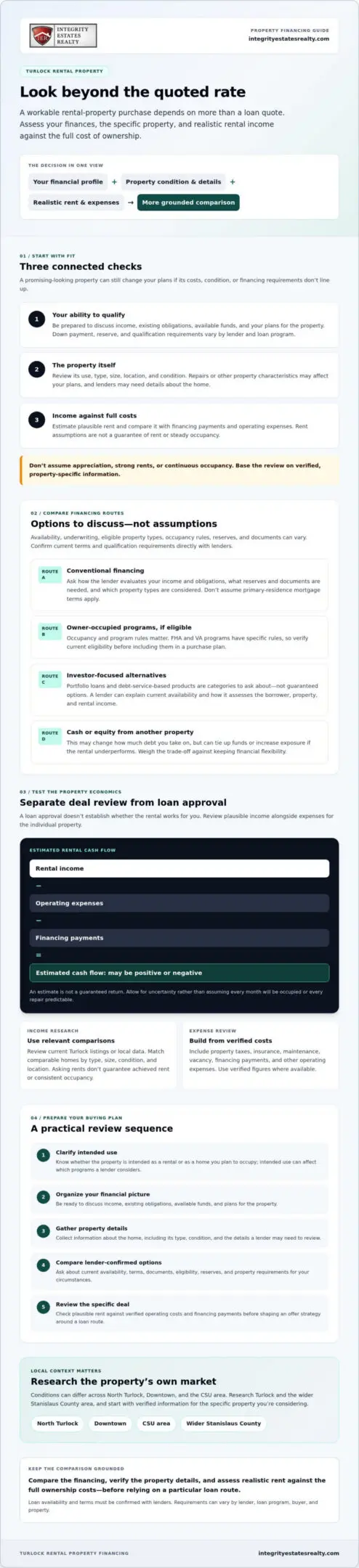
For financing a rental property in turlock, assess three connected factors: your ability to meet lender requirements, the property’s condition and characteristics, and a realistic estimate of its income and expenses. A property that looks promising on paper may still need repairs or carry costs that change your plans. Research Turlock and the wider Stanislaus County area carefully. Don’t assume appreciation, strong rents, or steady occupancy.
How investment-property financing differs from a home purchase
Lenders may assess intended occupancy and property use differently for a rental than for a home you’ll live in. Down payment, reserve, and qualification requirements vary by lender and loan program. Don’t rely on assumptions from a primary-residence purchase or another buyer’s experience. Ask a qualified lender to explain the terms, documents, and eligibility criteria for your circumstances and the property type.
Be ready to discuss your income, existing obligations, available funds, and plans for the property. The lender may also need details about the home itself. Confirm requirements directly before building an offer strategy around a particular financing route.
Turlock property research before choosing a loan
Start with the property, not an assumed rent figure. Review current Turlock listings or local data for comparable homes. Check that each comparison matches the property’s type, size, condition, and location. Asking rents don’t guarantee what a home will rent for or how consistently it will be occupied.
Next, estimate the costs that affect the individual deal, including property taxes, insurance, maintenance, vacancy, and other operating expenses. Use verified figures where available, and allow for uncertainty rather than assuming every month will be occupied or every repair will be predictable.
Rental-property cash flow is the rental income remaining after operating expenses and financing payments are accounted for. It may be positive or negative, and an estimate isn’t a guaranteed return. Reviewing that estimate alongside your finances and the home’s condition gives you a more grounded basis for comparing loans and deciding whether to proceed.
Compare Rental Property Financing Options Available to California Buyers
There isn’t one financing route for every buyer or rental property. As you compare options for financing a rental property in turlock, distinguish between products a lender confirms are available and categories you’re only exploring. Underwriting, eligible property types, occupancy requirements, reserves, and documentation can vary. For broader background on home financing, see this Santa Clara County mortgage broker financing guide.
Conventional financing and lender-specific terms
Conventional financing may be worth discussing for an investment property, but don’t assume the terms of a primary-residence mortgage apply. Ask lenders how they evaluate your income and obligations, what reserves and documents they require, and which property types they consider. A qualified lender can explain the specific terms and eligibility criteria for your circumstances.
Alternative financing routes to discuss with a lender
Portfolio loans and debt-service-based products are categories to ask about, not guaranteed options. A lender can explain whether either is currently available and how it evaluates the borrower, property, and rental income. FHA and VA programs have occupancy and program rules, so verify current eligibility before considering them for a purchase plan.
Using cash or equity from another property may change how much debt you take on for the purchase, but it can also tie up funds or increase your exposure if the rental underperforms. Weigh that trade-off against the value of keeping financial flexibility, and review the details with qualified financial and lending professionals. Before becoming a landlord, consult the State of California Department of Justice’s overview of California landlord-tenant law as an official starting point on relevant topics.
| Route to explore | Qualification basis | Documentation and flexibility | Questions to verify |
|---|---|---|---|
| Conventional mortgage | Borrower finances and property review | Requirements vary by lender and program | What reserves, property types, and terms apply? |
| Portfolio loan | Criteria set by the lender | May differ from conventional underwriting | Is it available, and how is the property assessed? |
| Debt-service-based product | May consider property income alongside other factors | Income and documentation rules vary | How is rent evaluated, and what records are needed? |
| Cash or home equity | Available funds or equity and individual circumstances | Can preserve or reduce liquidity, depending on the approach | How would this affect reserves and other obligations? |
Integrity Estates Realty provides mortgage services through lender relationships, helping buyers compare potential pathways without guaranteeing approval or availability. Buyers considering a Turlock property can explore mortgage guidance and residential representation as they evaluate next steps.
How to Evaluate a Turlock Rental Deal Beyond the Loan Approval
A lender’s approval indicates that a loan meets its underwriting criteria. It doesn’t establish that the purchase is affordable for you or suits your investment goals. When financing a rental property in turlock, assess the property’s potential income and costs separately, using evidence for that home rather than broad claims about the region.
Build a property-level income and expense picture
Start with comparable rentals that match the property’s type, size, condition, and location. Record the source and date for each rent figure, and treat advertised rents as evidence to investigate, not guaranteed income. Then make a conservative estimate that accounts for possible vacancy and includes:
- Expected rent, supported by relevant local comparisons
- Property taxes and insurance, verified for the specific property
- Repairs, maintenance, and other ongoing operating costs
- Mortgage payments and any other financing obligations
Use reasonable assumptions, not the most favorable scenario. A repair, an unoccupied period, or a change in expenses can alter the result. Projected cash flow, occupancy, and appreciation are estimates, not certain outcomes. California’s Department of Housing and Community Development lists California financing programs related to housing development. Check each program’s purpose and eligibility rather than assuming it applies to an individual rental purchase.
Match the financing structure to your investment plan
Consider how the proposed payment structure fits your timeline, the funds you want to keep accessible, and any lender conditions. Using more available cash may affect your flexibility to cover repairs or other obligations. Ask how the strategy would hold up if rent were lower than expected, expenses rose, or your personal income changed.
Compare financing terms with your intended ownership period and your capacity to manage periods when the property’s income doesn’t cover costs. Broader property-investment considerations also appear in this Gilroy commercial real estate investor strategy guide. Use it as additional context, while evaluating Turlock properties on their own evidence.
Before committing, review the assumptions behind your estimate and identify which figures still need confirmation. Loan approval is one input, not a verdict on the deal. A measured decision connects lender terms to verified property costs, plausible rental income, and your own comfort with uncertainty.
Prepare for Rental Property Financing in Turlock Step by Step
A clear preparation process can make lender conversations more productive and help you spot unanswered questions before making an offer. For financing a rental property in turlock, follow these steps while confirming requirements directly with each lender. Criteria vary, so don’t treat another buyer’s experience or a general checklist as a promise of qualification.
- Review your financial position. Organize an overview of your income, assets, debts, credit profile, and funds available for the purchase and reserves. This gives a lender context for discussing potential pathways, but it doesn’t replace the lender’s review.
- Gather property and purchase details. Be ready to describe the property type, intended use, purchase plan, and known condition concerns. Lenders may request different documents, so ask for a current, lender-specific list rather than assuming one universal set applies.
- Check the Turlock rental assumptions. Research comparable listings or local data that match the property’s type and location. Note the source and date, then verify relevant property details, taxes, insurance, and potential operating costs. Keep rent and vacancy assumptions cautious, and identify figures that still need confirmation.
- Ask lenders the same questions. Compare how each lender assesses qualification, what documentation it requires, which property types it may consider, and what loan structures are available. Ask about timing and conditions, and request written terms so you can compare the underlying assumptions, not just headline rates.
- Review the deal before proceeding. Put the proposed financing alongside your property-level income and expense estimate. Consider whether the plan remains manageable if expenses rise, rent differs from your estimate, or your personal financial circumstances change.
Keep a simple comparison sheet with each lender’s answers, requested materials, and unresolved questions. This makes differences easier to see and helps you avoid relying on assumed qualification criteria. Revisit your property research as details become available, especially if rent comparisons, insurance information, or estimated operating costs change.
Integrity Estates Realty provides mortgage services through lender relationships, including conventional loan processing and FHA and VA loan origination. To discuss financing questions and compare potential lender pathways for a Turlock purchase, contact Integrity Estates Realty. Lenders determine eligibility and terms, so confirm any route for your circumstances and the specific property.
Choose a Financing Partner for Your Turlock Rental Property
The right advisor should make the decision process clearer, not promise an outcome. When financing a rental property in turlock, a mortgage and real estate advisor can help you understand potential lender pathways and connect them to your purchase goals. The lender makes underwriting and approval decisions, and current eligibility and product availability must be confirmed for your situation.
Questions to ask a mortgage and real estate advisor
Before moving forward, make sure you understand who is responsible for each part of the process. Ask direct questions and look for clear answers about scope, assumptions, and limitations.
- Which lender pathways might fit my borrower profile and property, and are they currently available through your lender relationships?
- Who would handle mortgage origination or conventional loan processing, residential property representation, and communication with lenders?
- What information supports the proposed financing approach, and which assumptions about the property or rental income still need verification?
- How is the process handled, what compensation may apply, and what limitations should I understand before proceeding?
Integrity Estates Realty is a Gilroy-based California real estate agency and mortgage brokerage. Its stated service locations include Salinas, Seaside, Soledad, Prunedale, San Jose, Gilroy, Hollister, San Francisco, Hayward, San Leandro, Livermore, Merced, Los Banos, Delhi, Gustine, Stockton, Tracy, Modesto, Turlock, Sacramento, Madera, Fresno, and Clovis. Services include residential real estate representation and mortgage services through lender relationships, including FHA and VA loan origination, conventional loan processing, jumbo loan origination, and refinancing. Availability and terms depend on lender review, so ask what applies to your particular purchase rather than assuming every option is available.
Jose M Hernandez owns and operates Integrity Estates Realty. A useful conversation should connect your financing questions with the specific property and your goals, while keeping lender decisions and property assumptions transparent.
Take the next step with a property-specific plan
Before discussing a property, bring together your financing priorities, the rental and operating assumptions you’ve verified, and any questions lenders haven’t resolved. That gives the conversation a practical starting point without treating approval or projected investment performance as guaranteed.
If you’re weighing a Turlock property and want to discuss your goals and financing questions, talk with Integrity Estates Realty about your Turlock property goals.
Move Forward With a Clearer Financing Plan
Choosing financing for a rental property means looking beyond loan approval. Compare lender pathways against your borrower profile, then test the property’s potential income against verified expenses using cautious assumptions. Current, property-specific information can help you judge whether a purchase fits your goals, rather than relying on broad claims about Turlock’s market.
Integrity Estates Realty provides real estate and mortgage brokerage guidance, with mortgage origination through lender relationships. Turlock is among the firm’s stated California service locations. Confirm any financing option, eligibility, and terms with the lender for your circumstances and the property.
If you’re considering financing a rental property in turlock, bring your goals, property details, and unanswered lender questions into the conversation. Discuss your Turlock rental property financing questions with Integrity Estates Realty and take your next step with care.
Frequently Asked Questions
Can I use a conventional loan to finance a rental property in Turlock?
Yes, a conventional mortgage may be an option, but availability and terms depend on the lender, your finances, and the property. For financing a rental property in turlock, ask whether the lender considers the home’s intended rental use and property type, and confirm its current qualification and documentation requirements. Don’t assume terms for a primary residence apply. A lender can explain which conventional pathway, if any, fits your specific purchase.
How much down payment do I need for a rental property?
There isn’t one down payment amount for every rental purchase. The required amount can vary by lender, loan program, borrower profile, property type, and intended occupancy. Ask lenders for written estimates of the funds required and clarify whether they also expect reserves. Before making an offer in Turlock, understand how the down payment affects the cash you’ll have left for repairs, vacancies, and other ownership expenses.
Can rental income help me qualify for an investment-property mortgage?
It may, depending on the lender and loan program, but don’t assume projected rent will be counted in full or accepted without supporting information. Ask how the lender evaluates rental income, what evidence it requires, and whether it uses market rent, a lease, or another basis. Separately, compare the property’s plausible income with its expenses. Lender calculations don’t guarantee the rental will be affordable or perform as expected.
What do lenders look at when financing a rental property?
Lenders may review your income, assets, debts, credit profile, available funds, and reserves, along with the property’s type, condition, intended use, and rental assumptions. Exact criteria and documents vary by lender and program. For a Turlock property, ask what details the lender needs about the home and how it will assess any proposed rental income. Confirm requirements directly rather than relying on general qualification rules.
Is a debt-service-based loan available for a Turlock rental property?
Possibly, but availability isn’t guaranteed and depends on lender relationships, current offerings, and the details of your application. Ask lenders whether they offer a debt-service-based product for the property you’re considering, how they evaluate rental income and expenses, and what documentation they require. Compare written terms and assumptions with other financing pathways. Don’t treat a projected rent figure or preliminary discussion as approval.
Should I use home equity to finance a rental property?
Using home equity may provide funds for a purchase, but it also changes your financial exposure and can reduce the equity or liquidity available for other needs. Consider how the added obligation would fit your household finances if the rental has vacancies, needs repairs, or earns less than expected. Ask a qualified lender to explain the terms and discuss the risks with an appropriate financial professional before deciding.
What costs should I include when assessing a Turlock rental property?
Include the mortgage payment, property taxes, insurance, maintenance, repairs, vacancy assumptions, and other ongoing operating expenses relevant to the specific home. Verify figures using current property information and local evidence, and note the date and source of your rent comparisons. Ask for estimates where costs aren’t yet known, and use conservative assumptions. A complete assessment helps you judge the deal independently of whether a lender approves the loan.