
Gilroy Buyer Closing Costs: 2026 Budgeting Guide
The final number you see on your Closing Disclosure shouldn’t feel like a jump scare, yet many California homebuyers are blindsided by five-figure fees they never saw coming. Buying a home in our beautiful Garlic Capital is a major milestone, but the financial sticker shock at the finish line can quickly turn excitement into anxiety. You’ve worked hard to save for your down payment and found the perfect neighborhood, only to realize there’s a complex web of Northern California customs waiting for you at the table. Accurately budgeting for buyer closing costs in Gilroy is essential to ensuring your 2026 move is a success rather than a stress test.
We believe that transparency is the foundation of a reliable partnership. That’s why we’re pulling back the curtain on every line item, from Santa Clara County transfer taxes to the specific title insurance norms that define our local market. This guide provides a clear checklist of what you’ll owe, explains which fees are actually negotiable, and helps you budget for property tax impounds with absolute confidence. You deserve to walk into your new home with your eyes wide open and your finances firmly in control. Let’s replace uncertainty with a methodical plan for your future.
Key Takeaways
- Master the “2% to 5% rule” to accurately estimate your total out-of-pocket expenses before you ever sign a contract.
- Navigate Santa Clara County customs with ease by understanding how escrow fees and title insurance are typically shared between parties.
- Learn how to calculate the closing costs for buyer in gilroy, including lender fees, third-party appraisals, and essential local assessments.
- Discover how the timing of your closing date can significantly shift your prepaid interest and property tax impound requirements.
- Uncover the strategic benefits of a dual-service real estate and mortgage model in streamlining communication and protecting your bottom line.
Understanding Closing Costs for Buyers in Gilroy: What to Expect
Closing costs represent the final hurdle between you and the keys to your new front door. They aren’t just arbitrary fees. Instead, they’re a necessary collection of taxes, insurance premiums, and administrative requirements that solidify your ownership. For those researching the closing costs for buyer in gilroy, a broad Understanding Closing Costs provides the necessary context for how these funds are distributed. In our local market, these expenses ensure that every detail of your high-stakes transaction is ethically and legally sound.
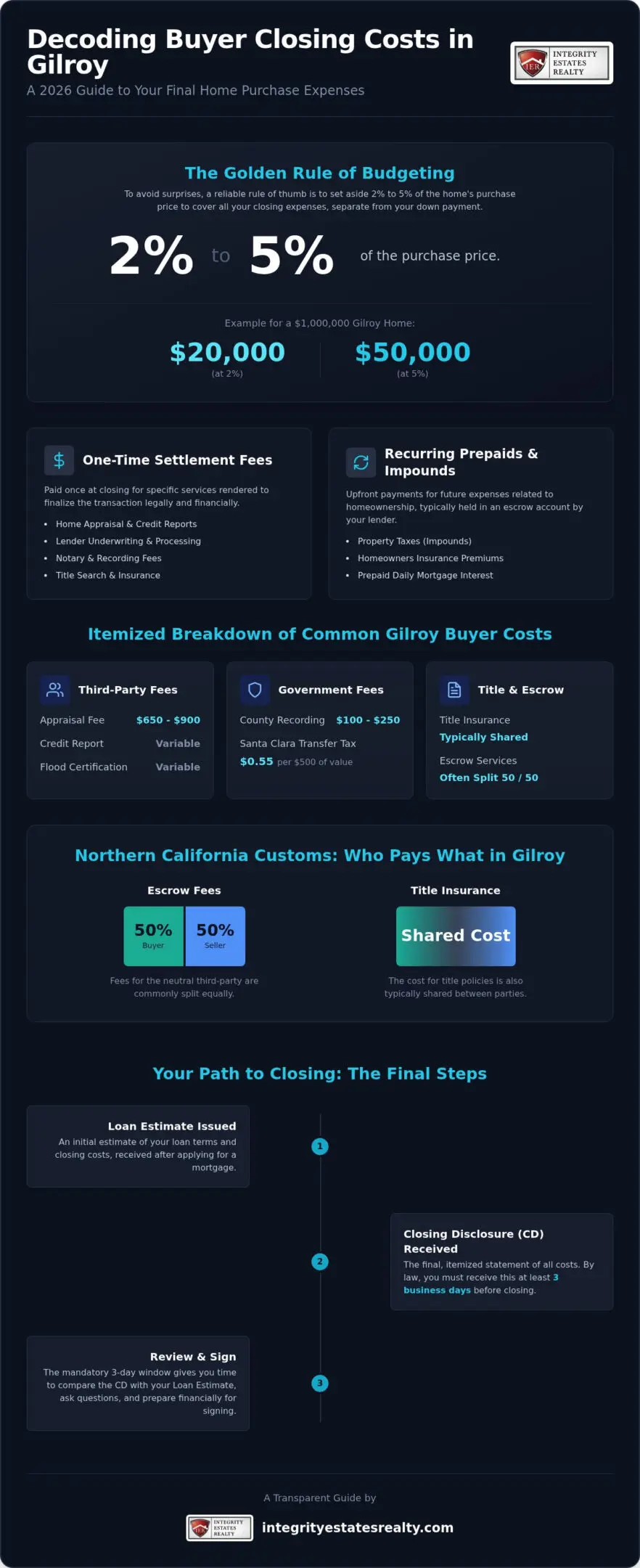
Budgeting for a home in Santa Clara County requires a precise approach. A reliable rule of thumb is to set aside between 2% and 5% of the home’s purchase price to cover your closing expenses. While this is separate from your down payment, it’s just as vital for a smooth transition. Because Gilroy properties often carry significant value, even a small percentage shift can impact your liquid savings, making early calculation a priority for any serious buyer.
You’ll encounter two distinct categories at the closing table: one-time settlement fees and recurring prepaids. Understanding the difference helps you see exactly where your money is going:
- One-time fees: These include specific services like the home appraisal, credit reports, and notary signatures.
- Recurring prepaids: These are upfront payments for property taxes and homeowners insurance that fund your future escrow account.
The way these costs are distributed often shifts based on Gilroy real estate market trends. In certain market cycles, savvy buyers can negotiate for seller credits to offset these expenses. Understanding the current climate allows us to position your offer strategically, potentially reducing your out-of-pocket requirements while maintaining a competitive edge.
Why Closing Costs Matter for Your 2026 Budget
Financial clarity is the antidote to the stress often found in real estate. Your total cash-to-close requirement is the ultimate figure you must prepare for, and accurately forecasting the closing costs for buyer in gilroy ensures your liquid assets remain protected. Seeing these numbers clearly well before the deadline prevents the “escrow anxiety” that blindsides many participants. Jose M Hernandez emphasizes early disclosure as a core value of the brand. By acting as an ethical anchor, we provide the transparency you need to feel confident in your 2026 financial planning, treating your purchase as a curated lifestyle choice rather than just a transaction.
The Role of the Closing Disclosure (CD)
The Closing Disclosure serves as the definitive map of your financial commitment. This document is the final five-page form that outlines your exact loan terms and costs. Under federal guidelines, you’ll receive this at least three business days before signing. This cooling-off period is your opportunity to compare the final numbers with your original Loan Estimate. It’s a purposeful pause in the process, designed to give you the confidence that every dollar is accounted for before you commit to your future in Gilroy.
Itemized Breakdown: Lender, Title, and Escrow Fees in Gilroy
Moving from a broad budget to an itemized list is where the financial reality of your purchase takes shape. Every professional involved in your transaction provides a specific service that ensures your investment is legally and financially secure. Lender fees typically cover the administrative work of your loan, including underwriting and processing. These administrative costs are paired with third-party fees, such as the appraisal, which in 2026 costs between $650 and $900 for a standard single-family home. You’ll also see smaller charges for credit reports and flood certifications. The official Closing Disclosure provides the final, granular detail of these amounts, allowing you to verify every penny before signing.
Government and administrative fees also play a role in the closing costs for buyer in gilroy. Santa Clara County charges a documentary transfer tax of $0.55 per $500 of the property’s value. Additionally, recording fees to officially file your deed and deed of trust usually range from $100 to $250. Escrow fees, which pay for the neutral third party that handles the exchange of funds, are often split 50/50 between the buyer and seller in our region. This collaborative approach is a hallmark of Northern California real estate customs, emphasizing a fair start for both parties.
Title Insurance: Protecting Your Gilroy Investment
Title insurance is a non-negotiable safeguard for any financed purchase in Santa Clara County. You’ll encounter two policies: the Lender’s Policy, which protects the bank’s interest, and the Owner’s Policy, which protects your equity. While customs vary by region, it’s common in Santa Clara County for the buyer to pay for both policies. This ensures that no hidden liens or ownership disputes can threaten your lifestyle in your new home. Our team acts as your steadfast guide, helping you identify which fees are standard and which can be optimized through our dual-service model.
FHA and VA Specific Closing Cost Rules
If you’re utilizing government-backed financing, your fee structure looks slightly different. VA buyers benefit from strict protections that prohibit them from paying certain “non-allowable” fees, such as specific administrative or processing charges. For those exploring FHA home loans in Gilroy, you must account for the Upfront Mortgage Insurance Premium (UFMIP). While this can often be rolled into the loan amount, it remains a critical factor in your overall debt-to-income calculations. These programs often allow for significant seller concessions, which can be a powerful tool for reducing your initial cash out-of-pocket when navigating the closing costs for buyer in gilroy.
Northern California Customs: Who Pays What in Gilroy?
While California state law remains silent on the allocation of settlement fees, the “Gilroy way” is shaped by decades of Santa Clara County tradition. These local customs serve as the starting point for any purchase agreement, providing a framework for how expenses are shared. A primary example is the escrow fee, which covers the neutral management of your transaction funds. In our region, this fee is almost universally split 50/50 between the buyer and seller. This shared responsibility reflects the collaborative nature of our local market. Understanding these nuances is a key part of calculating the closing costs for buyer in gilroy, as it prevents you from budgeting for expenses that the seller traditionally covers.
The County Transfer Tax is another significant line item that follows regional patterns. In Santa Clara County, this tax is calculated at $0.55 per $500 of the property’s value. Customarily, this is a seller’s expense in Gilroy, though it remains a negotiable point in any contract. In the 2026 market, your ability to adhere to or push back on these customs depends heavily on the specific competition for a property. When a listing receives multiple offers, a buyer might choose to pay fees that are traditionally the seller’s responsibility to make their bid more attractive. Conversely, in a slower market, you have more leverage to request that the seller cover a larger portion of the total bill.
The Santa Clara County Standard
Beyond the major taxes, smaller fees also follow local patterns. Sellers typically pay for the Natural Hazard Disclosure (NHD) and the initial termite inspection report. However, Gilroy’s local ordinances can sometimes introduce specific recording or inspection requirements that vary from neighboring cities. Working with a regional expert like Integrity Estates ensures you aren’t overpaying for “standard” fees. We leverage over 20 years of local experience to audit your settlement statement, ensuring every charge aligns with current Santa Clara County practices. Our role is to be your steadfast guide, protecting your interests while respecting the local culture that makes this area desirable.
Negotiating the Split
Custom is not a rule. If a property has been on the market for an extended period, you might successfully request a seller credit to offset your 2026 expenses. A seller concession is a contribution from the seller that pays for a portion of the buyer’s closing costs. This strategy can significantly lower your initial cash-to-close, allowing you to preserve savings for future home improvements or unexpected repairs. Whether you are navigating a competitive bidding war or a quiet negotiation, we act as your ethical anchor, ensuring your offer is both competitive and financially sound. This strategic approach is vital when managing the closing costs for buyer in gilroy.
Prepaids, Impounds, and the ‘Gilroy Factor’ in Property Taxes
Beyond the standard service fees, a significant portion of your cash-to-close involves “prepaids.” These are not fees paid to third parties, but rather upfront payments for your own future expenses, including homeowners insurance, mortgage interest, and property taxes. The timing of your signing plays a major role here. If you close at the end of the month, your prepaid interest requirement is minimal. However, closing earlier in the month requires you to pay interest for the remaining days, which can noticeably increase the closing costs for buyer in gilroy. We help you time your closing strategically to align with your liquid cash goals.
Most lenders in Santa Clara County require an “impound account” to manage these recurring costs. This account acts as a financial cushion, where the lender collects several months of property taxes and insurance premiums at the closing table. This ensures these critical bills are always paid on time, providing peace of mind for both you and the bank. While it feels like a large initial layout, it effectively streamlines your monthly budgeting for the years to come.
Budgeting for Property Tax Prorations
In Gilroy, property taxes are a foundational part of your 2026 financial plan. You’ll likely see a “proration” on your settlement statement, where the seller is credited for taxes they’ve already paid for the current period. While the baseline tax rate in Santa Clara County is approximately 1.25%, new owners should always prepare for a supplemental tax bill. This occurs when the county reassesses the property at your new purchase price, often resulting in a one-time bill for the difference in value. It’s a common “Gilroy Factor” that we ensure our clients are prepared for well in advance.
Grants and Credits for Closing Costs
If the total cash needed feels daunting, several programs are designed to assist local buyers. Programs like Empower Homebuyers SCC offer down payment and closing cost assistance for those who qualify, helping to bridge the gap in our high-value market. Additionally, the ZIP (Zero Interest Program) can be a powerful tool to offset your initial expenses. If your down payment is less than 20%, you must also account for private mortgage insurance (PMI), which protects the lender but allows you to enter the market sooner. Our dual-service model ensures you understand how these credits integrate with your loan structure. To see how these programs fit your specific situation, contact our team for a personalized consultation today.
The Integrity Estates Advantage: Streamlining Your Gilroy Purchase
The process of calculating the closing costs for buyer in gilroy shouldn’t feel like a series of disconnected hurdles. In many transactions, the real estate agent and the mortgage lender operate in separate silos. This often leads to communication gaps that can result in expensive delays or overlooked credits. Integrity Estates Realty, led by Jose M Hernandez, eliminates this friction through a unique dual-service model. By acting as both your real estate agency and your mortgage brokerage, we serve as an ethical anchor. We provide a unified perspective that ensures your financial interests are protected from the first showing to the final signature.
Our deep-rooted pride in the Gilroy community means we understand the specific nuances of local neighborhoods. This regional expertise allows us to forecast costs with a level of accuracy that outsiders simply cannot match. We don’t view your purchase as a mere transaction. It’s a sophisticated lifestyle upgrade, and our goal is to make the transition as calm and purposeful as possible. By bridging the gap between your physical asset and your personal dream, we turn a complex financial journey into a collaborative partnership.
Efficiency Through Dual Expertise
Precision matters when reviewing your final documents. Having your Realtor and Mortgage Broker in one office simplifies the Closing Disclosure review significantly. We can cross-reference your loan terms with your purchase contract in real time, ensuring every seller concession and fee split is recorded correctly. This integrated approach reduces the risk of financing-related delays that often lead to “per diem” interest charges. You aren’t just another file in a stack. You’re a partner who deserves a streamlined experience where redundant fees are eliminated and transparency is the standard.
Your Next Steps in Gilroy
As you approach your closing date, staying organized is the best way to maintain peace of mind. About 30 days before closing, you should finalize your homeowners insurance policy and ensure your down payment funds are liquid and ready for transfer. It’s also the ideal time to request a “Preliminary HUD-1” or an estimated settlement statement. This document provides a “near-final” look at the closing costs for buyer in gilroy, allowing us to resolve any discrepancies before the three-day Closing Disclosure window begins.
Preparation is the key to a successful 2026 move. If you’re ready to move forward with a team that values integrity and local expertise, schedule a consultation with Integrity Estates Realty to get your personalized closing cost estimate. We are here to guide you through every line item, ensuring you step into your new Gilroy home with absolute confidence and financial clarity.
Securing Your Future in the Garlic Capital
Entering the 2026 real estate market with a clear financial map is the most effective way to protect your investment. You now understand that while Santa Clara County customs provide a baseline, your final settlement is a strategic negotiation rather than a fixed expense. By mastering the distinction between one-time fees and recurring prepaids, you’ve moved from uncertainty to total control. Our dual-service model is designed to simplify this journey, ensuring that your transition into a new home is as seamless as it is sophisticated.
With over 20 years of Santa Clara County real estate authority, Integrity Estates Realty acts as your steadfast guide. Jose M Hernandez and our team offer integrated mortgage and realty services that maximize efficiency and eliminate the communication gaps that often plague traditional transactions. Don’t leave your final numbers to chance. To gain absolute clarity on the closing costs for buyer in gilroy, take the next step in your journey today.
Request a Personalized Gilroy Closing Cost Estimate from Integrity Estates to ensure your budget is as precise as your vision. We’re honored to be your partner in this major life decision. Your new lifestyle in Gilroy is waiting, and we’re here to help you reach it with complete peace of mind.
Frequently Asked Questions
Are closing costs negotiable for buyers in Gilroy?
Yes, almost every fee at the closing table is subject to negotiation within your purchase contract. While local customs in Santa Clara County provide a traditional starting point, you can request that the seller pays a portion of your expenses through a credit. We act as your steadfast advocate during this process, ensuring you aren’t paying for “standard” fees that could be optimized or shared with the other party.
How much should I budget for closing costs in Santa Clara County?
You should generally budget between 2% and 5% of the home’s purchase price for your total settlement expenses. This range covers lender fees, title insurance, and government taxes. For a California home at the 2026 median price of $905,000, this equates to roughly $18,100 to $45,250. Having this cash ready well in advance prevents last-minute stress during the final signing phase of your transaction.
Does the seller ever pay for the buyer’s closing costs in California?
Sellers can and often do contribute to a buyer’s expenses through a “seller concession.” This is a credit given at the close of escrow to pay for specific settlement fees, such as title insurance or loan origination costs. In a competitive market, these requests might make an offer less attractive, but they remain a powerful tool in balanced markets to reduce your initial cash out-of-pocket.
What is the difference between a down payment and closing costs?
Your down payment is the initial equity you put into the home, while closing costs are the fees paid to facilitate the legal and financial transfer of the property. These are two separate financial requirements. The closing costs for buyer in gilroy include professional services like appraisals and inspections, along with county taxes. You must account for both when calculating your total cash-to-close requirement for your move.
Can I roll my closing costs into my mortgage loan?
It depends on your specific loan program and the lender’s guidelines. While most conventional loans require these costs to be paid in cash at closing, some government-backed programs or specific lender credits allow for different structures. Alternatively, you can negotiate a higher interest rate in exchange for a lender credit that covers your fees. We analyze your financial profile to determine which strategy best protects your long-term wealth.
What are ‘prepaid’ items in a real estate closing?
Prepaids are upfront payments for recurring expenses that you’ll owe as a homeowner. These typically include the first full year of homeowners insurance, prepaid mortgage interest, and property tax impounds. Lenders collect these funds to establish an escrow account, ensuring these essential bills are paid on time. They’re distinct from one-time service fees like notary or recording charges because they’re payments for your own future ownership costs.
Why are escrow fees split differently in Northern vs. Southern California?
Regional customs dictate these splits because California law doesn’t mandate a specific payment structure. In Santa Clara County and most of Northern California, it’s customary for the buyer and seller to split escrow fees 50/50. In Southern California, the seller often pays the majority of these costs. Understanding these local norms is vital for accurate 2026 financial planning, especially if you’re relocating from a different part of the state.
How does my choice of loan type (FHA vs. Conventional) affect my closing costs?
FHA loans require an Upfront Mortgage Insurance Premium (UFMIP), which adds to your total costs, although it can often be financed into the loan amount. Conventional loans may avoid this specific premium but might have different private mortgage insurance (PMI) rates. When managing the closing costs for buyer in gilroy, we compare these programs side-by-side to find the most efficient path for your budget and long-term financial goals.