
Home Appraisal Checklist for Sellers in Hayward: Maximize Your Value in 2026
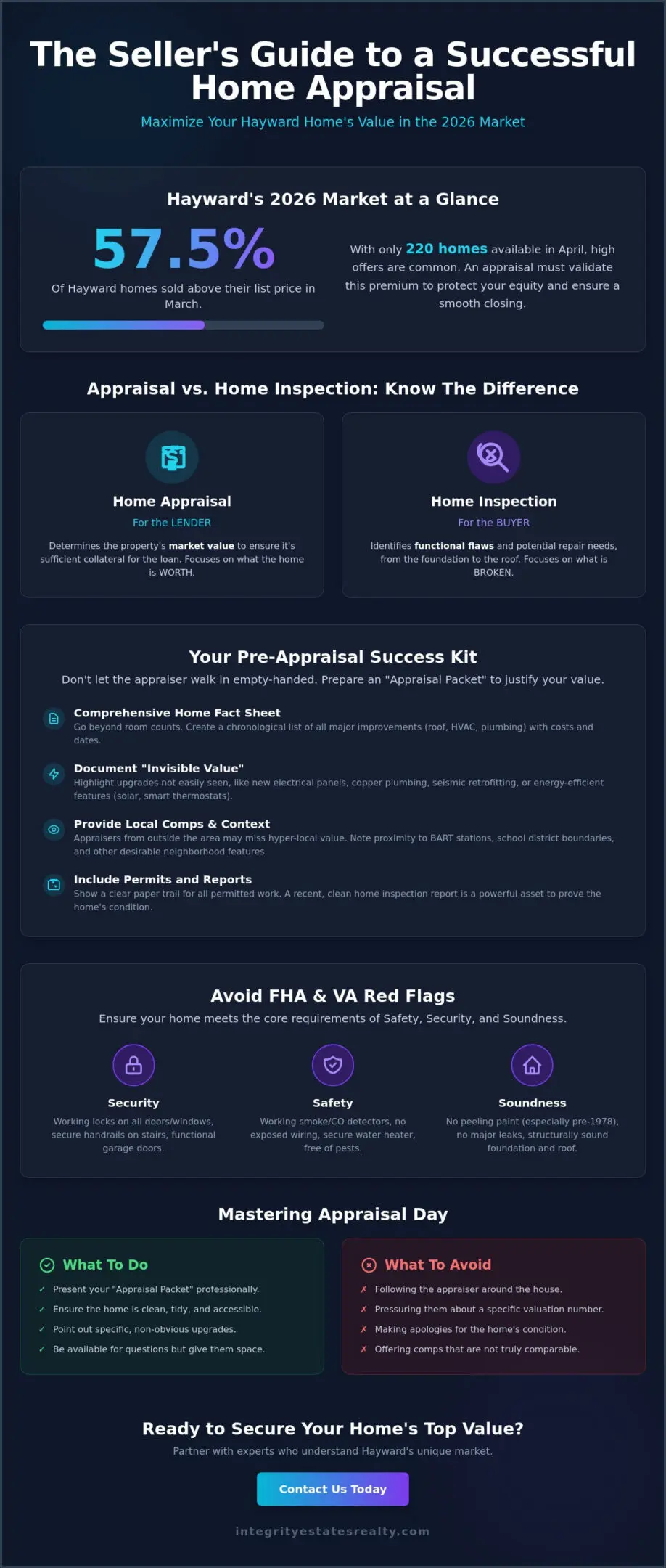
Did you know that 57.5% of homes in Hayward sold above their list price in March 2026? While that is fantastic news for your bottom line, it also places immense pressure on the valuation process to bridge the gap between a high offer and the bank’s final number. To protect your equity, you need a comprehensive home appraisal checklist for sellers in hayward that accounts for the latest market trends and regulatory shifts. It’s natural to feel a bit of anxiety when an appraiser arrives; after all, their report can either pave the way to a smooth closing or stall your sale with unexpected repair demands.
We understand that the distinction between a standard inspection and a formal appraisal often feels blurry, especially when you’re worried about FHA or VA safety requirements. You deserve a partner who views this process as a strategic “valuation interview” rather than a passive inspection. This guide provides the clarity you need to prepare your property effectively, from navigating the May 2026 VA Minimum Property Requirement updates to highlighting the specific upgrades that resonate in the East Bay. We’ll walk through exactly what you need to fix and document to ensure your home meets or exceeds its contract price without a single required repair.
Key Takeaways
- Distinguish between a home inspection and an appraisal to understand how lenders safeguard the loan amount and your final sale price.
- Learn why you shouldn’t let an appraiser walk in empty-handed and how to document “invisible value” like hidden system upgrades.
- Utilize our home appraisal checklist for sellers in hayward to address small, high-impact repairs that prevent appraisers from nickel-and-diming your home’s value.
- Identify and resolve FHA and VA safety red flags before the visit to ensure your property meets the core requirements of safety, security, and soundness.
- Master appraisal day etiquette to provide helpful information without appearing pushy, ensuring a professional and smooth valuation process.
Understanding the Home Appraisal Process in Hayward’s 2026 Market
Hayward’s housing market in 2026 remains a competitive arena for sellers. With only 220 homes available in April, buyers are often willing to pay a premium to secure a spot in the East Bay. However, a high offer only matters if the bank agrees with the price. An appraisal is the lender’s primary tool to verify that the property serves as sufficient collateral for the loan. It isn’t just a formality; it’s a rigorous financial audit that protects the bank from overextending. For anyone preparing to sell, mastering a home appraisal checklist for sellers in hayward is the first step in ensuring that a contract price of $809,000 or higher actually makes it to the closing table. Using a Understanding the Home Appraisal Process helps you grasp how professional valuations provide an objective foundation for these high-stakes transactions.
Appraisal vs. Home Inspection: The Critical Difference
It’s common to confuse an appraisal with a home inspection, but their purposes are distinct. A home inspector works for the buyer, examining crawl spaces and testing electrical panels to identify functional flaws. In contrast, an appraiser works for the lender to determine market value. They rely heavily on the “Sales Comparison Approach,” analyzing similar properties that have sold recently within the city. While an inspector looks at what is broken, an appraiser looks at what the home is worth in the current climate. A clean inspection report can actually be a powerful asset to show an appraiser, as it provides professional proof that the home’s condition supports its valuation.
Why Hayward Local Knowledge Matters for Appraisers
Hayward is a unique tapestry of micro-markets. A 1940s bungalow near the downtown core requires a completely different valuation perspective than a contemporary build in the Hayward Hills. Local nuances, such as proximity to the South Hayward BART station or the traffic patterns near the San Mateo Bridge approach, can swing a valuation by thousands of dollars. These factors dictate the daily rhythm of life and, consequently, the desirability of a property.
Appraisers from outside the East Bay sometimes miss these details. They might not realize that certain neighborhoods west of Mission Blvd carry a different lifestyle premium than those nestled near California State University, East Bay. Our home appraisal checklist for sellers in hayward encourages you to highlight these hyper-local benefits. Whether it’s the specific seismic bracing common in our region or the nuances of local school district boundaries, providing this context ensures the appraiser sees the full picture of your home’s value within the specific Hayward landscape.
The Seller’s Pre-Appraisal Homework: Documentation and Local Comps
Preparation begins long before the appraiser rings the doorbell. In a market where 57.5% of homes sell above list price, you must provide the data that justifies that premium. An “Appraisal Packet” acts as a professional resume for your home. It ensures the appraiser has every detail needed to support your valuation. This proactive approach is a cornerstone of our sell my home in Gilroy strategy, which we apply with equal precision to our Hayward listings. Leaving the appraiser to guess about your home’s history is a risk you don’t need to take.
Many of your most valuable investments are hidden behind walls or under the roof. New copper plumbing, upgraded electrical panels, or seismic retrofitting in older Hayward bungalows add significant security but aren’t always visible. Transparency regarding permit history is equally vital. Hayward appraisers often cross-reference city records. Providing these documents upfront prevents value slashes and builds trust. It shows you’ve maintained the property with high-minded dedication and ethical conduct. When you present a clear paper trail, you position your home as a reliable asset rather than a question mark.
Creating Your Comprehensive Home Fact Sheet
A detailed fact sheet is a core component of any home appraisal checklist for sellers in hayward. This document should go beyond basic room counts. Include a chronological list of major improvements, such as a roof replacement or HVAC installation, along with their associated costs. Don’t forget energy-efficient upgrades like solar panels or smart thermostats. While you prepare this data, reviewing a Physical Preparation Checklist can help you identify other subtle value-adders you might have overlooked. Mention neighborhood “soft” data too, like the quiet nature of your specific cul-de-sac or easy access to local parks.
Assisting with the Comparative Market Analysis (CMA)
Your agent plays a pivotal role by providing the appraiser with a curated selection of local Hayward comps. Not all sales are created equal. Some may be “outliers” due to distressed conditions or unique circumstances that don’t reflect true market value. We provide the “why” behind your contract price, explaining the competitive bidding environment that drove the valuation. This collaborative effort helps the appraiser see the property through the lens of a local expert. If you’re looking for a partner to guide you through these nuances, our residential real estate representation ensures your equity is always defended with professional precision.
Physical Preparation Checklist: Interior and Exterior High-Impact Fixes
When an appraiser steps onto your property, they’re looking for reasons to justify the contract price. We often recommend the “Rule of $500” as a guiding principle. If an appraiser spots several minor issues that would each cost less than $500 to fix, it creates a psychological ripple effect. These small flaws suggest a pattern of deferred maintenance, leading the appraiser to nickel and dime your home’s total value. Using a detailed home appraisal checklist for sellers in hayward helps you eliminate these distractions before the visit begins. Small things matter. A loose door handle or a cracked light cover might seem trivial, but a collection of them can push your home into a lower condition category.
The first 30 seconds of the visit are the most critical. This is when the appraiser forms an initial impression of the property’s “Quality of Finish” and overall care. In Hayward, environmental factors like seismic safety and proper drainage aren’t just suggestions; they’re essential components of a successful report. Ensure your water heater is double-strapped according to California code and that your seismic bracing is visible if applicable. These details provide the reassurance that your home is a sound, secure investment. It’s about bridging the gap between a physical asset and the buyer’s dream through meticulous preparation.
Exterior Maintenance and Curb Appeal
- Clear all debris from gutters: Ensure downspouts divert water at least three feet away from the foundation to prevent drainage concerns.
- Trim trees and shrubs: Keep vegetation away from the siding and roofline to show the structure is well-ventilated and maintained.
- Touch up peeling paint: Address trim, fences, and window sills. Peeling paint is a major red flag, especially for government-backed loans.
Interior Systems and Aesthetics
Inside the home, light is your best friend. Replace any burnt-out bulbs to create a bright, welcoming atmosphere that highlights the property’s best features. Fix leaky faucets and running toilets immediately. These are functional flaws that appraisers must note, and they suggest the home’s “C” (Condition) rating should be lower. While appraisers are trained to look past daily clutter, a spotless home implies structural pride. A deep clean suggests that if the visible surfaces are perfect, the hidden systems are likely in excellent shape too. We view this as a collaborative partnership where your preparation meets our market expertise to secure your equity.
FHA and VA Appraisal Requirements: Avoiding Safety Red Flags
Government-backed financing through FHA and VA loans opens doors for many Hayward buyers, but these programs come with stringent “Minimum Property Requirements” (MPRs). Unlike a conventional appraisal, these valuations prioritize the “Big Three”: Safety, Security, and Soundness. If a property fails to meet these benchmarks, the appraiser will flag specific repairs that must be completed before the loan can fund. You must address these issues early because a failed FHA or VA appraisal report “sticks” to the property for several months. Future buyers using similar financing will see those red flags, which can complicate your sale long after the first deal falls through.
Many of Hayward’s charming mid-century homes, particularly those built before 1978, face specific scrutiny regarding lead-based paint. Appraisers look for any chipping or peeling paint on both interior and exterior surfaces. Additionally, older electrical systems in these neighborhoods may lack modern grounding, which is another common safety flag. Integrating these safety checks into your home appraisal checklist for sellers in hayward is essential for a smooth transaction. For sellers looking to understand the broader financing landscape, our guide to FHA home loans Gilroy offers valuable context on how these requirements protect both the lender and the borrower.
Mandatory Safety Checkpoints
- Smoke and CO2 Detectors: Verify that detectors are installed on every floor and near every bedroom area. This is a non-negotiable safety requirement.
- Water Heater Strapping: California Code requires the water heater to be double-strapped for seismic safety. Appraisers will check for two metal straps, one in the upper third and one in the lower third of the tank.
- All-Weather Surfaces: Any exposed wood on the exterior, including trim and fences, must be painted or sealed to prevent rot. Raw wood is seen as a threat to the home’s structural soundness.
Health and System Standards
Appraisers are required to perform a “head and shoulders” inspection of the attic and crawlspace. You must ensure these areas are accessible and free of standing water or pests. The heating system must also be fully functional and capable of maintaining a safe temperature during the upcoming Hayward winter. Finally, check all stairs with three or more risers; they must have sturdy handrails to meet safety standards. If you’re preparing your property for the market and want to ensure every detail is handled with precision, our residential real estate representation provides the expert guidance you need to navigate these requirements with confidence.
Mastering Appraisal Day: Final Steps to Secure Your Equity
Appraisal day is the culmination of your strategic preparation. It’s the moment when your physical repairs and documentation are presented for professional review. While the appraiser is an objective third party, your conduct during the visit can influence the efficiency and accuracy of the report. Finalizing your home appraisal checklist for sellers in hayward involves more than just a clean house; it requires a professional mindset. In a market where the February 2026 sale-to-list price ratio reached 102.28%, the appraiser needs to see exactly why your home commanded such a high premium. We view this visit as a collaborative opportunity to showcase the lifestyle and structural integrity of your property.
The “Valuation Interview” Mindset
Success on appraisal day often comes down to accessibility and atmosphere. You should provide a clear, unobstructed path to every room, the garage, and critical utility points like the electrical panel and water heater. If an appraiser has to struggle to reach a crawlspace or attic, it can create a negative impression of the home’s maintenance. We recommend securing all pets and ensuring the home is at a comfortable temperature to make the visit as seamless as possible. Your representative from Integrity Estates Realty will typically meet the appraiser at the door to hand over your prepared appraisal packet. Once the data is provided, the best approach is to step back and let the professional work without distraction.
When the Number Falls Short: Next Steps
Even with meticulous preparation, an appraisal can occasionally come in below the contract price. This “appraisal gap” is a common stressor in fast-moving markets, but it isn’t always the final word. If the valuation is low, we immediately begin a rigorous Reconsideration of Value (ROV) process. We analyze the report for factual errors, such as incorrect square footage or a missing bathroom count, which can happen in older Hayward properties with complex permit histories. We also look for better Hayward-specific comps that the appraiser may have overlooked, particularly those that reflect the most recent neighborhood sales.
Managing these negotiations with the buyer’s lender requires a sophisticated touch and deep local expertise. We handle the heavy lifting, ensuring that your equity is defended through transparent, data-driven communication. Understanding these nuances is a vital part of your broader strategy, much like staying informed on gilroy real estate market trends to grasp the regional economic shifts. By combining a thorough home appraisal checklist for sellers in hayward with professional representation, you move toward your closing date with peace of mind and a valuation that reflects the true worth of your home.
Securing Your Hayward Home’s Future Value
The path to a successful closing in the East Bay requires more than just a signed contract; it demands a proactive defense of your home’s worth. By mastering your home appraisal checklist for sellers in hayward, you ensure that every hidden upgrade and safety improvement is recognized by the lender. Preparation doesn’t end with a clean kitchen. It involves a sophisticated approach to documentation and a deep understanding of local micro-market nuances that generic guides often overlook. From seismic bracing to neighborhood boundary details, your preparation is what bridges the gap between an offer and a funded loan.
At Integrity Estates Realty, we bring over 20 years of Bay Area expertise to every property we represent. Our unique model of integrated mortgage and realty services allows us to anticipate lender concerns before they ever arise. If a valuation falls short, we deploy sophisticated negotiation strategies and data-driven reconsiderations to protect your interests. You don’t have to face this high-stakes process alone. We’re here to act as your steadfast guide and ethical anchor.
Download Our Full Hayward Seller Strategy Guide to start your journey with confidence. We look forward to helping you achieve a smooth closing and the maximum value your home deserves.
Frequently Asked Questions
Do I need to be home for the appraisal in Hayward?
You don’t need to be present, but it’s often beneficial for your agent to be there to handle access. Appraisers need entry to every room, the garage, and the attic. While you can stay, it’s usually best to let the professional work undisturbed. Your agent will provide the necessary documentation to ensure the appraiser has all the relevant property facts upfront.
How long does a typical home appraisal take?
A standard on-site visit typically takes between 30 and 60 minutes. The duration depends on the size and complexity of your property. For Hayward homes with unique layouts or extensive upgrades, the process might take a bit longer. After the visit, the appraiser spends several days researching local market data and comparable sales before delivering the final report to the lender.
Will a messy house affect my home appraisal value?
A messy house generally won’t lower your appraisal value, as appraisers focus on the structure and permanent features. However, extreme clutter that prevents access to vital systems like the electrical panel or water heater can cause delays. A clean, well-maintained home suggests a higher level of care, which helps the appraiser justify a higher condition rating for your property during the valuation.
What are the most common things that fail an FHA appraisal in California?
Common FHA failures in California often involve safety hazards like peeling lead-based paint, missing smoke detectors, or lack of proper water heater strapping. Appraisers also look for functional issues such as leaky roofs or inadequate heating systems. Addressing these items on your home appraisal checklist for sellers in hayward before the visit prevents “subject to repair” flags that could stall your closing and cause unnecessary stress.
How much does a home appraisal cost for the seller?
The buyer typically pays for the appraisal as part of their loan application fees, so sellers rarely encounter a direct cost. If you decide to commission a pre-listing appraisal to verify your home’s value before hitting the market, you would pay that fee to a third-party appraiser. It’s best to consult with your agent to determine if an independent valuation is a necessary step for your specific selling strategy.
Can I give the appraiser a list of my home improvements?
Yes, providing a detailed list of upgrades is highly encouraged and adds significant value to the process. You should include the dates of completion and the approximate costs for major items like new roofing, HVAC systems, or kitchen remodels. This transparency helps the appraiser account for “invisible value” that might not be obvious during a quick walkthrough of the property, ensuring your equity is fully recognized.
What happens if the appraisal is lower than the offer price?
If the appraisal comes in low, the buyer and seller must negotiate how to handle the “appraisal gap.” Options include the buyer paying the difference in cash, the seller lowering the price, or a combination of both. You can also request a Reconsideration of Value if your agent identifies factual errors or better comparable sales that support the higher contract price in the Hayward market.
Does solar energy add value to a Hayward home appraisal in 2026?
Solar energy systems can add value to a Hayward home, but the impact depends on whether the panels are owned or leased. Owned systems are considered permanent fixtures and typically increase the property’s valuation. In 2026, as energy costs remain a priority for East Bay buyers, documenting these upgrades on your home appraisal checklist for sellers in hayward helps the appraiser recognize the long-term lifestyle and financial value.