
How Much Mortgage Can I Afford in San Jose? A 2026 Buyer’s Guide
What if the key to winning a Silicon Valley bidding war isn’t just a higher offer, but a deeper understanding of the $1,249,125 conforming loan limit? You likely already know that securing a home in Santa Clara County requires more than just a dream; it demands a sophisticated financial strategy. The high cost of living and the pressure of competing against multiple offers can make the question of how much mortgage can I afford in san jose feel overwhelming. It’s natural to feel a sense of hesitation when the median home price sits at $1,500,000, but clarity is the first step toward a successful purchase.
We’re here to help you discover your true home-buying power by examining the specific financial requirements of the current market. This guide provides a clear roadmap for your budget by breaking down 2026 loan limits, current 30-year fixed rates of 6.031%, and the nuances of Jumbo versus conventional financing. You’ll gain the confidence to start the pre-approval process with a firm grasp of property taxes and debt-to-income ratios tailored to our unique region. Let’s transform the complexity of Silicon Valley real estate into a manageable, transparent journey toward your new front door.
Key Takeaways
- Understand why national affordability benchmarks don’t apply to Silicon Valley and how to leverage your full compensation package, including bonuses and stock options.
- Identify the exact 2026 thresholds that separate conforming loans from Jumbo financing in Santa Clara County to avoid unexpected down payment requirements.
- Calculate your true monthly budget for a home by factoring in San Jose’s specific property tax rates and often-overlooked homeowner association fees.
- Learn why a unified strategy for real estate representation and mortgage origination is the most efficient way to determine how much mortgage can I afford in san jose.
Defining Home Affordability in the San Jose Real Estate Market
Determining how much mortgage can I afford in san jose requires a departure from standard financial advice. In most American cities, affordability is a simple calculation of debt against income. In the heart of Silicon Valley, however, it’s a delicate balance between your monthly net take-home pay and the high carrying costs unique to Santa Clara County. With the median home sale price reaching $1,500,000 as of March 2026, the entry point for homeownership is significantly higher than national averages. This creates a market where “qualifying” for a loan and “comfortably affording” one are two very different realities.
Lenders may approve you for a high-balance loan based on your gross income, but they don’t always account for your specific lifestyle or the competitive nature of local bidding wars. Since homes in San Jose sell in an average of just 10 days, your purchasing power must be calculated with precision before you ever step foot in an open house. Real affordability here isn’t just about the mortgage payment; it’s about maintaining your financial peace of mind while navigating a landscape where the median sale price per square foot is approximately $905.
The 28/36 Rule vs. The San Jose Reality
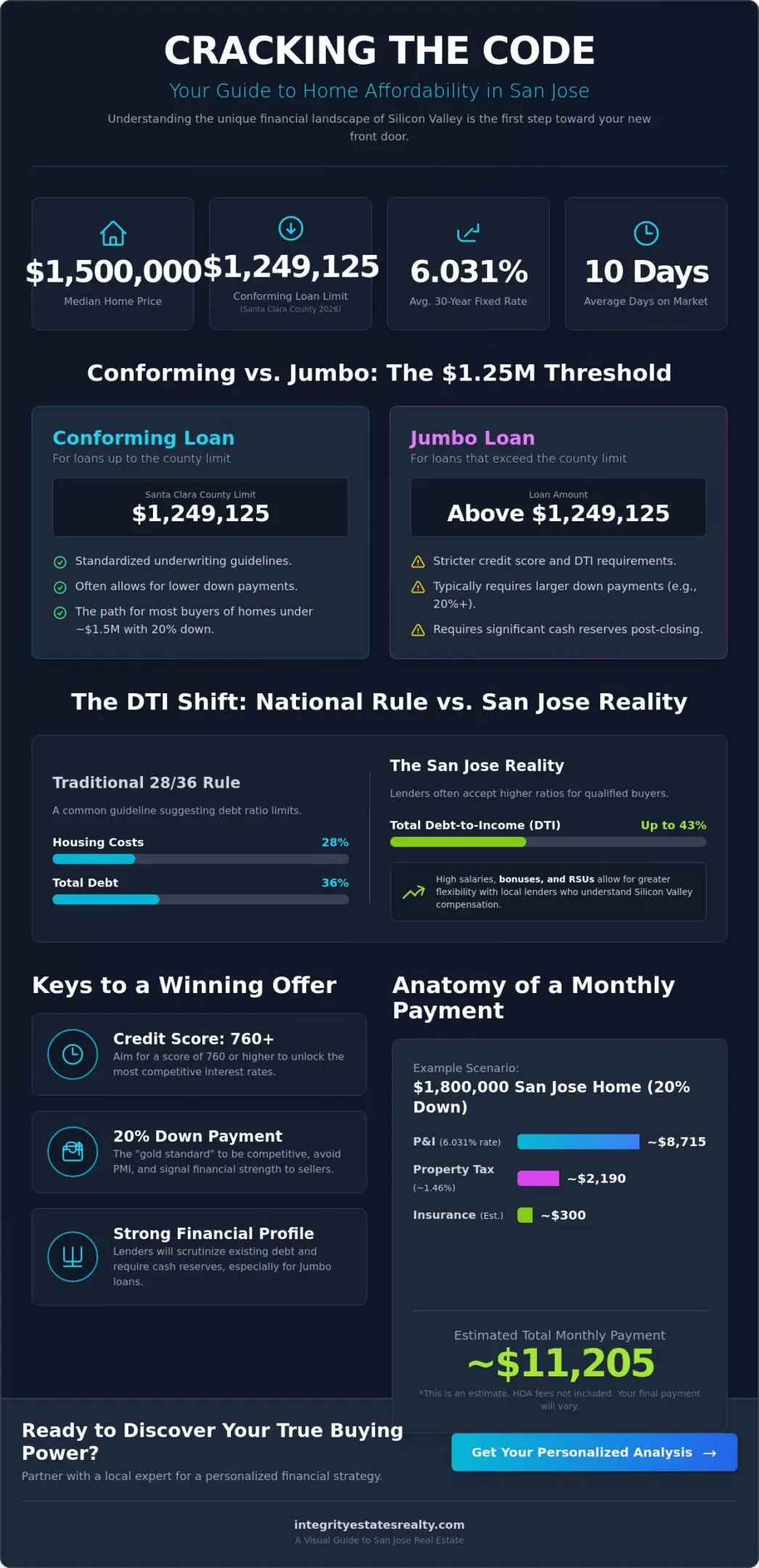
The traditional 28/36 rule suggests that your mortgage should not exceed 28% of your gross monthly income, and your total debt shouldn’t top 36%. While this is a helpful baseline, many San Jose buyers find these boundaries difficult to maintain. High Silicon Valley salaries, often bolstered by Restricted Stock Units (RSUs) and performance bonuses, sometimes allow for more flexibility in debt-to-income (DTI) ratios. Lenders in this region are accustomed to seeing DTIs push toward 43% for well-qualified candidates, especially when utilizing specific Jumbo loan products designed for high-net-worth professionals. It’s vital to understand that while you might have the income to support a higher DTI, you must still account for the 6.031% interest rates currently seen in the 2026 market.
Why San Jose Requires a Specialized Financial Lens
The complexity of San Jose’s economy means that your budget must account for more than just a house. You’re paying a “Silicon Valley premium” for proximity to global tech hubs, top-tier schools, and a unique cultural ecosystem. This premium extends to an effective property tax rate of roughly 1.46%, which can add thousands to your monthly obligation. San Jose mortgage affordability is a precise blend of your gross income, specific Santa Clara County tax rates, and the unique thresholds of local loan limits. By focusing on these localized variables, you can move forward with a budget that respects both your financial logic and your long-term lifestyle aspirations.
Key Factors Influencing Your San Jose Mortgage Budget
Lenders in Santa Clara County evaluate your financial profile through a highly specific lens that accounts for the region’s unique economic landscape. When asking how much mortgage can I afford in san jose, your credit score acts as the primary gatekeeper for the most favorable terms. A score of 760 or higher is typically required to secure the most competitive 30-year fixed rates, which currently sit near 6.031%. While a lower score doesn’t necessarily disqualify you, it can lead to higher monthly interest costs that significantly reduce your overall purchasing power. Existing debt, such as student loans or car payments, further tightens the “San Jose squeeze,” as lenders strictly monitor your debt-to-income ratio against the city’s high cost of living.
While some national lenders suggest that a 3% or 5% down payment is sufficient, the local reality is often different. In a market where homes sell in an average of 10 days, a 20% down payment remains the gold standard for competitive bidding. This substantial upfront investment does more than just eliminate private mortgage insurance; it signals to sellers that you have the financial stability to close the deal quickly. Considering where the local housing market heading in 2026, a robust down payment is one of your strongest tools for success. If you’re looking for a partner to help balance these variables, consulting with Integrity Estates Realty can provide the personalized guidance you need.
Silicon Valley Compensation: RSUs and Bonuses
For many tech professionals, a significant portion of their wealth is tied to Restricted Stock Units (RSUs) and annual bonuses. Lenders generally require a consistent two-year history of receiving this non-guaranteed income before they’ll include it in your mortgage qualification. It’s a critical nuance; if you’ve recently switched companies or your vesting schedule has changed, you may need to provide additional documentation to prove income stability. Smart buyers often use their vested stock equity to bolster their down payment, effectively lowering their loan-to-value ratio and improving their chances of securing a lower interest rate.
Property Taxes and Mello-Roos in Santa Clara County
Calculating how much mortgage can I afford in san jose also requires a deep dive into the local tax structure. While California’s Proposition 13 limits base property taxes to 1%, the median effective rate in San Jose is actually closer to 1.46% due to local bonds and assessments. Newer developments, particularly in areas like North San Jose or parts of Silver Creek, may also carry Mello-Roos fees. These special tax districts fund local infrastructure and can add hundreds of dollars to your monthly obligation. You should also budget for supplemental tax bills, which are one-time charges issued shortly after purchase to cover the difference between the previous owner’s tax base and your new purchase price.
Conforming vs. Jumbo Loans: The Santa Clara County Threshold
Understanding the boundary between a high-balance conforming loan and a Jumbo mortgage is essential for anyone asking how much mortgage can I afford in san jose. Because the Santa Clara County market is classified as a high-cost area, the standard national loan limits don’t apply here. Instead, you benefit from elevated thresholds that reflect our local property values. When your loan amount stays within these limits, you often enjoy more flexible underwriting and lower down payment requirements. However, once you cross that line, the financial scrutiny intensifies, requiring a more robust strategy to secure a successful closing.
The distinction between these loan types often dictates the feasibility of your offer in a competitive market. While interest rates for conforming high-balance loans and Jumbo products occasionally align, their qualifying criteria remain distinct. Jumbo loans typically require higher credit scores and more significant liquid assets. By identifying where your target home price falls relative to these thresholds, you can prepare your finances to meet the specific demands of Bay Area lenders without unnecessary stress.
Santa Clara County Loan Limits for 2026
For 2026, the conforming loan limit for a single-family home in Santa Clara County is $1,249,125. This figure is a critical benchmark for buyers aiming for the median home price of $1,500,000. If you provide a 20% down payment on a median-priced home, your loan amount of $1,200,000 stays safely within the conforming high-balance range. This is an important distinction to make when reviewing the 2025 conforming loan limits for Santa Clara County and how they’ve evolved into the current 2026 standards. It’s also worth noting that FHA high-balance limits and Conventional high-balance limits may differ, often providing various pathways for buyers with different down payment capabilities.
Qualifying for a Jumbo Loan in San Jose
Crossing into Jumbo territory, any loan amount exceeding $1,249,125, shifts the focus toward your post-closing liquidity. Lenders typically require 6 to 12 months of cash reserves to be held in a liquid or semi-liquid account after your down payment and closing costs are paid. This requirement ensures you can weather potential economic shifts without risking your investment. Furthermore, debt-to-income ratios are often capped more strictly at 43% for Jumbo financing, leaving less room for error than conforming products. If you’re navigating these high-stakes requirements, our guide on mortgage brokers in Santa Clara County offers deeper insight into finding the right Jumbo expertise for your specific needs. Determining how much mortgage can I afford in san jose becomes much simpler when you have a partner who understands these rigorous institutional standards.
Calculating Your Monthly Payment for the Bay Area
Moving from the technicalities of loan limits to the practical reality of a monthly checkbook is where many buyers feel the true weight of the Silicon Valley market. When you ask how much mortgage can I afford in san jose, you must look beyond the principal and interest. A complete budget accounts for the full PITI breakdown: principal, interest, taxes, and insurance. With current 30-year fixed rates at 6.031%, the interest portion of your payment on a $1,500,000 median-priced home is substantial. Additionally, the effective property tax rate of 1.46% in Santa Clara County adds nearly $1,825 per month to a median-priced property, a figure that often surprises those relocating from regions with lower tax bases.
Maintenance and utilities also require a dedicated line item in your financial plan. Much of the San Jose housing stock consists of charming but older mid-century homes that may require more frequent upkeep than newer builds. Beyond the mortgage, you should anticipate higher utility costs for cooling during increasingly warm South Bay summers. If your down payment is less than 20%, you must also factor in Private Mortgage Insurance (PMI). While PMI protects the lender, it adds a monthly cost that does not contribute to your home equity, potentially reducing your overall purchasing power by hundreds of dollars each month.
Homeowners Insurance in the 2026 California Market
The insurance landscape in California has shifted significantly, making it a pivotal factor in determining how much mortgage can I afford in san jose. Many traditional carriers have limited new policies, often pushing homeowners toward the California FAIR Plan as a last resort for fire coverage. These policies can be considerably more expensive than standard private insurance, directly impacting your total monthly affordability. It’s essential to obtain a formal insurance quote during your contingency period to confirm the property is both insurable and fits within your established budget. This proactive step prevents last-minute financial strain before closing.
The Impact of HOA Fees on Your Purchasing Power
Homeowners Association (HOA) fees are a “hidden” cost that can dramatically alter your borrowing capacity. In many San Jose condo and townhome communities, monthly HOA dues of $500 are common. Because lenders treat these fees as a recurring debt obligation, a $500 monthly fee can reduce your total borrowing power by approximately $75,000. When comparing a single-family home to a condo, the lower purchase price of the condo is often offset by these high carrying costs. If the San Jose core feels out of reach due to these added expenses, you might find more flexibility by checking Gilroy real estate market trends for more affordable alternatives nearby. To get a precise calculation of your unique buying power, contact the experts at Integrity Estates Realty for a personalized consultation.
Partnering with Integrity Estates Realty for Your San Jose Search
In a market as volatile and fast-paced as Santa Clara County, having a fragmented team can lead to missed opportunities. When you’re trying to figure out how much mortgage can I afford in san jose, you need more than just a real estate agent; you need a strategic partner who understands the intricacies of Jumbo loan origination and FHA requirements. Integrity Estates Realty provides this dual-expertise by housing both residential representation and mortgage services under one roof. This integrated approach ensures that your financial boundaries and your property search are always in perfect alignment, removing the friction often found between separate brokers and lenders.
The “Integrity Advantage” is specifically designed for the unique compensation structures of Silicon Valley. We don’t just look at a base salary; we specialize in custom financing strategies that account for RSUs, bonuses, and complex asset portfolios. Whether you’re a veteran utilizing VA loan origination or a first-time buyer exploring conventional loan processing, we provide the technical precision required for high-stakes transactions. Our goal is to shift the conversation from a stressful “what if” to a confident “what’s next,” providing the ethical anchor you need in a competitive industry.
Integrated Mortgage and Real Estate Services
Having your agent and loan officer on the same team isn’t just convenient; it’s a competitive necessity. This synergy allows us to streamline the pre-approval process, enabling you to submit offers within hours rather than days. With over 20 years of experience in the Santa Clara County market, we understand the local nuances that make an offer stand out. We act as your steadfast guide, ensuring that every detail of your financing is transparent and purposeful, which ultimately builds trust with listing agents and sellers alike. Our collaborative partnership model focuses on your long-term value, prioritizing your peace of mind over a quick transaction.
Take the Next Step Toward Your San Jose Home
Moving from the initial question of how much mortgage can I afford in san jose to holding the keys to your new home requires a methodical plan. A local pre-approval letter from a recognized regional expert carries significant weight in the eyes of San Jose listing agents. It signals that your financing is secure and that you’re working with a partner who understands the local culture and pace. We invite you to request a personalized affordability analysis based on your 2026 financial goals to begin this journey with clarity. Contact Integrity Estates Realty for a personalized mortgage consultation today to discover your true buying power and start your search with confidence.
Secure Your Future in the Heart of Silicon Valley
Mastering the nuances of the Santa Clara County market is about more than just numbers; it’s about strategy. You’ve learned how the $1,249,125 conforming loan limit shapes your down payment options and why local tax assessments must be factored into your monthly carry. Determining how much mortgage can I afford in san jose is the essential first step to transforming a complex search into a successful acquisition. With the right financial lens, you can navigate Silicon Valley’s unique compensation structures and competitive bidding wars with absolute clarity.
At Integrity Estates Realty, we offer a seamless partnership through our integrated real estate and mortgage brokerage. Our team brings over 20 years of Santa Clara County expertise to every transaction, specializing in FHA, VA, and Jumbo loans tailored for local professionals. We’re ready to help you move from calculation to a winning offer. Get Pre-Approved for Your San Jose Dream Home today. Your path to homeownership in this vibrant region is within reach, and we’re honored to be your steadfast guide throughout the journey.
Frequently Asked Questions
What is the average mortgage payment in San Jose in 2026?
The average monthly mortgage payment for a median-priced $1,500,000 home in San Jose is approximately $9,500 to $10,500. This estimate assumes a 20% down payment and a 30-year fixed rate of 6.031%, covering principal, interest, and the local 1.46% effective property tax rate. Your final cost will fluctuate based on specific homeowner association fees and your selected insurance coverage.
Can I buy a house in San Jose with a $150,000 salary?
Purchasing a median-priced single-family home with a $150,000 salary is difficult without a very large down payment or secondary income source. A person at this income level typically qualifies for a loan between $500,000 and $600,000, which is more aligned with entry-level condos or townhomes in the region. Understanding how much mortgage can I afford in san jose often involves looking at properties that fit your specific debt-to-income ratio rather than just the city’s median price.
How much down payment do I really need for a San Jose home?
While 20% is the standard for staying competitive in bidding wars, you can secure a home with as little as 3.5% using FHA high-balance programs. VA loans offer 0% down options for eligible veterans, even for high-cost properties in Santa Clara County. However, putting down less than 20% will require you to pay for private mortgage insurance, which increases your monthly obligation and reduces your total borrowing power.
What are the conforming loan limits for Santa Clara County in 2026?
The 2026 conforming loan limit for a single-family residence in Santa Clara County is $1,249,125. This high-cost designation allows buyers to access conventional financing for million-dollar homes without immediately jumping into the stricter requirements of a Jumbo loan. If your loan amount exceeds this specific threshold, you’ll need to meet the more rigorous reserve and credit standards associated with Jumbo products.
Are property taxes in San Jose higher than the California average?
Yes, the effective property tax rate in San Jose is often higher than the state average due to various local bond measures and special assessments. While California’s base rate is 1%, San Jose homeowners should budget for a median effective rate of 1.46%. These additional funds support local infrastructure and schools, but they must be accounted for when calculating how much mortgage can I afford in san jose.
How do RSUs affect my mortgage application in Silicon Valley?
Lenders in Silicon Valley treat Restricted Stock Units as qualifying income if you can demonstrate a consistent two-year history of receipt and vesting. You’ll need to provide your vesting schedule to prove that this income is likely to continue for at least three years into the future. Because stock prices fluctuate, lenders often apply a “haircut” or discount to the value of your RSUs to account for market volatility during the underwriting process.
Is it better to get a Jumbo loan or two separate loans (piggyback) in San Jose?
A piggyback loan, often structured as an 80/10/10, can be a strategic alternative if you want to avoid the higher reserve requirements of a Jumbo loan. This involves a first mortgage for 80% of the home’s value and a second home equity line of credit for 10%, allowing you to bypass private mortgage insurance with only a 10% down payment. Conversely, a single Jumbo loan might offer a lower combined interest rate for borrowers with exceptional credit and significant cash reserves.
What credit score do I need for the best mortgage rates in San Jose?
A credit score of 760 or higher is generally required to unlock the most competitive interest rates for high-balance and Jumbo loans in San Jose. While you can qualify with a score in the 600s, the interest rate premiums on a $1.2 million loan can add hundreds of dollars to your monthly payment. Maintaining a high score ensures you receive the best possible terms, which is vital for preserving your long-term purchasing power in a high-cost market.