
How to Buy Commercial Property in Santa Clara County: A 2026 Investor’s Guide
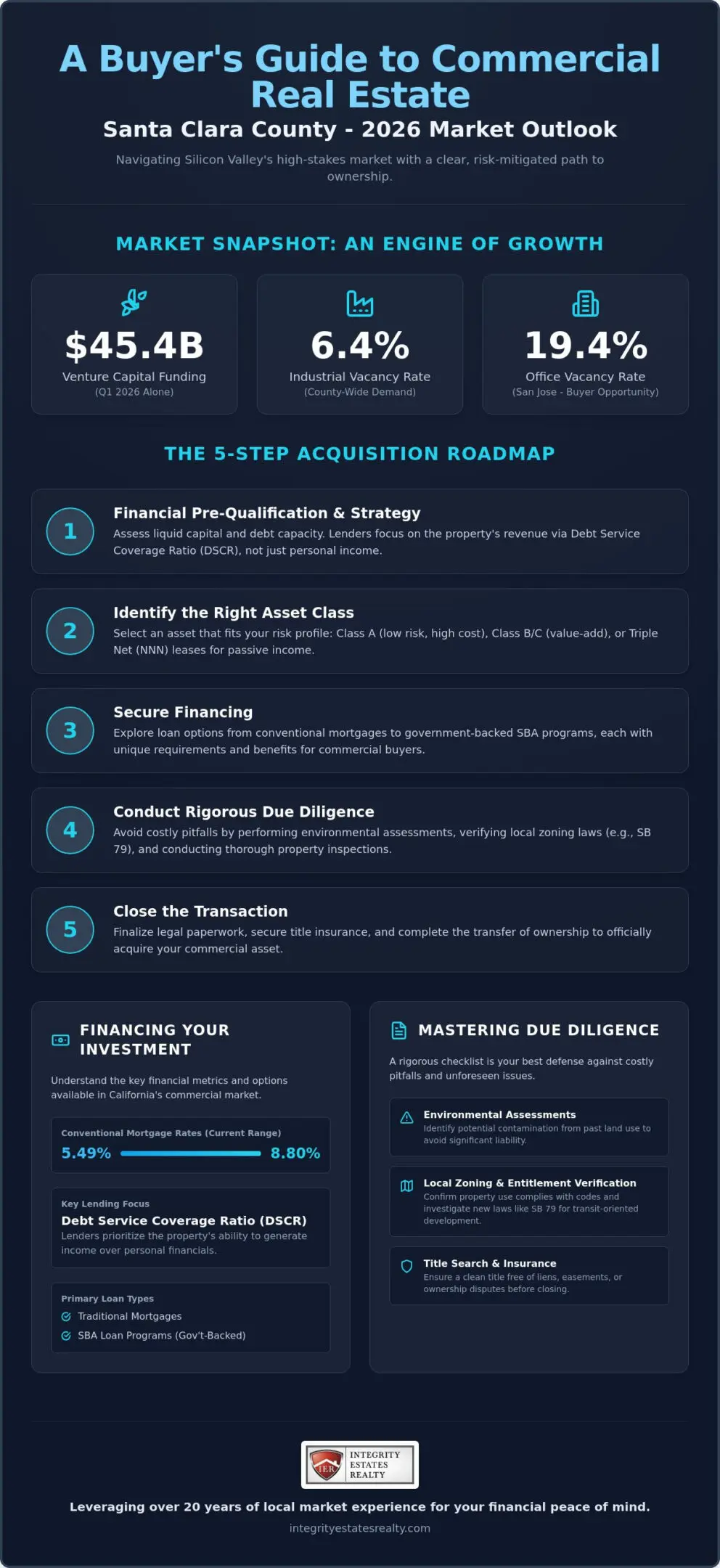
With $45.4 billion in venture capital funding flooding the region in the first quarter of 2026 alone, Santa Clara County remains an unmatched engine for long-term asset appreciation. You likely understand that the barrier to entry here is high, defined by aggressive pricing and a dense thicket of environmental regulations. Learning how to buy commercial property in santa clara county requires more than just capital; it demands a sophisticated strategy to handle the complexities of Silicon Valley’s unique market dynamics.
Key Takeaways
- Identify high-growth opportunities by understanding the 2026 shifts in Silicon Valley’s office and industrial sectors.
- Master a streamlined five-step acquisition roadmap that clarifies how to buy commercial property in santa clara county with confidence.
- Navigate complex lending requirements by exploring the nuances between traditional mortgages and government-backed SBA loan programs.
- Avoid costly regulatory pitfalls through rigorous due diligence, including environmental assessments and local zoning verification.
- Leverage over 20 years of local market experience to secure a transparent partnership that prioritizes your long-term financial peace of mind.
Navigating the Santa Clara County Commercial Landscape in 2026
The Silicon Valley commercial market isn’t just a collection of buildings; it’s a global center of innovation that consistently defies broader economic cooling. Investors looking at how to buy commercial property in santa clara county in 2026 are entering a landscape shaped by $45.4 billion in venture capital funding from just the first quarter of the year. While the national narrative often focuses on office market distress, the local reality is far more nuanced. High-quality assets in tech-centric submarkets remain incredibly resilient, fueled by the explosive growth of the artificial intelligence sector and a steady demand for specialized industrial spaces.
Why Santa Clara County Remains a Global Commercial Hub
Reliability in this market stems from a deep-rooted tech ecosystem that provides a buffer against volatility. For a detailed Santa Clara County overview, one can see how the region’s geography and economic history have created a high-barrier-to-entry environment that protects long-term value. In 2026, infrastructure projects and transit expansions are making mixed-use developments in urban centers more attractive than ever. State laws like SB 79 now authorize denser development near transit stops, allowing investors to reimagine underutilized commercial land as vibrant, multi-functional spaces that meet the housing and professional needs of the modern workforce.
Strategic Locations: From San Jose to Gilroy
Geography dictates the rhythm of your investment. San Jose’s central business district offers the prestige and density of a true urban core, though it currently navigates a 19.4% office vacancy rate. This creates unique negotiation leverage for savvy buyers who see the long-term potential in high-quality “Class A” spaces. Conversely, the southern reaches of the county tell a different story. In Gilroy, the focus shifts toward logistics and industrial use where demand remains exceptionally tight. With a county-wide industrial vacancy rate of only 6.4%, properties near the US-101 and I-880 corridors command premium prices, often reaching average asking rents of $1.64 per square foot.
The path you choose depends entirely on your ultimate objective. Owner-users often prioritize integrated mortgage and brokerage services to secure a permanent home for their operations, while passive investors focus on long-term appreciation in emerging corridors. Understanding how to buy commercial property in santa clara county means recognizing that a warehouse in Gilroy serves a fundamentally different portfolio goal than a mixed-use retail strip in Sunnyvale. Each micro-market requires a tailored approach to due diligence and a clear-eyed view of the local zoning shifts currently in flux.
A Comprehensive 5-Step Process for Commercial Property Acquisition
Acquiring a commercial asset in Silicon Valley is a methodical journey that requires both financial precision and local intuition. In a market where high-quality inventory moves quickly, having a structured roadmap ensures you remain competitive without compromising your long-term goals. Understanding how to buy commercial property in santa clara county begins with aligning your business vision with the practical realities of the current 2026 market cycle.
Step 1: Financial Pre-Qualification and Strategy
Commercial financing is fundamentally different from residential lending. Instead of focusing solely on personal income, lenders prioritize the property’s ability to generate revenue, often measured through the Debt Service Coverage Ratio (DSCR). You’ll need to assess your liquid capital against your leveraged debt capacity early in the process. While you’re evaluating your commercial leverage, you might also find it helpful to review our insights on Mortgage Brokers in Santa Clara County to see how residential and commercial strategies can complement a broader portfolio.
Step 2: Identifying the Right Asset Class
Success depends on selecting the asset class that fits your risk profile. Class A properties, like the sleek AI-ready offices in Sunnyvale, offer lower risk but higher entry costs. Class B and C assets may present value-add opportunities, especially if they’re candidates for the office-to-residential conversions encouraged by new state laws. You must also decide between Triple Net (NNN) leases, where the tenant covers taxes and insurance, or Gross leases. Performing a “highest and best use” analysis is vital to ensure the parcel’s zoning allows for your intended growth.
Once your strategy is set, the process moves into the active phase:
- Market Search and Property Tours: We look beyond public platforms like LoopNet to find off-market opportunities through our deep local networks.
- The Letter of Intent (LOI): This non-binding document outlines your price, due diligence period, and closing timeline. It’s your first chance to signal you’re a serious, ethical buyer.
- Purchase and Sale Agreement (PSA): This is the formal contract. It must be navigated within the framework of California 2026 Real Estate Law to protect your interests and define clear contingencies.
The final stage involves a rigorous escrow period and a smooth transition into ownership. Managing the complex legal documentation and post-purchase logistics requires a partner who understands the human narrative behind the transaction. If you’re ready to explore these steps in more detail, our team is here to act as your steadfast guide in the Santa Clara market.
Completing this 5-step process successfully means you’ve secured more than just a physical asset; you’ve established a foothold in one of the world’s most desirable economies. Our role is to provide the reassurance and transparency you need to make these high-stakes decisions with absolute peace of mind.
Financing Your Investment: Commercial Loan Options in California
Securing the right capital is the bridge between a strategic vision and a physical asset. When you’re determining how to buy commercial property in santa clara county, your financing strategy must be as precise as your site selection. Unlike residential loans that lean heavily on personal credit, commercial lending focuses on the asset’s performance. Lenders scrutinize the Loan-to-Value (LTV) ratio and the Debt Service Coverage Ratio (DSCR) to ensure the property’s income can comfortably support the debt. In the current July 2026 market, conventional commercial mortgage rates are ranging between 5.49% and 8.80%, requiring a sophisticated approach to underwriting.
Short-term agility is often necessary in Silicon Valley’s fast-paced environment. Bridge loans and institutional debt fund options, currently hovering between 6.6% and 8.1% based on SOFR plus a spread, allow investors to seize opportunities before permanent financing is finalized. These tools are particularly useful for “value-add” projects where a property requires renovation or repositioning to reach its full market potential.
SBA Loans vs. Conventional Commercial Financing
For business owners who intend to occupy at least 51% of their building, government-backed programs offer a compelling alternative to traditional debt. SBA 504 and 7(a) loans are designed to preserve your liquid capital, often requiring only a 10% down payment compared to the 20% or 30% typically demanded by conventional lenders. As of mid-July 2026, SBA 504 loan rates are stabilized between 6.17% and 6.20%. This fixed-rate stability provides long-term peace of mind, protecting your operations from the volatility of adjustable-rate markets while allowing for significant asset appreciation.
The Integrated Advantage: Brokerage and Mortgage Under One Roof
Deal fatigue is a common risk in high-stakes transactions. It often stems from fragmented communication between real estate agents and separate lending institutions. We solve this by providing integrated real estate and mortgage services, ensuring your loan officer and broker are in constant, seamless alignment. This “one-stop-shop” approach allows us to leverage wholesale lender networks to find niche products that retail banks might overlook.
This streamlined process is especially vital when exploring high-growth areas. If you’re considering expanding your portfolio southward, our Commercial Real Estate in Gilroy strategy guide illustrates how integrated financing can help you secure industrial or logistics assets in emerging corridors. By managing both the brokerage and the mortgage, we provide an ethical anchor for your investment, prioritizing your long-term financial health over a quick transaction. Understanding how to buy commercial property in santa clara county becomes a far less stressful journey when you have a steadfast guide managing every technical and emotional nuance of the deal.
Mastering Due Diligence and Local Zoning Regulations
Due diligence is the phase where a promising investment is either validated or exposed as a liability. When you are learning how to buy commercial property in santa clara county, looking beyond the aesthetic appeal of a listing is essential. You must uncover the regulatory and physical realities that exist beneath the surface. This process isn’t just about checking boxes; it’s about protecting your capital through a sense of ethical responsibility and local expertise.
Navigating Santa Clara County Zoning and Land Use
Cities like San Jose and Gilroy operate under intricate General Plans that dictate building density and specific business uses. Securing a “Use Permit” or navigating the variance process requires a partner who understands the local political and administrative landscape. You must also account for the California Environmental Quality Act (CEQA), which mandates rigorous environmental impact reviews for many commercial projects. Overlooking details like parking requirements or ADA compliance can lead to expensive retrofitting that quickly erodes your projected ROI. We prioritize transparency here, ensuring you understand every restriction before you commit.
The Physical Inspection: More Than Just Four Walls
Financial due diligence is equally critical. You’ll need to audit rent rolls, T-12 statements, and actual operating expenses to ensure the property’s performance matches the seller’s claims. Simultaneously, a title review and ALTA survey will identify easements or encroachments that could limit your future development plans. This methodical approach alleviates the stress of high-stakes transactions by replacing uncertainty with data. If you need a team that values your personal narrative and financial security, contact Integrity Estates Realty today to begin your due diligence with confidence.
Partnering with Integrity Estates Realty for Seamless Transactions
The complexities of the Silicon Valley market require more than just a broker; they require a partner who is deeply invested in your long-term narrative. Mastering how to buy commercial property in santa clara county is a journey defined by high stakes and intricate details. Whether you are navigating the dense zoning laws of San Jose or seeking industrial space in Gilroy, the process demands a level of transparency that only comes from decades of local immersion. We pride ourselves on being an ethical anchor in a competitive industry, prioritizing your peace of mind over a quick transaction.
Our dual-service model is designed specifically to alleviate the stress often associated with these high-value acquisitions. By managing both the commercial brokerage and the mortgage origination, we eliminate the communication gaps that frequently lead to deal fatigue. This integrated approach allows us to leverage wholesale lender networks to secure specialized financing products that align with your specific asset class. It’s a methodical flow that ensures your financial logic and emotional aspirations are always in balance.
Expert Guidance from Jose M Hernandez
Led by Jose M Hernandez, our firm brings over 20 years of experience to the table. This legacy of service extends across Santa Clara, Monterey, and Fresno counties, providing us with a unique perspective on regional growth patterns. Jose M Hernandez’s approach is fundamentally personal; she understands that every commercial property represents a dream of expansion or a legacy of stability for a local business owner. We don’t just facilitate transactions. We curate a path to ownership that respects the human experience behind the contract. For business owners looking to build equity in a premier tech hub, this personalized advocacy is the key to a successful acquisition.
Your Path to Commercial Ownership Starts Here
The roadmap we have explored, from initial financial strategy to the final closing, is built on a foundation of reliability and local pride. Choosing how to buy commercial property in santa clara county with our team means you gain access to a “one-stop-shop” that handles the heavy lifting of legal documentation and lender negotiations. We invite you to view our current listings or discuss off-market opportunities that may not be visible on public platforms. Your investment deserves a steadfast guide who understands the culture and the people that make this region desirable.
If you’re ready to transition from a cautious participant to a confident owner, let’s begin the conversation. We are here to provide the sophisticated analysis and warm, professional advice you need to secure your place in the Silicon Valley landscape. Contact Integrity Estates Realty today for your commercial property consultation and take the first step toward a risk-mitigated, high-value investment.
Building Your Legacy in Silicon Valley
Successfully navigating the Silicon Valley market requires more than just capital; it demands a synergy of localized zoning knowledge and a robust financing strategy. By mastering the 5-step acquisition process and conducting rigorous due diligence, you can mitigate the risks inherent in high-stakes transactions. Understanding how to buy commercial property in santa clara county is the first step toward securing a high-performing asset in a premier tech hub. Our team brings over 20 years of local expertise to every deal, providing integrated mortgage and brokerage services that simplify the path to ownership.
We prioritize ethical and transparent representation to ensure your investment logic aligns with your long-term aspirations. Whether you’re looking for owner-user space or a strategic addition to your portfolio, we act as a steadfast guide through every complexity. You don’t have to face these high-stakes decisions alone. With the right partner, the journey from initial consultation to final closing becomes a source of peace of mind rather than stress.
Secure Your Commercial Future with Integrity Estates Realty & Mortgage. We look forward to helping you establish your foothold in one of the world’s most innovative economies.
Frequently Asked Questions
What is the typical down payment for commercial property in Santa Clara County?
A typical down payment ranges from 20% to 30% for conventional commercial mortgages. However, if you qualify for an SBA 504 or 7(a) loan, you can often secure a property with as little as 10% down. This lower entry point is ideal for business owners who want to preserve their liquid capital for operational growth while building long-term equity in the Silicon Valley market.
How long does the commercial buying process usually take in California?
The timeline generally spans between 60 and 120 days from the initial offer to the final closing. Commercial transactions require extensive due diligence, including environmental assessments and detailed financial audits, which often take 30 to 60 days on their own. Our integrated approach helps streamline these milestones, ensuring that your transition remains purposeful and avoids the frantic energy often found in high-pressure sales environments.
Can I use an SBA loan to buy an office building in San Jose?
You can utilize an SBA loan for an office building provided your business occupies at least 51% of the total square footage. This is a powerful strategy for those learning how to buy commercial property in santa clara county because it offers fixed-rate stability. It allows you to transform a monthly rent expense into a long-term investment that supports your company’s narrative and future growth.
What is the difference between a residential and commercial real estate agent?
Commercial agents specialize in income-producing assets and complex regulatory landscapes rather than personal lifestyle needs. While a residential agent focuses on school districts and neighborhood aesthetics, a commercial broker analyzes Debt Service Coverage Ratios, environmental liabilities, and local zoning codes. We act as an ethical anchor, bridging the gap between financial logic and your professional aspirations with sophisticated market expertise.
What are the specific closing costs for commercial buyers in Santa Clara County?
Closing costs usually include appraisal fees, Phase I Environmental Site Assessments, title insurance, and escrow fees. You should also account for loan origination fees, which typically range from 1 to 3 points for certain bridge products. Since Santa Clara County has a base property tax rate of 1%, you’ll also need to prepare for pro-rated tax assessments and potential voter-approved bonds at the time of purchase.
Is it better to lease or buy commercial space in the 2026 market?
Buying is often the superior choice for established businesses looking to hedge against rising rents and secure long-term asset appreciation. While leasing offers short-term flexibility, ownership provides tax advantages and the ability to customize your space for high-intensity tech or industrial use. In the current 2026 cycle, stabilized interest rates make ownership a reassuring path toward building a permanent legacy in the region.
How do I verify the zoning of a commercial property in Gilroy?
You can verify zoning by consulting the Gilroy General Plan and the city’s Planning Division records. It’s essential to confirm that your intended business use aligns with local land-use designations, especially with new 2026 regulations regarding transit-oriented development. We assist our clients by conducting thorough zoning verifications early in the search process to ensure every property under consideration is a viable match for their goals.
Does Integrity Estates Realty handle both the property search and the financing?
We provide a dual-service model that integrates expert commercial brokerage with specialized mortgage origination. This “one-stop-shop” approach simplifies the process of how to buy commercial property in santa clara county by keeping your realtor and loan officer in constant alignment. It creates a transaction experience that feels both efficient and comprehensive, allowing you to focus on your business while we manage the technical details.