
Investment Property Loans in Santa Clara County: 2026 Investor’s Financing Guide
In a market where the median home sale price has reached $1,625,000, your financing strategy is no longer just a detail; it’s the engine of your entire ROI. Securing investment property loans in Santa Clara County in 2026 requires more than just a good credit score. It demands a sophisticated understanding of how to navigate the $1,249,125 high-balance conforming limits and a competitive landscape where homes go pending in just 16 days. You need a strategy that matches the speed of the South Bay.
You likely know that Silicon Valley offers incredible appreciation potential, but the high barrier to entry and strict debt-to-income requirements can make even seasoned investors feel sidelined. It’s frustrating to watch opportunities slip away because of slow processing or rigid lending criteria. This guide will show you how to bypass traditional hurdles by leveraging specialized loan products that prioritize property cash flow over personal income. We’ll explore the critical differences between Conventional and DSCR loans, analyze the impact of 2026 property tax assessments, and reveal how a dual-licensed partner can accelerate your closing time in this fast-moving market.
Key Takeaways
- Identify the most effective investment property loans in Santa Clara County by comparing conventional financing with DSCR options that focus on property cash flow rather than personal debt-to-income ratios.
- Uncover the reality of 2026 down payment requirements and learn how to navigate the high entry costs of the South Bay market without compromising your liquidity.
- Explore strategic “house hacking” opportunities for multi-unit properties that leverage FHA or VA loan programs to maximize your initial leverage in a high-value landscape.
- Streamline your acquisition timeline by mastering the pre-underwriting phase and gathering the essential “Big Four” documents before you even make an offer.
- Discover the efficiency of a dual-licensed partnership where real estate expertise and mortgage precision are integrated to provide a seamless, ethical path to closing.
The 2026 Investment Landscape in Santa Clara County
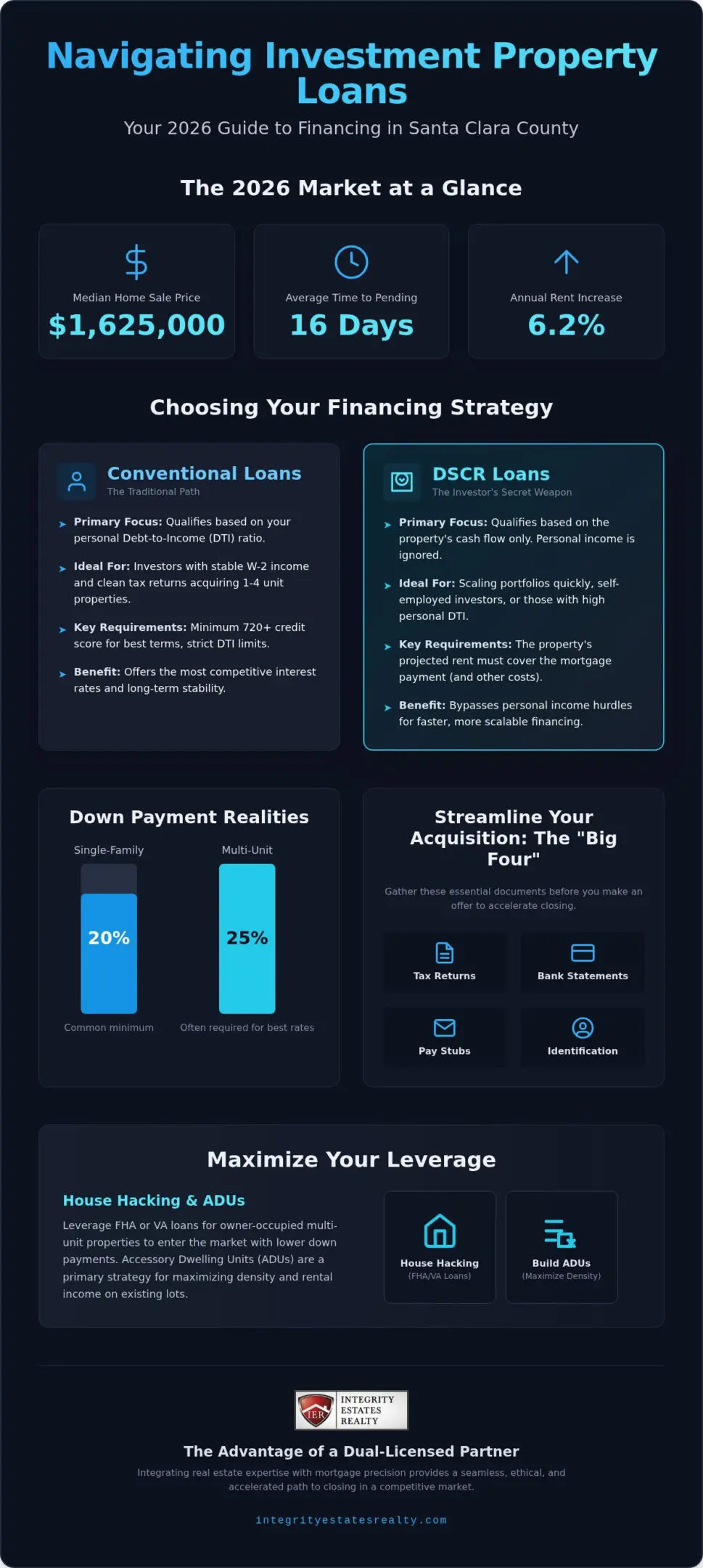
The investment environment in 2026 is defined by a paradox of high entry costs and relentless rental demand. With a median home sale price of $1,625,000, the barrier to entry is undeniably high, yet the 6.2% annual increase in average rent keeps the South Bay at the top of many portfolios. Choosing the right investment property loans in Santa Clara County is essential to offset these valuations while capturing the 4.74% annual growth in assessed property values. This steady appreciation, backed by a tech-driven economy, provides a level of security that few other global markets can match.
Institutional and private investors remain focused on this region because of the deep-rooted stability of Silicon Valley. This Santa Clara County overview highlights how the local infrastructure and a high Area Median Income of $205,500 create a reliable tenant base. We’re seeing a significant shift toward “missing middle” housing, where investors prioritize multi-unit properties and lots with high density potential. In a market where homes go pending in just 16 days, having your financing strategy prepared is the only way to compete effectively.
South Bay vs. Gilroy: Where the Alpha Lies
Investors often face a choice between the stability of core San Jose and the higher yields found in South County. While San Jose properties offer lower cap rates, they provide unmatched liquidity and long-term prestige. Conversely, Gilroy offers significant value-add potential for those willing to look further south. The “commuter belt” demand remains exceptionally strong in 2026 as professionals seek larger homes without leaving the valley’s economic orbit. You can find a deeper dive into these localized shifts in our Gilroy Real Estate Market Trends: A Comprehensive 2026 Analysis.
Regulatory Factors for Santa Clara Landlords
Managing a property in this region requires a sophisticated understanding of local ordinances. The state is currently refining SB 9 amendments to align with local zoning, which directly impacts how you finance and build Accessory Dwelling Units (ADUs). These units are becoming a primary strategy for investors to maximize density on existing lots. However, navigating the mix of Proposition 13 tax caps and potential Mello-Roos assessments in newer developments is complex. Local expertise is vital to ensure your projections account for these nuanced costs and avoid compliance errors that could erode your ROI. For investors looking to expand their portfolio into the Sacramento region, Home Showings Property Management provides the professional residential services needed to ensure long-term success.
Comparing Investment Property Loan Types
One common myth is that a 20% down payment is a universal requirement for every deal. In reality, 2026 guidelines often require 25% for multi-unit properties to secure the most favorable pricing, though some portfolio products allow for flexibility if the asset’s equity position is strong. For properties exceeding the $1,249,125 high-balance limit, Jumbo loans become the standard. These require deeper cash reserves but offer the necessary leverage for the South Bay’s luxury rental tier and high-end multi-family units.
Conventional Investment Loans
These loans follow Fannie Mae and Freddie Mac guidelines and are ideal for 1 to 4 unit properties. They offer the most competitive interest rates and long-term stability, provided you can meet strict debt-to-income (DTI) requirements. Most lenders in 2026 look for a credit score of 720 or higher to unlock the best terms. If your personal income is stable and your tax returns are straightforward, this remains a reliable path for building equity over thirty years. It is a conservative choice that rewards those with strong personal financial profiles.
DSCR Loans: The Investor’s Secret Weapon
The Debt Service Coverage Ratio (DSCR) loan is designed for speed and scalability. Unlike conventional financing, it ignores your personal income and focuses entirely on the property’s ability to pay for itself. Lenders typically look for a ratio of 1.2x, meaning the monthly rental income should be 120% of the mortgage payment, taxes, and insurance. This is the preferred choice for investors who have hit the ten-loan limit with Fannie Mae or those whose complex tax returns make traditional qualifying difficult. It allows you to grow your portfolio based on the merit of the real estate rather than your paycheck.
Hard Money & Bridge Options
Short-term capital is vital for those pursuing fix-and-flip or BRRRR strategies. These asset-based loans prioritize the “after-repair value” rather than the current state of the home, which is why fix and flip loans explained by financial experts often emphasize speed over interest rates. These products bridge the gap until you can refinance into a permanent loan. If you are looking at larger scale opportunities, our guide on Commercial Real Estate in Gilroy: The 2026 Investor’s Strategy Guide provides deeper insights into industrial and retail transitions. For a personalized review of which path fits your goals, you can connect with our mortgage team to discuss your specific portfolio needs.
Qualifying for Financing in a High-Value Market
Qualifying for investment property loans in Santa Clara County requires a tactical approach to your financial profile. With the median sale price holding at $1,625,000, the entry cost is often the primary hurdle for even high-earning professionals. To manage these high entry costs, many strategic investors utilize “house hacking” by securing FHA or VA loans for 2 to 4 unit properties. This allows you to enter the market with as little as 0% to 3.5% down, provided you occupy one of the units. It’s a powerful way to let your tenants pay your mortgage while you build equity in one of the world’s most valuable zip codes.
Liquidity is the second pillar of a successful application. Lenders don’t just want to see that you have the down payment; they require “reserves.” In 2026, most conventional guidelines for investment properties demand at least six months of principal, interest, taxes, and insurance (PITI) in liquid accounts. If you own multiple properties, you’ll likely need additional reserves for every asset in your portfolio. Keeping a close eye on Santa Clara County housing market statistics is vital for predicting the appraisal gaps that often occur in San Jose and Sunnyvale, where competitive bidding can sometimes outpace conservative bank valuations.
Presenting your tax returns is another area where precision matters. While your CPA works to minimize your tax liability through depreciation and expenses, your mortgage strategist must ensure your “add-backs” are calculated correctly to maximize your qualifying income. We look at the nuances of your Schedule E to ensure every dollar of rental income is utilized to improve your debt-to-income ratio. This transparency ensures that the underwriting process remains a collaborative effort rather than a source of stress.
Asset-Based vs. Income-Based Qualification
Choosing between asset-based and income-based qualification depends on your long-term liquidity goals. Income-based loans offer the lowest interest rates but require a clean, high-income paper trail. If you’re short on cash but have a robust 401(k) or existing equity in a primary residence, you can often leverage those assets for your down payment through a HELOC or a retirement account loan. This is particularly useful in the South Bay, where being able to cover an appraisal gap with cash can be the difference between a winning bid and a lost opportunity.
Leveraging Sibling Article Insights
Investor pre-approval is a much deeper dive than a traditional homebuyer’s pre-approval. It involves a comprehensive review of your entire real estate portfolio and your long-term wealth-building goals. It’s a process that differs significantly from purchasing a primary residence, a topic we explore in detail in our guide on Mortgage Brokers in Santa Clara County: A 2026 Buyer’s Guide to Home Financing. At Integrity Estates Realty, we pride ourselves on being a steadfast guide, ensuring that your financial narrative is presented ethically and accurately to secure the best possible terms.
The Step-by-Step Loan Acquisition Process
Securing investment property loans in Santa Clara County requires a methodical approach that mirrors the precision of the local tech industry. The journey begins with a comprehensive portfolio review where we align your financing with your long-term wealth goals. This phase is followed by pre-underwriting, where we gather the “Big Four” documents to ensure your file is ready for scrutiny before you even step foot in a listing. Once a property is identified, we help you craft an investor-friendly offer that balances competitive speed with necessary protections. For multi-unit or commercial assets, the process extends into environmental reviews and specialized appraisals to verify the asset’s viability. The final stages involve a meticulous closing process and a transition into post-closing management to ensure your first payment and escrow are set up for success.
Preparing Your Financial Dossier
A flawless application is the key to navigating the strict 2026 lending environment. Your financial dossier should include two years of complete tax returns, two months of asset statements showing required reserves, recent W-2s or 1099s, and current lease agreements for any existing rentals in your portfolio. Letters of Explanation are often vital for investors with complex profiles; they provide the narrative context for business write-offs or multiple credit inquiries that automated systems might flag. It is also essential to verify the chain of title, which is the sequential record of property ownership that confirms the seller’s legal right to transfer the asset. If you’re ready to begin your portfolio review, schedule a consultation with our dual-licensed team to secure your financing.
Navigating the Appraisal Process
The appraisal is often the most critical hurdle in a high-value market. For investment properties, lenders require a Form 1007 Market Rent Addendum to prove the property’s income potential matches your projections. This document is what allows the lender to use the property’s future rent to offset the mortgage payment in your debt-to-income calculation. In a competitive landscape where prices can escalate quickly, a low appraisal requires a calm, strategic response. This might involve a formal rebuttal based on more recent comparable sales or a restructuring of the loan-to-value ratio. While homes in the South Bay often go pending in 16 days, you should expect the full loan process to take between 21 and 30 days. Setting these realistic expectations early prevents the stress that often accompanies high-stakes Silicon Valley transactions.
Why Partner with Integrity Estates Realty & Mortgage?
In the high-stakes South Bay market, the distance between your real estate agent and your mortgage broker can be the difference between a closed deal and a missed opportunity. Integrity Estates Realty offers a dual-service model that is rare in the industry. As a dual-licensed brokerage, we provide both real estate representation and mortgage origination under one roof. This integration ensures that your strategy for investment property loans in Santa Clara County is perfectly aligned with the properties you’re pursuing. Led by Jose M Hernandez, our team brings over 20 years of local experience to every transaction, serving as an ethical anchor in a competitive field.
Most investors are tired of the “telephone game” that occurs when their lender and realtor aren’t on the same page. When you work with us, that friction disappears. We understand the nuances of the local landscape from San Jose to Gilroy because we’ve been part of this community for decades. Our personality is one of high-minded dedication, prioritizing long-term relationships over quick commissions. We’re here to alleviate the stress of high-stakes transactions through transparency and a composed, methodical approach.
The Integrated Investor Solution
We prioritize a “mortgage-first” approach to realty. You’ll know exactly what your debt service coverage ratio looks like before you even step foot on a property. Because we operate as a mortgage brokerage, we have access to extensive wholesale lender networks. These networks often provide more flexible terms than traditional big banks, allowing us to source customized solutions for complex investor profiles. Whether you’re looking for jumbo financing or specific DSCR products, our integrated model streamlines the entire acquisition. For those exploring the unique inventory in South County, our guide on Homes for Sale in Gilroy, CA: The 2026 Buyer’s Lifestyle & Financing Guide offers a comprehensive look at how lifestyle and financing intersect.
Commitment to the Santa Clara Community
Our roots in Gilroy and the wider South Bay run deep. We aren’t just processing transactions; we’re helping shape the housing landscape of the communities where we live and work. The “Integrity” promise isn’t just a name. It’s a commitment to transparent, ethical guidance that prioritizes your long-term peace of mind. We’ve built our reputation on reliability and a willingness to tell clients when a deal doesn’t make financial sense. In the complex world of investment property loans in Santa Clara County, you need a partner who is as invested in your future as you are. We’re here to be your steadfast guide and your bridge to real estate success in 2026 and beyond.
Securing Your Future in the South Bay Market
Success in the 2026 real estate landscape requires more than just capital; it demands a strategic alignment of your debt structure with the unique dynamics of Silicon Valley. You’ve seen how the right investment property loans in Santa Clara County can transform a high-value entry into a sustainable wealth-building engine. Whether you’re prioritizing the property-centric flexibility of a DSCR loan or the long-term stability of conventional financing, your choice of partner remains the most critical variable in your ROI. You deserve a guide who understands that every property is both a physical asset and a personal milestone.
With over 22 years of California real estate experience, Integrity Estates Realty provides a unique dual-service advantage that big banks can’t replicate. Jose M Hernandez is dual-licensed as a Realtor® and a Mortgage Broker, specializing in the specific market dynamics of Gilroy and the wider Santa Clara County area. We’re here to ensure your financial narrative is presented with precision and ethics. Schedule a Strategic Portfolio Consultation with Integrity Estates Realty today. Your bridge to South Bay real estate success is ready when you are.
Frequently Asked Questions
What is the minimum down payment for an investment property in Santa Clara County?
Most lenders require a minimum down payment of 20% to 25% for standard investment property loans in Santa Clara County. While single-family homes may occasionally qualify for 15% down with a higher interest rate, multi-unit properties almost always demand 25% to secure conventional pricing. If you are using a “house hacking” strategy with an FHA or VA loan, these requirements can drop significantly to 3.5% or even 0% for those who qualify.
Can I use an FHA loan for an investment property in California?
You cannot use an FHA loan for a property intended strictly for investment; these loans are reserved for owner-occupied residences. However, you can purchase a multi-unit property with up to four units using an FHA loan if you occupy one unit as your primary residence for at least a year. This allows you to use the rental income from the other units to help pay the mortgage while building equity with a low down payment.
How does a DSCR loan differ from a conventional mortgage for investors?
A DSCR loan qualifies you based on the property’s rental income rather than your personal debt-to-income ratio. Conventional mortgages offer lower interest rates but require extensive documentation of your personal paycheck and tax returns. DSCR loans are often the preferred choice for scaling a portfolio quickly because they don’t have the same limits on the number of financed properties an individual can own.
What are the current conforming loan limits for Santa Clara County in 2026?
The 2026 high-balance conforming limit for a single-unit property in Santa Clara County is $1,249,125. For investors looking at multi-unit opportunities, the limits are higher, reaching $1,599,375 for two units and up to $2,402,625 for four units. Any loan amount exceeding these high-balance limits is considered a Jumbo loan, which typically requires larger cash reserves and a higher credit score to qualify.
Is it better to invest in Gilroy or San Jose for rental income?
San Jose offers unmatched appreciation and stability, while Gilroy often provides better cash-on-cash returns due to lower entry prices. San Jose’s rental market is driven by high-income tech professionals, leading to a 6.2% increase in average rent recently. Gilroy serves as a vital commuter hub, offering value-add opportunities for investors who want to capture the “missing middle” housing demand in the South Bay.
Do I need a specific credit score to qualify for an investment property loan?
You generally need a minimum credit score of 620 to 640 for most investment programs, but a score of 720 or higher is necessary to unlock the most competitive rates. Lenders view non-owner-occupied properties as higher risk, so a strong credit profile helps reduce your required down payment and reserve amounts. Maintaining a high score ensures you have access to the full spectrum of wholesale lender networks.
How long does it take to close on an investment property loan in the South Bay?
Closing on investment property loans in Santa Clara County typically takes between 21 and 30 days. Although the local market moves fast with homes going pending in just 16 days, the appraisal and underwriting for an investment asset require extra care. Our dual-licensed model helps accelerate this timeline by integrating the realty and mortgage processes, ensuring that your financial dossier is ready for immediate submission.
Can I finance the renovation costs into my investment property loan?
Standard conventional loans do not allow you to bundle renovation costs, so most investors use hard money or bridge loans for the initial purchase and repair. Once the renovations are complete and the property is tenanted, you can refinance into a permanent conventional or DSCR loan. This transition is a core part of the “buy, rehab, rent, refinance” strategy used to maximize equity in high-value California markets.