
Real Estate Contingencies Explained: Protecting Your California Home Purchase in 2026
Your earnest money deposit isn’t just a gesture of good faith; it’s a significant financial asset that remains at risk until the very moment you sign a formal contingency removal form. Having real estate contingencies explained California style is the only way to ensure that your deposit, which often totals 3% of the purchase price, stays safely in your pocket if a home inspection reveals a deal-breaker. You likely feel the weight of this decision, especially with the 2026 market’s unique complexities and new disclosure requirements for everything from AI-altered photos to gas appliances. It’s natural to worry that a missed deadline or a misunderstood “active removal” rule could cost you thousands of dollars and your peace of mind.
We’re here to replace that uncertainty with a sense of calm, professional control. This guide will give you the absolute clarity you need to handle these legal safeguards like a seasoned pro, turning potential contract hurdles into powerful negotiation tools. We will walk through the standard 17 and 21 day timelines, explain how to protect your investment under current laws, and provide a clear roadmap for the entire contingency period so you can move forward with absolute confidence.
Key Takeaways
- Learn how California Civil Code § 1436 creates a legal framework that protects your interests from the moment you sign a purchase agreement.
- Master the nuances of real estate contingencies explained california style to ensure your inspection, appraisal, and loan periods serve as effective negotiation tools.
- Identify the specialized disclosures and title contingencies that prevent hidden liens or easements from clouding your future homeownership.
- Navigate the “Active Removal” requirement and standard timelines to maintain control over your earnest money deposit throughout the transaction.
- Discover how combining real estate representation with in-house mortgage expertise can simplify the complex financing contingency process.
What is a Real Estate Contingency? The California Legal Framework
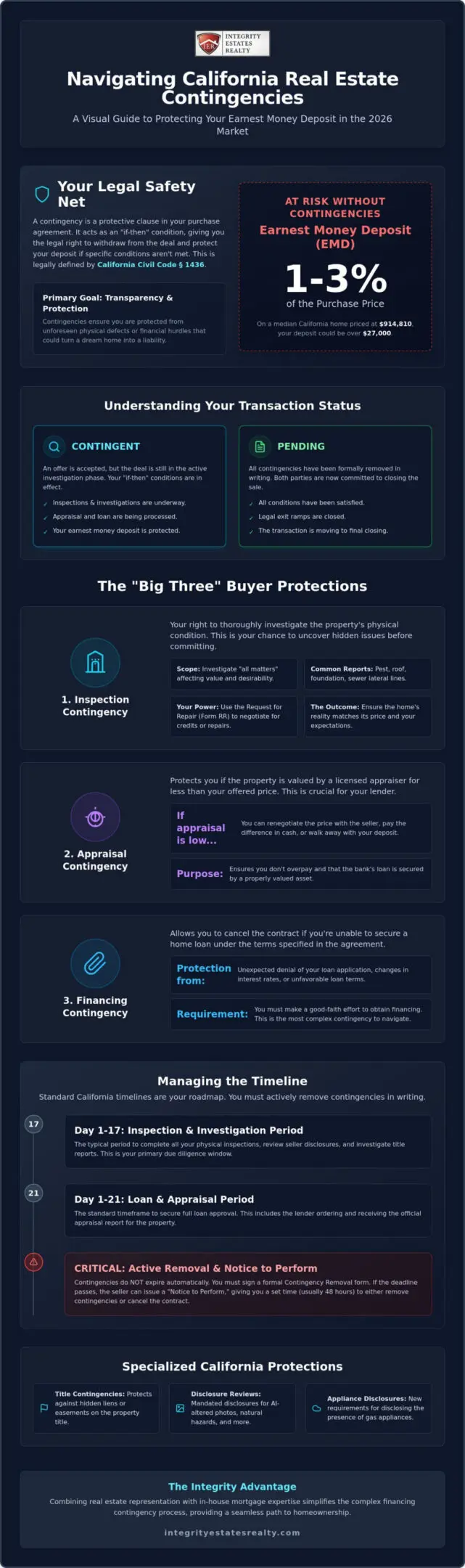
At its core, a contingency is a protective clause that transforms a standard agreement into a dynamic, conditional promise. Within the framework of a Real estate contract, these provisions function as “if-then” statements. If a specific condition is not met, then the buyer has the legal right to withdraw. This isn’t just industry custom; it’s rooted in California Civil Code § 1436, which defines these conditions as events that must occur before a contractual obligation becomes absolute. Having real estate contingencies explained california style means understanding that you aren’t just signing a paper; you’re building a legal shield around your future.
In the 2026 market, where the California median home price reached $914,810 in April, the stakes couldn’t be higher. In competitive hubs like San Jose or when you are selling your home in Gilroy, the Earnest Money Deposit (EMD) typically represents 1% to 3% of the purchase price. Without these safeguards, that deposit is vulnerable. Contingencies act as the ultimate safety net, ensuring your hard-earned capital isn’t lost to a property with hidden structural issues or an appraisal that doesn’t meet the mark. Understanding how real estate contingencies explained california regulations work is essential for anyone entering this environment. With only 18% of California households able to afford a median-priced home as of April 2026, every dollar of your investment deserves protection.
The Purpose of the Safety Net
The primary goal of these clauses is to foster an environment of radical transparency. They protect you from unforeseen physical defects or financial shifts that could turn a dream home into a liability. By providing a clear, legal path to cancel the contract, contingencies alleviate the pressure of high-stakes transactions. They encourage sellers to be forthcoming and buyers to be diligent, creating a partnership built on ethical conduct rather than high-pressure sales tactics. This process ensures that your investment is grounded in reality, not just optimistic listing photos.
Contingent vs. Pending: Knowing the Difference
You’ll often see these terms on the MLS, but they represent very different stages of the journey. A listing marked “Contingent” means the seller has accepted an offer, but the deal is still subject to those “if-then” clauses we’ve discussed. This is the most active phase of escrow. It’s a time of inspections, reports, and intense verification. Once all contingencies are formally removed in writing, the status shifts to “Pending.” At that point, the legal exit ramps are closed, and both parties are committed to the final closing. It’s the moment when a physical asset truly begins to feel like a personal dream realized.
The “Big Three” Contingencies: Inspection, Appraisal, and Financing
While the legal framework provides the skeletal structure of your offer, these three specific clauses represent the engine of your protection. Having real estate contingencies explained california style requires looking at how physical, financial, and market valuations intersect to safeguard your equity. In a secure Gilroy real estate transaction, these pillars ensure you don’t overpay for a property that might harbor hidden, costly defects. They turn a high-pressure moment into a methodical, transparent process where every detail is verified before your deposit becomes non-refundable.
The Inspection Contingency: More Than Just a Walkthrough
This phase is far more than a cursory glance at the countertops or the curb appeal. The standard California Residential Purchase Agreement (RPA) grants you the broad right to investigate “all matters” affecting the value and desirability of the property. This typically includes specialized reports for wood-destroying organisms (pest), roof integrity, and sewer lateral lines. If the inspector uncovers issues, we use the Request for Repair (Form RR) to negotiate for seller credits or direct repairs. It’s about ensuring the home’s physical reality matches the lifestyle and price point you’ve agreed upon. You have the right to be fully informed about the structural narrative of the house.
The Appraisal and Financing Contingencies
These two safeguards are deeply intertwined and function as your financial fail-safe. In competitive markets like San Jose, where the median home price reached $914,810 in April 2026, an appraisal that comes in below the purchase price can create a “funding gap.” Since lenders only provide funds based on the appraised value or the purchase price, whichever is lower, this contingency allows you to renegotiate the price or walk away if the numbers don’t align. It prevents you from being forced to cover a massive shortfall out of pocket just to close the deal.
The loan contingency is the final, critical hurdle. It’s the bridge between an initial pre-approval and a final, funded commitment from the lender. For those utilizing FHA home loans in Gilroy, the FHA Amendatory Clause provides an extra layer of statutory protection regarding the appraised value. Navigating these timelines, especially with 30-year mortgage rates averaging 6.43% as of July 2026, requires a partner who understands both the contract and the capital. Working with experienced mortgage brokers in Santa Clara County ensures your financing strategy is as robust as your real estate offer. If you want to ensure your loan and your home search are perfectly synchronized, our team can help you align your financing and property goals for a seamless experience.
Specialized California Contingencies and Disclosures
Beyond the primary pillars of inspection and finance, California law mandates a series of specialized protections that address the nuances of property ownership and disclosure. These requirements are where real estate contingencies explained california regulations truly show their depth, ensuring that your dream home isn’t burdened by legal or environmental surprises. A title contingency, for instance, allows you to review the Preliminary Title Report. This document is essential for spotting clouds on the title, such as undisclosed liens or utility easements that could restrict how you use your land. It’s about securing your peace of mind before you’re fully committed to the deed.
When you’re selling your home in Gilroy while simultaneously trying to purchase another, the Home Sale Contingency becomes your most vital tool. It creates a legal bridge between two transactions, though it often comes with a “kick-out” clause. This provision allows the seller to keep their home on the market and potentially accept a non-contingent offer if you can’t perform within a specific timeframe. It’s a delicate balance of risk and reward that requires expert coordination to execute successfully without losing your deposit or your future home.
The Home Sale Contingency Domino Effect
Managing two concurrent escrows is a logistical puzzle. If one deal stalls, the entire chain can collapse, a phenomenon often called the “domino effect.” In markets like Salinas or Hollister, making a contingent offer attractive requires a strong strategy, such as providing proof that your current home is already under contract. We often explore options like bridge loans to mitigate these risks, allowing you to move forward without the stress of perfectly timed closings. This approach prioritizes your financial stability and ensures the transition feels like a step forward, not a source of chaos.
Reviewing Disclosures and HOA Documents
California is famous for its rigorous disclosure standards, which were further strengthened in 2026. The Transfer Disclosure Statement (TDS) and the Seller Property Questionnaire (SPQ) require sellers to reveal every known material fact about the property. As of January 1, 2026, these now include specific details about gas appliances and whether listing photos were AI-altered. You’ll also receive a Natural Hazard Disclosure (NHD), a report unique to our state that identifies if a property sits in a fire, flood, or seismic zone. If the home is part of a Homeowners Association, you’ll have a specific window to review CC&Rs and meeting minutes to ensure the community’s financial health aligns with your long-term lifestyle goals.
Managing the Timeline: Active Removal and the Notice to Perform
One of the most significant misunderstandings in our local market is the belief that protections simply expire once a deadline passes. Unlike many other states that use a passive system, California operates under an “active removal” rule. This means your safeguards remain in full effect until you formally waive them in writing using C.A.R. Form CR. Having real estate contingencies explained california style means recognizing that the clock doesn’t do the work for you; you must take deliberate, written action to move the transaction toward its conclusion. Under the standard California Residential Purchase Agreement, you typically have 17 days for inspections and 21 days for loan approval, though these windows are frequently negotiated to be shorter in high-demand areas.
The Mechanics of Contingency Removal (Form CR)
The process of removing these clauses is often a strategic, multi-step journey rather than a single event. You don’t always have to remove every protection at once. A partial removal allows you to waive the inspection contingency while keeping the loan or appraisal safeguards active as you wait for final bank approval. This methodical approach provides a layer of sophisticated control over your Earnest Money Deposit. While the escrow officer plays a vital role in tracking these dates, it’s the collaborative partnership between you and your representative that ensures no deadline is missed. If you need a partner to manage these critical milestones with precision, our team provides expert residential real estate representation to keep your transaction on track and your deposit secure.
What Happens if a Contingency Isn’t Met?
If an inspection reveals a major structural flaw or your loan is denied, you have the unilateral right to cancel the contract and receive a full refund of your deposit. However, if you simply need more time to finalize paperwork, we can request an Extension of Time (Form ETA). It’s a common part of the rhythm of escrow. If a buyer remains silent past the deadline, the seller isn’t helpless; they can issue a Notice to Perform (NTP). This document is essentially a formal 48-hour warning. It requires the buyer to either remove the contingency or face a potential cancellation of the contract by the seller.
The moment you sign a full contingency removal, the legal landscape shifts dramatically. At this point, your deposit effectively becomes non-refundable because you’ve signaled to the seller that all your conditions have been satisfied. It’s the final bridge to cross before the keys are placed in your hand, and it’s a step that requires absolute certainty that every physical and financial detail of the property meets your standards. Our goal is to ensure you reach that moment with total peace of mind, knowing your investment is ethically and legally protected.
The Integrity Advantage: Integrated Real Estate and Mortgage Expertise
Understanding the legal nuances of real estate contingencies explained california style is only half the battle; the other half is having a team that can execute those protections with precision. At Integrity Estates Realty, we don’t just view these clauses as contract requirements. We see them as the foundation of your financial security. By integrating residential real estate representation with in-house mortgage services, we eliminate the traditional friction between your lender and your agent. This unified approach is especially critical when managing the 21-day loan contingency window in a competitive market where timing is everything. Whether you’re navigating an appraisal gap or securing a complex jumbo loan, our integrated model ensures that everyone is working from the same playbook to protect your deposit.
Jose M Hernandez brings over 20 years of experience to this process, having guided families through every imaginable market shift from Gilroy to Fresno. This deep-rooted local expertise allows us to anticipate potential hurdles before they become deal-breakers. In the sophisticated 2026 landscape, where new disclosure laws and shifting interest rates add layers of complexity, having a steadfast guide isn’t just a luxury; it’s a necessity. We prioritize ethical, transparent conduct because we value long-term relationships over quick transactions. Our goal is to ensure that your move into a new home is defined by excitement and belonging, not by the stress of legal surprises.
Closing with Confidence
Our collaborative partnership approach is designed to create a seamless journey from the initial offer to the final key exchange. By handling both the real estate and the financing aspects, we reduce the risk of communication breakdowns that often lead to missed contingency deadlines. We work closely with the escrow company to track every Form CR and Form NTP, ensuring your interests are always the priority. This commitment to “Integrity” is more than just our name; it’s a recurring promise to act as your ethical anchor in a high-stakes industry. We take pride in being regional experts who understand the people and the culture that make this area a desirable place to call home.
Next Steps for California Buyers and Sellers
Every neighborhood has its own rhythm, and every transaction requires a tailored strategy. Whether you’re looking for a lifestyle-oriented property in the valley or a strategic investment in the city, the right preparation starts long before the contract is signed. For those looking for expert guidance in other regions, you can learn more about Steve Kooner & Associates to see how they support clients in the Fraser Valley with similar professional dedication. We recommend a comprehensive mortgage consultation to align your budget with the current 2026 rates before you begin your search. This proactive step strengthens your position when it’s time to negotiate those “Big Three” contingencies.
- Receive a tailored contingency strategy based on your specific local neighborhood.
- Gain clarity on your financing options with a professional mortgage review.
- Experience a partnership that values your personal narrative and long-term goals.
Contact Integrity Estates Realty today for expert guidance on your next move.
Securing Your Future in the 2026 California Market
You’ve now seen how the “Big Three” contingencies and the unique “active removal” process serve as your ultimate defense against the unexpected. By having real estate contingencies explained california style, you can navigate the 2026 market with the clarity required to protect your earnest money deposit. These aren’t just technicalities; they’re the tools that ensure your transition to a new home is grounded in financial logic and personal peace of mind. Every detail of your contract should work in harmony with your long term goals.
Since 2004, our team has proudly served Gilroy, Santa Clara County, and the Central Valley with a commitment to transparency and ethical conduct. We provide over two decades of local expertise and a seamless closing experience through our integrated mortgage and real estate services. This combined approach ensures your loan and your purchase contract are always in perfect sync. Your home is more than an asset; it’s the backdrop of your life’s next chapter. Ready to buy or sell with confidence? Contact Integrity Estates Realty for a professional consultation.
Your dream home deserves a partner who is as invested in your future as you are. Let’s build that future together.
Frequently Asked Questions
What is the most common contingency in a California real estate contract?
The home inspection, appraisal, and loan contingencies are the most frequent safeguards, often referred to as the “Big Three.” These form the core of most residential agreements because they address the primary risks of property condition and financial viability. Having real estate contingencies explained california style means recognizing that while other specialized clauses exist, these three are the essential pillars that protect the majority of buyers in every successful escrow.
Do real estate contingencies expire automatically in California?
No, contingencies do not expire on their own in California. Our state follows an “active removal” process, meaning a buyer must sign a specific form, the C.A.R. Form CR, to formally waive their protections. If a deadline passes without a signature, the contingency remains in place. However, the seller then gains the legal right to issue a Notice to Perform, which starts a clock to move the process toward a firm decision.
Can a buyer back out of a home sale after removing all contingencies?
A buyer can technically withdraw at any time, but doing so after removing all contingencies usually results in the forfeiture of the earnest money deposit. Once those legal exit ramps are closed, the deposit typically serves as liquidated damages for the seller. It’s the point where your financial commitment becomes absolute, which is why we ensure every physical and financial detail is verified before you sign that final removal form.
How long is the standard inspection period in California for 2026?
The standard timeframe for the inspection period in the 2026 California Residential Purchase Agreement is 17 days. This window allows you to conduct general, pest, and specialized inspections to fully understand the home’s structural narrative. While this is the default, it’s often negotiated to be shorter in competitive markets like San Jose or Gilroy to make an offer more appealing to a seller who desires a faster timeline.
What is a “Notice to Perform” and why did I receive one?
A Notice to Perform is a formal request, typically giving a buyer 48 hours to fulfill a contractual obligation, such as removing a contingency. If you received one, it’s a signal that the seller is ready to move the deal forward or potentially cancel if you don’t act. It’s a standard tool used to keep the escrow timeline on track and avoid indefinite delays, ensuring the transaction remains purposeful and efficient.
Is it ever a good idea to waive contingencies in a competitive market?
Waiving contingencies is a high-stakes strategy that should only be considered with extreme caution and professional guidance. While it makes an offer more attractive to sellers, it leaves your deposit unprotected if the loan fails or major repairs are discovered. A more balanced approach often involves shortening the timelines rather than removing the safety net entirely, preserving your peace of mind while still demonstrating your commitment to the seller.
Can a seller back out of a deal if a contingency is not met?
A seller can cancel the agreement if a buyer fails to remove a contingency after the deadline and after being served a Notice to Perform. The seller cannot simply back out because they changed their mind; there must be a specific failure on the buyer’s part to meet the agreed-upon conditions. This legal structure ensures both parties are held to the ethical standards of the contract, protecting the integrity of the entire journey.
How does an appraisal contingency protect me if the home price is too high?
When you have real estate contingencies explained california regulations clearly, you see that the appraisal contingency is a vital financial safeguard. It prevents you from being forced to cover a massive funding gap out of pocket if the bank’s valuation is lower than your offer. This clause gives you the power to renegotiate the purchase price or walk away with your deposit intact if the numbers don’t align with the current market reality.