
San Francisco Mixed-Use Property for Sale: The 2026 Investor’s Guide
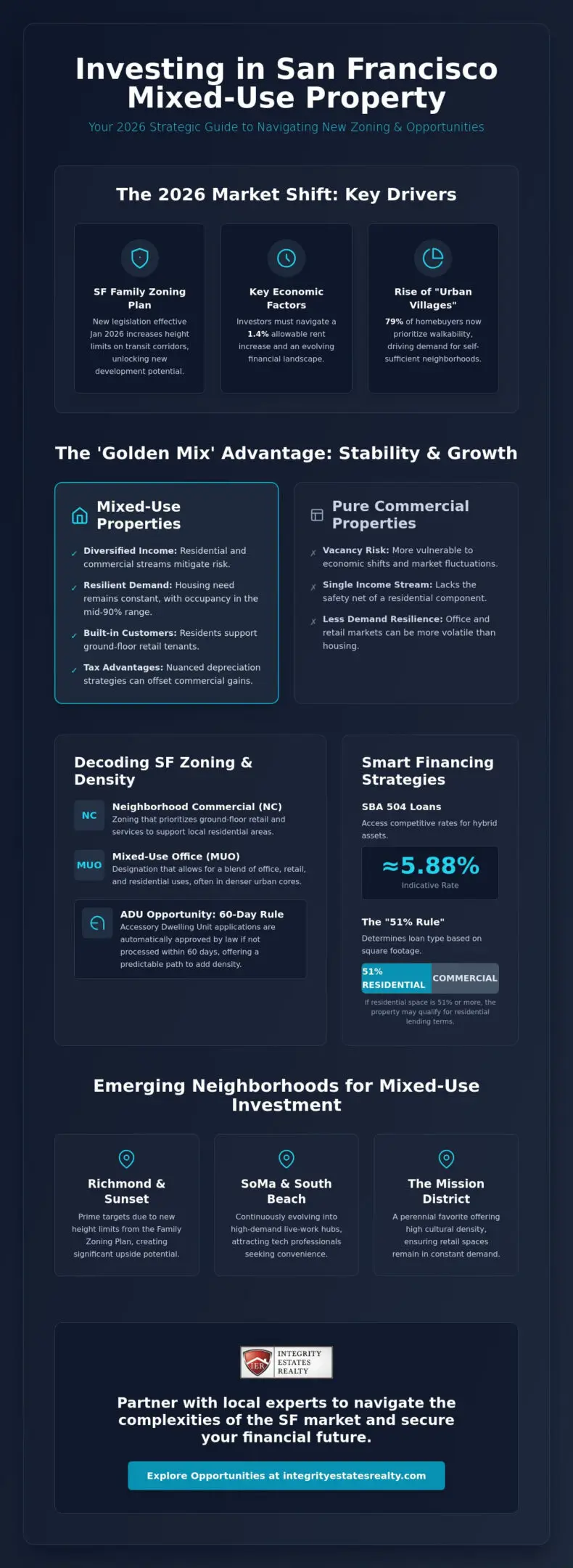
With the San Francisco Family Zoning Plan now in full effect as of January 2026, height limits on transit corridors have reached new levels, yet many investors are still playing by the old rules. You likely recognize that finding a san francisco mixed-use property for sale requires more than just capital; it demands a deep understanding of the SF Planning Department’s evolving density regulations and the current 1.4% allowable rent increase. It’s natural to feel some trepidation regarding the high barrier to entry and the specialized financing required for these hybrid assets, but these complexities often act as a shield for those who know how to navigate them.
We’re here to act as your ethical anchor and expert guide, ensuring you approach this high-stakes market with absolute clarity. This guide promises to help you master the intricacies of the 2026 landscape, from leveraging SBA 504 loans with rates near 5.88% to identifying properties that balance stable commercial storefronts with low-vacancy residential units. We will preview the specific high-yield strategies and due diligence steps necessary to transform a complex transaction into a secure, long-term investment that reflects your personal aspirations for growth in the city.
Key Takeaways for Your 2026 Investment
- Learn how to identify a high-potential san francisco mixed-use property for sale by navigating the “urban village” model driving demand in the current market.
- Gain clarity on SF Planning Department zoning, including the critical differences between Neighborhood Commercial (NC) and Mixed-Use Office (MUO) designations.
- Master the “51% rule” to determine whether your asset qualifies for residential or commercial lending through a specialized mortgage brokerage approach.
- Evaluate long-term ROI by balancing the requirements of the Soft-Story Retrofit Program with the complexities of residential rent control and commercial lease structures.
- Leverage a collaborative partnership rooted in a 20-year legacy of ethical conduct and local expertise to secure your financial future in the Bay Area.
Navigating the San Francisco Mixed-Use Real Estate Market in 2026
Understanding what mixed-use development is provides the foundation for any successful Bay Area investment strategy. These properties serve as the architectural heartbeat of our city, blending residential units with ground-floor commercial or retail spaces. In 2026, the San Francisco market has shifted toward an “urban village” model. This approach prioritizes neighborhood self-sufficiency and high density. Investors aren’t just buying brick and mortar; they’re acquiring community anchors that cater to a population increasingly focused on local living. Recent data indicates that 79% of homebuyers now prioritize walkability, making a san francisco mixed-use property for sale a highly competitive asset class.
The “Golden Mix” is the hallmark of a high-performing asset. It’s the delicate balance between retail, office, and residential square footage that ensures long-term stability. While pure commercial buildings often face vacancy risks during economic shifts, mixed-use buildings offer a safety net. You gain diversified income streams that protect your portfolio. If the retail sector faces a quiet quarter, your residential units provide a reliable floor. Conversely, a strong commercial tenant can elevate the entire building’s profile and value. It’s a sophisticated way to mitigate risk while participating in the city’s vibrant culture.
Why Mixed-Use Assets Outperform Pure Commercial in SF
Residential demand in San Francisco remains remarkably resilient. Even as office markets fluctuate, the need for housing stays constant. Stabilized assets in the city currently maintain occupancy rates in the mid-90 percent range. This residential backbone supports ground-floor retail tenants by providing a built-in customer base. Beyond the steady cash flow, owners benefit from nuanced tax advantages. Depreciation strategies for the residential portion of a hybrid building can often offset the gains from commercial leases. It’s a pragmatic choice for the cautious yet ambitious investor who values peace of mind alongside growth.
Emerging Neighborhoods for Mixed-Use Investment
The 2026 landscape has been permanently altered by the Family Zoning Plan that took effect in January. This legislation increased height limits for multi-family housing on transit corridors, particularly in the Richmond and Sunset districts. These traditionally residential areas are now prime targets for investors seeking a san francisco mixed-use property for sale with significant upside. Meanwhile, SoMa and South Beach continue to evolve into live-work hubs, attracting tech professionals who prefer a short commute to ground-floor amenities. The Mission District remains a perennial favorite, offering a cultural density that ensures retail spaces rarely stay vacant for long. Each neighborhood requires a local expert’s eye to navigate the specific cultural and regulatory nuances that determine a property’s true worth.
Understanding SF Zoning: Commercial-Residential Synergy
The San Francisco Planning Department acts as the ultimate gatekeeper for any san francisco mixed-use property for sale. Navigating the city’s 42 unique zoning classifications requires more than just a map; it requires an understanding of how local officials view the “highest and best use” for a specific block. Whether you’re looking at a Neighborhood Commercial (NC) district or a Mixed-Use Office (MUO) designation, the zoning determines your tenant mix, your density limits, and your long-term exit strategy. Understanding San Francisco’s zoning regulations is the first step in transforming a standard real estate transaction into a strategic portfolio move.
One of the most compelling opportunities in the 2026 market involves Accessory Dwelling Units (ADUs). Under current law, if a complete ADU application is not approved or denied within 60 days, it’s deemed approved by law. This provides a clear, predictable timeline for investors looking to add residential density to existing mixed-use structures. If you encounter an underperforming commercial space, “Change of Use” permits can offer a path to revitalization, though they require a methodical approach to ensure compliance with current building codes and community requirements. Our team at Integrity Estates Realty can help you evaluate these conversion opportunities with a focus on ethical, high-yield results.
Neighborhood Commercial (NC) Districts Explained
NC districts are designed to protect the vibrant, local character of San Francisco’s streets. These zones often have strict “formula retail” restrictions, which limit the presence of large chain stores to ensure small businesses can thrive. However, the trade-off is significant. Properties in these districts often qualify for height and density bonuses, especially under the Family Zoning Plan that took effect on January 12, 2026. Many of these transit-oriented developments (TOD) also benefit from parking requirement exemptions, allowing you to maximize your square footage for habitable or leasable space rather than vehicle storage.
Live-Work and Industrial Mixed-Use (PDR)
For those looking toward the Dogpatch or parts of SoMa, PDR (Production, Distribution, and Repair) zoning offers a unique hybrid value. These spaces are the backbone of the city’s creative and industrial economy. Investing in PDR-zoned assets requires a deep dive into the legal requirements for live-work loft conversions, which have become more stringent in 2026 to preserve industrial capacity. Future-proofing these assets involves ensuring they meet modern environmental standards while maintaining the flexible, open floor plans that modern “maker” tenants and residential dwellers alike find so desirable. It’s about finding a property that respects the city’s past while serving its future.
Financing Strategies for Mixed-Use Assets in the Bay Area
Securing a san francisco mixed-use property for sale requires a departure from standard residential lending practices. Most traditional banks struggle to categorize hybrid assets, often leading to stalled applications or unfavorable terms. A specialized mortgage brokerage approach is essential because it bridges the gap between residential stability and commercial potential. Lenders evaluate these properties through a different lens, focusing heavily on the “51% rule.” If more than half of the square footage is residential, you may qualify for different loan products than a property that is majority commercial. For example, FHA guidelines in 2026 allow for up to 49% commercial use, provided you occupy one of the units, while VA loans limit commercial space to 25%.
Your Debt Service Coverage Ratio (DSCR) is the most critical metric in this journey. Lenders use this to ensure the property’s net operating income can comfortably cover the monthly debt obligations. In a high-value market like San Francisco, maintaining a DSCR of 1.20 or higher is often the benchmark for approval. Lenders will also cross-reference the official San Francisco Zoning Information to verify that the property’s current use aligns with its legal designation. For investors managing diverse interests across the region, leveraging mortgage brokers in Santa Clara County can provide access to wholesale lenders who specialize in multi-county portfolios and complex hybrid assets.
SBA 504 Loans for Owner-User Investors
If you plan to operate your own business out of the commercial storefront, the SBA 504 loan is a powerful tool. It allows you to acquire a san francisco mixed-use property for sale with as little as 10% down. As of June 2026, SBA 504 rates are holding steady between 5.88% and 6.17%, offering a predictable fixed-rate environment. The primary requirement is that your business must occupy at least 51% of the total square footage. This strategy not only builds equity in the real estate but also provides the long-term security of owning your business premises.
Portfolio Lending and Private Capital
Not every property fits into a neat regulatory box. If you’re eyeing a distressed asset or a building with non-conforming commercial tenants, portfolio lending or private capital may be the answer. Bridge loans are particularly useful for acquisitions that need a “value-add” phase before they qualify for permanent financing. Local wholesale lenders often have more flexibility than national banks, allowing them to structure deals based on the unique narrative of the property and its place in the neighborhood. This methodical approach ensures that even the most complex transactions proceed with transparency and peace of mind.
Due Diligence: Evaluating ROI and Compliance for SF Properties
Analyzing a san francisco mixed-use property for sale requires a methodical deep dive into two vastly different regulatory worlds. You aren’t just buying one building; you’re acquiring a dual-purpose asset governed by both the San Francisco Rent Ordinance and complex commercial contract law. The financial soul of your investment lies in the rent roll, where you must reconcile the 1.4% allowable residential rent increase (effective through February 2026) with the more flexible, market-driven terms of a ground-floor commercial lease. This divergence is exactly why a sophisticated due diligence process is non-negotiable for the cautious investor.
Structural compliance is the next pillar of your evaluation. San Francisco’s Soft-Story Retrofit Program has specific mandates for wood-frame buildings with three or more stories. If a property hasn’t yet completed these mandatory upgrades, the looming capital expenditure can significantly alter your initial ROI projections. Beyond the bones of the building, an Environmental Phase I assessment is vital, especially for older structures that may have historically housed “high-risk” tenants like dry cleaners or automotive shops. We believe in providing the transparency you need to uncover these details early, ensuring your peace of mind before you commit to a high-stakes transaction.
Calculating your true Cap Rate also involves factoring in local tax realities. The effective property tax rate in San Francisco is approximately 1.18% of the assessed value. Additionally, you must account for the Real Property Transfer Tax (Prop I), which sits at 5.5% for properties sold between $5 million and $9.999 million. While a proposed transfer tax reduction through the BUILD Act is under discussion as of March 2026, current modeling should rely on established rates to ensure your financial logic remains sound. Our team at Integrity Estates Realty provides the expert oversight necessary to navigate these complex audits. Partner with us to secure a comprehensive analysis of your next Bay Area acquisition.
SF Rent Control Nuances for Mixed-Use Owners
It’s essential to determine exactly which residential units fall under local rent control versus the California Tenant Protection Act (AB 1482). This distinction dictates your ability to implement pass-through costs for utilities or capital improvements. During the escrow process, we prioritize obtaining Estoppel Certificates from every tenant. these documents act as an ethical anchor, confirming the current lease terms, security deposits, and any verbal agreements that might otherwise lead to post-closing disputes. It’s a simple step that protects the integrity of your personal narrative as a new owner.
Commercial Lease Audits
Commercial leases in San Francisco typically fall into Triple Net (NNN) or Modified Gross structures. In a NNN setup, the tenant covers property taxes, insurance, and maintenance, which offers you a more predictable cash flow. You’ll want to scrutinize the tenant’s creditworthiness and the remaining length of their term, paying close attention to “Right of First Refusal” or “Option to Renew” clauses. These details determine your future flexibility. A strong anchor tenant, such as a long-standing local cafe or a boutique retail shop, doesn’t just pay the rent; it curates the lifestyle of the entire building and stabilizes your residential vacancy rates.
Partnering with Integrity Estates Realty for Your SF Investment
Choosing a partner for your next acquisition is a decision that extends far beyond a single transaction. It’s about finding an ethical anchor in a competitive industry. At Integrity Estates Realty, our 20-year legacy in the California real estate and mortgage market provides the stability you need to navigate the city’s unique challenges. We understand that a san francisco mixed-use property for sale isn’t just a building; it’s a personal narrative of growth and a physical asset that requires precise financial handling. Our personality is rooted in high-minded dedication, prioritizing your long-term peace of mind over a quick transaction.
Our strategic advantage lies in our deep regional footprint. By integrating our specialized knowledge of commercial real estate in Gilroy with direct San Francisco market access, we offer a bird’s-eye view of the Bay Area’s economic corridors. This multi-county expertise across Santa Clara, Monterey, and San Francisco ensures that whether you are diversifying your portfolio or making your first hybrid acquisition, you are backed by data-driven insights and local pride. We bridge the gap between financial logic and your personal aspirations for comfort and belonging.
The true strength of our partnership is our dual-licensed approach. Unlike traditional firms that hand you off to a third-party lender, we manage both the brokerage and the financing in-house. This seamless integration is vital when dealing with the “51% rule” or securing SBA 504 loans mentioned earlier. From FHA and VA originations to Jumbo loan processing and refinancing, we act as your steadfast guide. We alleviate the stress of high-stakes transactions through transparency and methodical execution, ensuring the financing matches the property’s unique zoning requirements.
The Integrity Estates Realty Difference
We prioritize lifestyle curation and long-term value. Our boutique service model means you aren’t just another file; you’re a collaborative partner. Our deep local network often provides access to off-market mixed-use opportunities that never reach public aggregators. This gives you a distinct advantage in a market where timing and ethical conduct are everything. We remain by your side from the initial search through the final loan funding, ensuring every detail of the san francisco mixed-use property for sale aligns with your specific ROI goals and your vision for the future.
Start Your SF Investment Journey Today
The 2026 market rewards those who move with intention and preparation. We invite you to schedule a consultation to review your investment criteria and explore the current inventory across the Bay Area. Our team will help you get pre-qualified for specialized mixed-use financing, providing the reassurance needed to submit a winning offer with confidence. Contact Integrity Estates Realty to find your next San Francisco investment and secure a partner who is as invested in your future as you are.
Securing Your Legacy in the San Francisco Market
The path to a successful investment in San Francisco’s hybrid assets requires a blend of local intuition and technical precision. By mastering the nuances of SF Planning Department regulations and aligning your portfolio with the 2026 urban village model, you position yourself to capture long-term value in a city that prizes walkability and community density. We’ve explored how specialized financing structures and rigorous lease audits act as the foundation for sustainable ROI, ensuring that your acquisition stands as a secure anchor for years to come.
Identifying the right san francisco mixed-use property for sale is only the first step; the true victory lies in the ethical execution of the deal and the seamless integration of your financing. With over 20 years of California real estate expertise and a unique model that provides integrated mortgage brokerage services, we’re here to streamline the complexities of your journey. We understand the personal narrative behind every transaction and remain dedicated to your peace of mind throughout the process. Our deep knowledge of local planning codes ensures that no detail is overlooked in your pursuit of growth.
Explore San Francisco Mixed-Use Opportunities with Integrity Estates Realty
We look forward to acting as your steadfast guide and helping you transform your financial goals into a lasting reality in the heart of the Bay Area. Your future in this vibrant landscape starts with a single, well-informed decision.
Frequently Asked Questions
Is a mixed-use property considered residential or commercial for financing?
Financing depends on the ratio of residential to commercial square footage within the building. Generally, if the residential portion exceeds 50% of the total area, the asset may qualify for residential loan products. If the commercial space is the primary use, lenders will require commercial mortgage structures. This distinction is vital because it dictates your down payment requirements, interest rates, and the specific loan programs available to you.
What is the average cap rate for San Francisco mixed-use properties in 2026?
In 2026, cap rates for prime, stabilized mixed-use assets in San Francisco typically hover in the low single digits. While these yields are conservative compared to other markets, they reflect the city’s high property values and long-term appreciation potential. Smaller or value-add buildings in neighborhoods like the Sunset or Richmond often command slightly higher cap rates as investors balance risk with higher potential yields.
Does San Francisco rent control apply to mixed-use buildings?
Yes, the San Francisco Rent Ordinance applies to the residential units in most mixed-use buildings constructed before June 1979. For the current period ending February 28, 2026, the allowable rent increase is set at 1.4%. Commercial tenants don’t have these same protections, which allows owners to negotiate market-rate leases for ground-floor spaces. It’s essential to verify the specific rent control status of every unit during your due diligence.
Can I use an FHA loan to buy a mixed-use property in SF?
You can use an FHA loan to purchase a san francisco mixed-use property for sale if you meet specific occupancy and usage requirements. The commercial space cannot exceed 49% of the building’s total square footage, and you must occupy one of the residential units as your primary residence. This program is an excellent entry point for owner-user investors who want to leverage lower down payment options in a high-value market.
What are the biggest risks when buying mixed-use real estate in San Francisco?
The primary risks involve navigating complex local zoning laws and managing the dual responsibilities of residential and commercial tenancies. A vacancy in a ground-floor retail space can be harder to fill than a residential unit, potentially impacting your cash flow for several months. Additionally, unexpected compliance costs from local mandates can diminish your ROI if they aren’t uncovered early. Professional oversight is necessary to mitigate these high-stakes variables.
How do I verify the zoning of a San Francisco property before making an offer?
To verify the zoning of a san francisco mixed-use property for sale, you should consult the SF Planning Department’s online Property Information Map. This tool allows you to search by address to find the exact classification, such as Neighborhood Commercial (NC) or Mixed-Use Office (MUO). You can also check for any active building permits or neighborhood-specific restrictions that might limit your future development plans or change-of-use applications.
What is a soft-story retrofit, and does it affect mixed-use buildings?
A soft-story retrofit is a structural reinforcement required for wood-frame buildings with three or more stories and large ground-floor openings, such as storefronts. Many mixed-use buildings in the city fall into this category. It’s crucial to confirm a building’s compliance status before purchase. The cost of these mandatory seismic upgrades can be substantial, so they must be factored into your acquisition budget to ensure your financial logic remains sound.