
The Ultimate Mortgage Refinance Checklist: Your 2026 California Guide
What if the difference between securing a 7.19% refinance rate and watching a lock-in window slam shut came down to a single missing PDF in your inbox? In our current 2026 market, many homeowners feel the weight of this uncertainty as they try to navigate the complex California mortgage refinance requirements. It’s natural to feel anxious about whether your credit score meets the 660 to 680 threshold for conventional loans or if you’ve properly accounted for California’s specific closing costs, which typically range between $3,000 and $6,000.
We agree that the paperwork can feel like an insurmountable mountain when you’re simply trying to lower your monthly payments or access equity for home improvements. This guide from Integrity Estates Realty promises to transform that mountain into a clear, manageable path with a comprehensive, document-by-document checklist designed for this year’s unique economic landscape. We’ll walk through exactly what you need to have ready, from income verification to the latest state-mandated disclosures, ensuring your journey toward financial freedom is as steady and purposeful as the home you’ve built. By the time you finish reading, you’ll have a complete roadmap to navigate the 2026 lending environment with total confidence.
Key Takeaways
- Identify your primary refinancing objectives for 2026 to ensure your new loan terms align with your long-term financial health and lifestyle goals.
- Gain a clear understanding of the current california mortgage refinance requirements, including the specific income and tax documents lenders demand in today’s market.
- Navigate the appraisal and shopping process with confidence by learning how to evaluate competing Loan Estimates and secure a favorable interest rate lock.
- Prepare for a stress-free closing by mastering the nuances of the California escrow process and the “Right of Rescission” protections available to primary homeowners.
Determining Your Refinance Goals: Is 2026 the Right Time for You?
At its core, refinancing means replacing your existing mortgage with a new loan under different terms. If you want a deeper grounding in the concept before diving into the numbers, the Wikipedia entry on what is mortgage refinancing offers a solid encyclopedic overview of the various types and motivations involved. But understanding the definition is only the starting point. The real question is whether your personal financial picture and the current California market align well enough to make a move worthwhile in 2026.
California homeowners are entering this year with a distinct set of motivations. Some are chasing lower monthly payments after rates softened from their recent peaks. Others want to compress a 30-year term into 15 years to build equity faster. A growing number are exploring cash-out refinances to fund kitchen renovations, ADU construction, or debt consolidation, leveraging the substantial equity that high-value California properties have accumulated. Unlike generic national advice suggesting you refinance any time you can shave 0.75% off your rate, the calculus here is more nuanced. High property values mean larger loan balances, which amplifies both the potential savings and the closing costs you’ll need to recoup.
The 2026 California Rate Environment
Federal Reserve policy decisions continue to ripple directly into the mortgage rates California borrowers see at the closing table. For long-term Gilroy residents specifically, the Gilroy real estate market trends heading into 2026 reflect a local economy shaped by its proximity to Silicon Valley employment corridors and steady housing demand. Fixed-rate loans offer predictability for homeowners planning to stay put for a decade or more, while adjustable-rate mortgages may appeal to those with a defined shorter horizon, though they carry inherent rate-reset risk worth weighing carefully.
Calculating Your Potential Savings
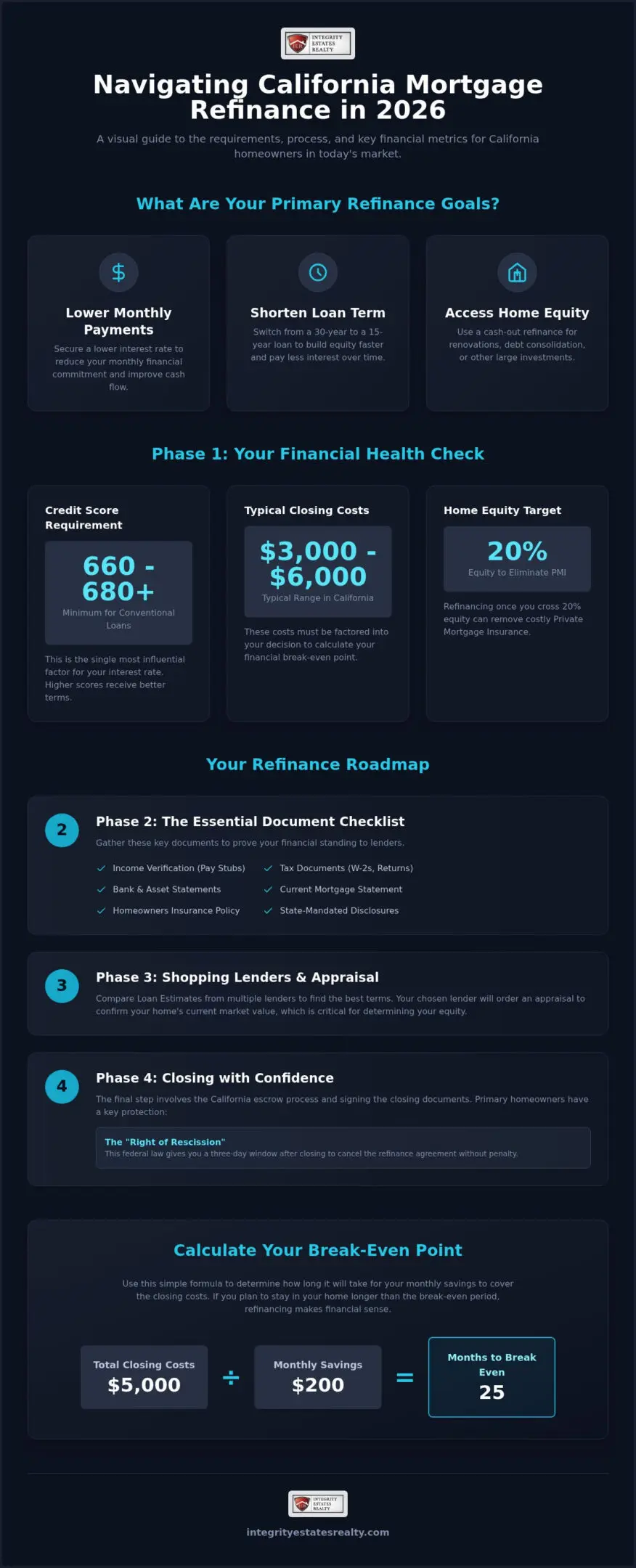
The break-even formula is straightforward: divide your total closing costs by your projected monthly savings. If closing costs run $5,000 and you save $200 per month, your break-even point is 25 months. If you plan to stay in the home well beyond that threshold, refinancing makes financial sense. But a lower rate isn’t the only lever worth pulling. Eliminating private mortgage insurance once your equity crosses the 20% mark can deliver meaningful monthly relief independent of rate movement. Cash-out refinances, meanwhile, can be a strategically sound tool for high-value renovations that increase your home’s appraised value, provided you approach them as a deliberate investment rather than a short-term fix.
Understanding these goals upfront is the foundation of meeting california mortgage refinance requirements successfully. Every document you’ll gather, every threshold you’ll need to clear, flows directly from the objective you define today.
Phase 1: Financial Health & Equity Assessment for California Homeowners
Before you begin gathering pay stubs, you must first understand the foundation of your financial profile. This initial assessment is where many homeowners find the most clarity, as it reveals exactly how you align with current california mortgage refinance requirements. Your credit score, debt-to-income (DTI) ratio, and home equity aren’t just numbers on a page; they are the primary tools lenders use to measure your reliability as a borrower in the competitive 2026 market.
Optimizing Your Credit Profile
Your credit score is the single most influential factor in determining your interest rate. For conventional loans in 2026, most lenders require a minimum score between 660 and 680 to qualify. We recommend reviewing your credit report for errors at least three months before you intend to apply. Even a small mistake, like an incorrectly reported late payment, can drag your score down and cost you thousands over the life of the loan. While national standards offer a baseline, local lenders and mortgage brokers in Santa Clara County often apply their own overlays to these tiers, rewarding those with higher scores with the most favorable pricing. During this period, it’s vital to avoid opening new credit lines or making large purchases, as these actions can fluctuate your score and raise red flags during the final underwriting stages.
Understanding Your Home Equity
Equity is the difference between what you owe and what your home is worth today. In high-value areas like Santa Clara County, market values can shift quickly based on recent high-stakes transactions in your neighborhood. It’s important to distinguish between market value and appraised value; while your neighbor’s home may have sold for a premium, a lender’s appraiser will look for concrete comparable sales to justify your loan amount. Navigating the nuances of California government refinancing policies provides a clear picture of how state-level regulations can influence your path, particularly regarding loan-to-value (LTV) limits. To avoid private mortgage insurance (PMI), you generally need to maintain at least 20% equity. However, if your equity is currently lower, you might explore the benefits of FHA home loans in Gilroy, which often accommodate lower credit scores and higher LTV ratios. Taking a moment to consult with a local professional can help you determine your exact standing before you pull the trigger on an application.
Finally, calculate your DTI ratio by dividing your total monthly debt payments by your gross monthly income. A DTI of 43% or lower remains the standard for 2026. If you’re close to this limit, consider paying down small balances to create more breathing room in your application.
Phase 2: The Essential Mortgage Refinance Document Checklist
Gathering your paperwork is often the most stressful part of the journey, yet it’s the most critical step in satisfying california mortgage refinance requirements. While understanding the refinancing process conceptually is helpful, the actual execution relies on a meticulous paper trail. Think of this checklist as the bridge between your financial goals and the final approval. Lenders in 2026 are more detail-oriented than ever, so having these items ready will prevent delays that could jeopardize your rate lock.
To establish a clear picture of your current standing, you’ll need to provide the following foundational documents:
- Proof of Income: Your most recent 30 days of pay stubs and W-2 forms for the past two years.
- Tax Documentation: Complete federal tax returns for the last two years, including all schedules and attachments.
- Asset Verification: 60 days of consecutive statements for all bank, brokerage, and retirement accounts.
- Property Information: Your most recent mortgage statement, current homeowners insurance declaration page, and recent property tax bills.
Having these items organized allows your loan officer to move quickly. It also demonstrates that you’re a prepared and reliable candidate for the best available rates.
Documentation for Self-Employed & 1099 Earners
Many generic guides overlook the complexities of non-traditional income, but we recognize that many California homeowners run their own businesses or work as independent contractors. If you fall into this category, you’ll need to provide a year-to-date Profit and Loss (P&L) statement. Lenders will also require business bank statements and your 1099-MISC or 1099-NEC forms. Integrity in reporting is the cornerstone of our approach; being transparent about your business expenses and income ensures your loan is structured for long-term stability rather than just a quick approval. This clarity protects your financial health as much as it satisfies the lender.
Specialized Loan Requirements (VA & FHA)
If you’re refinancing through a government-backed program, specific forms are mandatory to confirm your eligibility. VA loan applicants must provide their Certificate of Eligibility (COE) and a copy of their DD-214 form. For FHA loans, you’ll need to document your existing FHA case number and your current mortgage insurance details. While some streamline options exist for these loan types that may reduce the total volume of paperwork, starting with a complete file is always the most efficient path. These specialized programs are designed to support your homeownership journey, and we’re here to act as your steadfast guide through their unique requirements.
Phase 3: Shopping Lenders and Navigating the California Appraisal Process
Shopping for a lender is about more than finding a low interest rate. It’s about finding a partner who understands the specific california mortgage refinance requirements and the nuances of our local property values. We recommend requesting Loan Estimates from at least three different lenders. This side-by-side comparison reveals the true cost of borrowing beyond the advertised number. Once you find a favorable offer, lock in your interest rate immediately. This protects you from the sudden volatility that can occur in the 2026 economic landscape, ensuring your monthly payment remains exactly where you expect it to be.
How to Compare Loan Estimates
When you receive your Loan Estimate, look closely at the “Total Interest Percentage” (TIP). This figure shows the total amount of interest you’ll pay over the life of the loan as a percentage of your loan amount. In California, you’ll see a mix of legitimate third-party costs, such as title insurance and escrow fees, alongside potential “junk fees.” These might appear as excessive application fees or courier charges that don’t add value to your transaction. Working with a refinance mortgage expert in Gilroy gives you an edge. They understand local fee structures and can help you identify which costs are standard and which are negotiable. This transparency is the cornerstone of an ethical lending experience.
Preparing for the California Home Appraisal
The appraisal is a pivotal moment because it determines your final Loan-to-Value (LTV) ratio. To ensure you receive maximum value, prepare a detailed list of all recent home improvements, including dates and costs, to provide to the inspector. In neighborhoods like Gilroy, curb appeal isn’t just about aesthetics. It’s a signal of property maintenance that appraisers take into account when comparing your home to recent sales. If the appraisal comes in lower than expected, you can work with your advisor to file an appraisal rebuttal. This involves providing additional comparable sales that the appraiser might have overlooked during their initial walkthrough.
Finally, your lender must provide a Closing Disclosure (CD) at least three days before you sign the final papers. This mandatory waiting period is designed to give you time to compare the CD with your original Loan Estimate. Look for any significant changes in loan terms or closing costs. If you’re ready to see how your property stacks up in today’s market, reach out to our team for a personalized equity review. This careful review ensures there are no surprises at the closing table, keeping your financial transition smooth and transparent.
Closing Your Refinance with Integrity Estates Realty
The final stage of your journey is where preparation meets execution. Once you have navigated the complex california mortgage refinance requirements and received your final approval, the closing process begins. One of the most important protections you have during this phase is the “Right of Rescission.” For a refinance on your primary residence, federal law provides a three-day cooling-off period after you sign the closing documents. This window allows you to cancel the transaction for any reason without penalty, giving you one last opportunity to ensure the terms align perfectly with your long-term financial health.
After this period expires, your local California title company will finalize the escrow process. This includes the secure wiring of funds for closing costs or the distribution of your cash-out proceeds if you are leveraging your home’s equity for improvements or debt consolidation. Once the new loan is recorded, you’ll transition to your new mortgage servicer and begin making payments under your updated terms. This moment marks the beginning of your improved financial position, whether it’s through lower monthly payments, a shorter loan duration, or the removal of mortgage insurance.
The Integrity Estates Advantage
With over 20 years of experience, Integrity Estates Realty serves as your steadfast guide through every high-stakes detail of the closing process. We prioritize the human experience behind every transaction, ensuring you never feel like just another file in a queue. Our integrated approach creates a collaborative partnership between our real estate and mortgage experts, streamlining communication and eliminating the friction often found with larger, impersonal lenders. We view ourselves as an ethical anchor in a competitive industry, prioritizing your peace of mind and long-term financial stability over a quick transaction. Our dedication to transparency means you’ll always understand exactly what you’re signing and why.
Next Steps: Get Your Personalized Refinance Plan
Every homeowner’s situation is unique, and the 2026 market demands a tailored approach. We invite you to schedule a no-obligation consultation with Jose M Hernandez to discuss your specific goals. Whether you’re looking to refinance a property in San Jose, Gilroy, or Fresno, our team understands the local nuances that impact your application. We’ll help you determine if you meet the current california mortgage refinance requirements and design a roadmap that prioritizes your family’s future. Our steady, purposeful rhythm ensures that all your inquiries are addressed thoroughly while remaining highly efficient in execution. Secure your financial future with a partner you can trust by reaching out to us today.
Securing Your Financial Future in the 2026 Market
Refinancing your home is more than a simple transaction; it’s a strategic move toward long-term stability and personal lifestyle curation. By mastering the document checklist and understanding the specific california mortgage refinance requirements, you’ve already cleared the most significant hurdle. We’ve explored how a clear equity assessment and a meticulous approach to your credit profile can unlock the best available rates in the 2026 market.
Integrity Estates Realty stands as your steadfast guide through this complex landscape. With over two decades of California mortgage expertise, our locally owned brokerage under the leadership of Jose M Hernandez provides the integrated real estate and loan services you need for a seamless, stress-free experience. We prioritize your financial health and peace of mind. We act as an ethical anchor in a competitive industry.
Ready to take the next step toward a lower monthly payment or accessing your home’s equity? Get Your Personalized 2026 Refinance Quote Today and discover how we can help you achieve your homeownership dreams. You’ve worked hard to build a life in your home; now it’s time to ensure your mortgage works just as hard for you.
Frequently Asked Questions
What is the minimum credit score for a mortgage refinance in California in 2026?
Most lenders require a score of 660 to 680 for conventional loans as of August 2026. FHA loans offer more flexibility, potentially accepting scores as low as 500 to 580 depending on your equity and other factors. Higher scores generally secure the most competitive interest rates. It’s best to review your report for errors before applying to ensure you meet the california mortgage refinance requirements for your chosen loan program.
How long does the mortgage refinance process typically take from application to closing?
The timeline generally spans 30 to 45 days, though high demand or complex files can extend this period. Your speed in providing the documents listed in our checklist directly impacts this duration. Factors like appraisal scheduling and the mandatory three-day right of rescission are built into this window. We work to maintain a steady, purposeful rhythm to move your application through underwriting as efficiently as possible for your family.
Can I refinance my mortgage if I have a second mortgage or HELOC?
Yes, you can refinance, but you must decide whether to pay off the second lien or ask the lender to subordinate it. Subordination means the second mortgage holder agrees to stay in second position behind your new primary loan. New California regulations, like AB 130 effective June 2025, have updated requirements for subordinate mortgage servicing. These rules ensure transparency during the process, protecting your long-term financial health while you restructure your debt.
What are the typical closing costs for a refinance in Santa Clara County?
Homeowners usually pay between $3,000 and $6,000 in closing costs, or roughly 2% to 6% of the loan amount. These fees cover the appraisal, title search, escrow services, and lender origination charges. Because property values are higher in Santa Clara County, your total costs might sit at the higher end of this range. We prioritize transparency, providing a clear breakdown of every fee so there are no surprises at the closing table.
Is a home appraisal always required for a refinance?
Most traditional refinances require a full appraisal to verify the home’s current market value, but exceptions do exist. Some lenders offer appraisal waivers if they have sufficient data on your property and your loan-to-value ratio is low. Government-backed streamline programs may also waive this requirement. However, in a competitive market like Gilroy, a fresh appraisal often helps confirm the equity growth you’ve earned through recent neighborhood appreciation and home improvements.
What is a “no-closing-cost” refinance, and does it actually save money?
This option allows you to avoid paying upfront fees by either rolling them into the loan balance or accepting a slightly higher interest rate. While it reduces your immediate out-of-pocket expenses, it often costs more over the life of the loan due to increased interest charges. It’s a strategic choice for homeowners who plan to sell within a few years. We help you calculate the long-term impact to ensure it fits your goals.
Can I refinance my FHA loan into a conventional loan to remove PMI?
You can certainly make this switch if you have reached at least 20% equity in your home. Moving to a conventional loan is a popular way to satisfy california mortgage refinance requirements while eliminating permanent FHA mortgage insurance premiums. This transition can save you hundreds of dollars each month. We’ll help you review your current appraisal and equity position to determine if this move provides the best long-term value for your household.
What happens to my escrow account when I refinance?
Your current lender will close your old escrow account and refund any remaining balance to you, usually within 30 days of the loan payoff. You’ll then set up a new escrow account with your new lender to cover property taxes and homeowners insurance. It’s important to remember that you might need to provide funds to seed the new account at closing. This ensures your essential payments continue without interruption during the transition.