
Understanding Property Taxes After Buying a Home in Gilroy: A 2026 Homeowner’s Guide
Did you know that while Proposition 13 technically caps your base tax rate at 1%, the average homeowner in Gilroy actually pays an effective rate of 1.24%? For many new residents, understanding property taxes after buying a home in gilroy feels like solving a puzzle where the pieces keep moving. You’ve likely felt the relief of closing on your dream home, only to be met with the nagging anxiety of an unexpected supplemental bill or a confusing line item for Mello-Roos assessments. It’s a common concern, especially when you’re trying to settle into the local lifestyle and protect your long-term financial health.
We’re here to provide the clarity you deserve so you can manage your household budget with absolute confidence. You’ll learn exactly how to master the nuances of California’s tax laws, from the specific timeline of your annual bills to the ways you can apply for exemptions like the $7,000 homeowner’s credit. This guide explores how escrow accounts handle tax increases and what to expect from Gilroy’s unique local bonds; we’ll ensure your investment remains a source of pride rather than stress.
Key Takeaways
- Learn how Proposition 13 limits your tax increases and why your home’s assessed value resets to the purchase price once you’ve closed.
- Gain clarity on understanding property taxes after buying a home in gilroy by preparing for the supplemental tax bill that often catches new owners off guard.
- Identify Gilroy-specific assessments and Mello-Roos fees that fund local infrastructure but can push your effective tax rate higher than the 1% base.
- Understand the mechanics of escrow accounts to avoid the “escrow shock” that occurs when your monthly mortgage payment adjusts for new tax rates.
- Discover how to lower your annual costs through the California Homeowner’s Exemption and the tax base transfer benefits of Proposition 19.
The Foundation: How Proposition 13 Limits Your Gilroy Property Tax
Your annual tax bill is governed by a landmark piece of legislation known as Proposition 13. This law provides the essential framework for understanding property taxes after buying a home in gilroy by establishing a predictable, capped system. Without this protection, homeowners would face the risk of being priced out of their own neighborhoods as market values rise. Instead, California utilizes an acquisition-based system that prioritizes long-term stability for every homeowner.
It’s common for new residents to feel a sense of confusion when comparing bills with their neighbors. If you recently purchased your home for a million dollars, your base tax is calculated on that figure. Your neighbor, who might have purchased an identical floor plan in the late nineties, is likely paying taxes based on a much lower original price plus small annual adjustments. This disparity isn’t an error; it’s the intended result of a system that rewards those who invest in the community over time.
Calculating Your Base Tax Rate
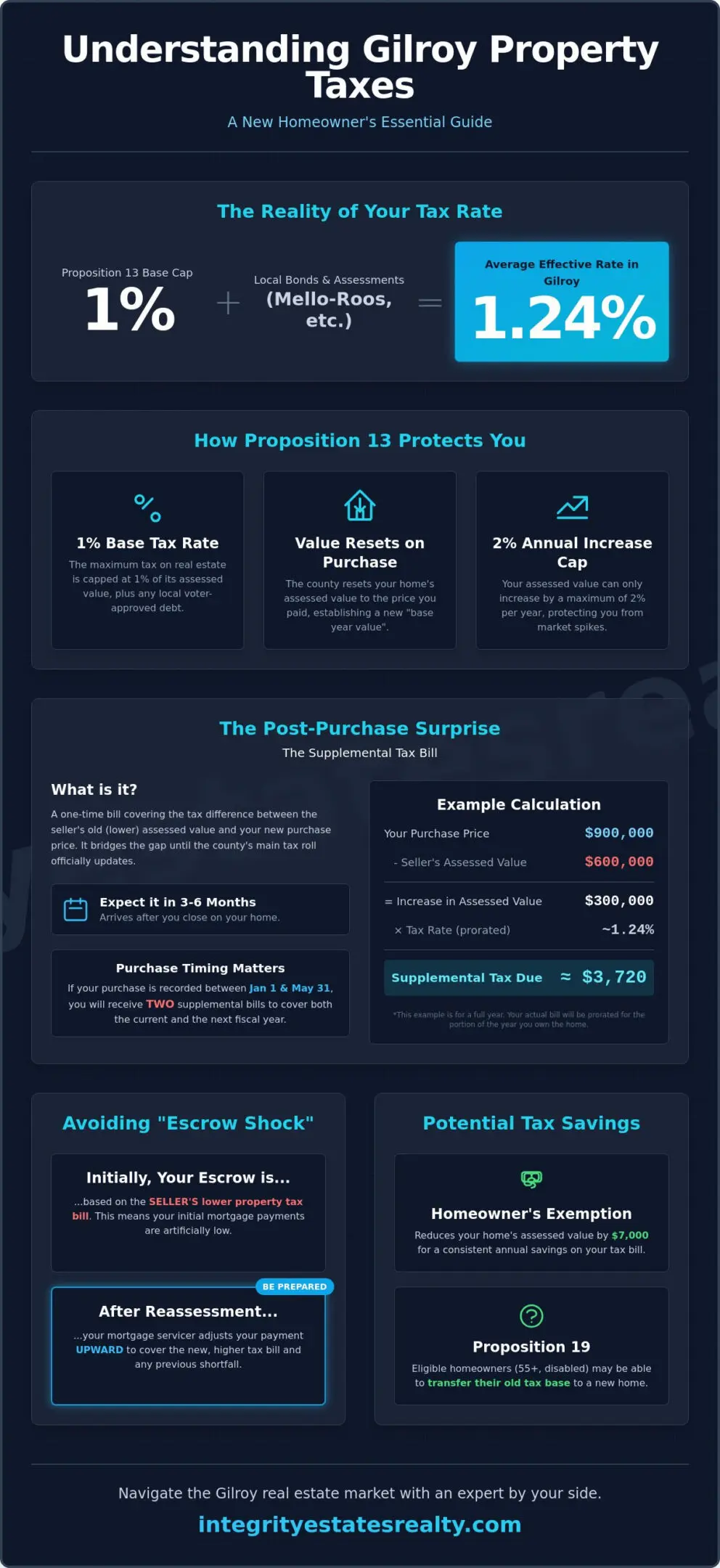
The calculation begins with a 1% base levy, which is the maximum ad valorem tax rate allowed on real property across the state. When you complete your purchase, the Santa Clara County Assessor resets the property’s assessed value to match the current market price. This reset ensures that your initial tax burden reflects the actual value of your investment at the time you acquired it. The base year value is the full cash value of your property at the time of purchase and serves as the definitive starting point for all future Gilroy tax calculations. While you’ll see additional line items for local bonds and assessments later, this 1% remains the bedrock of your bill.
The 2% Annual Inflation Factor
Predictability is perhaps the greatest benefit of the local tax structure. Even if Gilroy’s housing market experiences a sudden surge in demand, your tax bill won’t follow suit with an equally dramatic spike. The law mandates that the assessed value of your home can only increase by a maximum of 2% each year, regardless of how much the actual market value grows. This adjustment is tied to the California Consumer Price Index (CCPI), ensuring that your tax burden remains manageable even as inflation fluctuates. This protection creates a significant “lock-in” effect for homeowners. Over a decade or more, the gap between your assessed value and the home’s true market value can become substantial, providing a reliable financial anchor that allows you to plan for the future with total peace of mind.
The Supplemental Tax Bill: Preparing for the Post-Purchase Surprise
The closing process involves many moving parts, but one of the most overlooked is the arrival of the supplemental tax bill. This isn’t a mistake or a double charge. Instead, it represents the “gap” between the previous owner’s tax basis and your new purchase price. Because the Santa Clara County tax roll only updates once a year, there is a delay between when you buy the home and when the official system reflects your higher assessment. Understanding property taxes after buying a home in gilroy means expecting this secondary bill to arrive roughly three to six months after you move in.
The timing of your purchase, often referred to as the “pruning” effect, determines the volume of mail you’ll receive from the county. If your deed is recorded between January 1 and May 31, the Assessor’s office actually generates two separate supplemental bills. One covers the remainder of the current fiscal year ending June 30, and the second covers the entire following fiscal year. This happens because the main tax roll for the upcoming year was already “set” based on the old values before you bought the home. Identifying these dates early allows you to avoid the stress of an unbudgeted expense during your first year of residency.
The Supplemental Math Explained
Calculating this amount is straightforward but vital for your financial planning. You take your purchase price and subtract the seller’s prior assessed value; the resulting difference is then multiplied by the tax rate and prorated. The supplemental bill covers the period from your closing date to the start of the next tax cycle. While you might be eligible for certain Proposition 19 Benefits that allow you to transfer a lower tax base, most buyers should prepare for the full reassessment. For example, if you purchase a home for $900,000 that was previously assessed at $600,000, you will be billed for the 1% tax on that $300,000 difference, adjusted for the months you actually owned the property.
Managing the Two-Bill Reality
A common point of confusion involves your mortgage escrow account. Most lenders calculate your monthly payment based on the projected annual tax, but they rarely include funds for the one-time supplemental bill. This often leads to “escrow shock” if you aren’t prepared to pay the county directly. If you’re currently in the search phase, partnering with a professional for residential real estate representation can help you navigate these financial nuances before you sign the final papers. To stay ahead of the curve, follow these practical steps:
- Review your Preliminary Title Report to find the seller’s current assessed value.
- Calculate the difference between your purchase price and that value to estimate the total “gap.”
- Set aside approximately 1.25% of that difference to ensure you have liquid funds when the bill arrives.
- Monitor your mail for the “Notice of Assessed Value” change from the Santa Clara County Assessor.
By treating the supplemental bill as a planned event rather than a surprise, you maintain control over your investment. This proactive approach ensures that the excitement of your new home isn’t dampened by a simple administrative delay in the county’s billing cycle.
Local Levies: Mello-Roos and Gilroy-Specific Assessments
While Proposition 13 provides the bedrock of your tax bill, local levies are what determine your final monthly commitment. These voter-approved debts and special assessments fund the very infrastructure that makes our community a desirable place to live. Understanding property taxes after buying a home in gilroy requires a close look at the “Direct Assessments” section of your Santa Clara County tax statement. This is where you’ll find charges for school bonds, community college districts, and regional water projects that sit on top of that base 1% rate. These line items reflect the collective choices of the community to invest in its own growth and stability.
It’s helpful to view these assessments not as hidden fees, but as the price of admission for a well-maintained municipality. When you review your bill, you’ll notice that these charges aren’t based on your home’s value but are instead flat fees or calculated based on specific property characteristics like square footage. This distinction is crucial because it means these portions of your bill won’t necessarily rise just because your home’s market value does. They remain tied to the specific bond or service they were created to fund, providing a level of transparency for every dollar spent.
Common Gilroy Special Assessments
Gilroy homeowners often see several standard line items that support regional services. The Gilroy Unified School District bonds are a primary driver, alongside assessments from the Santa Clara Valley Water District. However, if you’ve chosen a home in a newer development like Lions Creek or Eagle Ridge, you’ll likely encounter a Mello-Roos Community Facilities District (CFD) tax. These special taxes are used to finance public improvements like roads, sewers, and parks within specific neighborhoods. In 2026, Mello-Roos assessments in Gilroy typically range from approximately $1,200 to over $6,000 per year, depending on the specific district and the size of your property. Identifying these districts during the escrow process is essential for accurate long-term budgeting.
Why Effective Rates Exceed 1%
It’s a common misconception that 1% is the final number on your tax statement. In reality, the median effective property tax rate in Gilroy is 1.24%, which is slightly higher than the California state median of 1.21%. This difference covers essential services that directly impact your daily life and safety. Your tax dollars fund a variety of local needs:
- Local police and fire department operations.
- Maintenance and expansion of city parks and recreational facilities.
- Modernization of local school infrastructure and technology.
- Regional water conservation and flood protection projects.
While a higher effective rate might seem daunting at first, it represents a collective investment in the community’s future. High-quality local amenities and well-funded infrastructure are key factors that sustain long-term home values in South County. By looking at these assessments as a contribution to the local lifestyle, you can see the tangible value returned to your household every day. This steady reinvestment ensures that Gilroy remains an ethical anchor for families seeking comfort and long-term value in their residential assets.
Escrow Accounts and the Mortgage Connection
Your mortgage payment is more than just principal and interest; it is a carefully balanced financial ecosystem. For most buyers, the process of understanding property taxes after buying a home in gilroy begins during the initial stages of FHA loan origination or conventional financing. Lenders typically set up an escrow account to collect a portion of your annual property taxes each month. This system is designed to provide peace of mind by ensuring that funds are available when the Santa Clara County Tax Collector sends the bill. However, a common disconnect occurs because lenders often use the seller’s current, lower tax basis to estimate your initial monthly payments.
This discrepancy eventually leads to what industry professionals call “escrow shock.” Once the county records your new purchase price and resets the assessed value, your lender will receive a significantly higher tax bill than they originally projected. When the lender performs their annual escrow analysis, they will discover a shortage. To correct this, they must increase your monthly mortgage payment to both cover the new, higher tax rate and “catch up” on the funds that weren’t collected during your first year of ownership. Deciding whether to use an escrow account or pay the county directly is a significant choice. While direct pay offers more control over your cash flow, the escrow system acts as a reliable safeguard against missed deadlines and late penalties.
Handling the Escrow Shortage
When your lender identifies a shortage, they will typically offer you a few ways to resolve the balance. You might choose to pay the entire deficit in a single lump sum to keep your monthly payment from spiking too dramatically. Alternatively, you can spread the shortage over the following twelve months, though this will result in a higher monthly commitment. To be proactive, you should send a copy of your new “Notice of Assessed Value” to your mortgage servicer as soon as it arrives. By updating them early, you can adjust your monthly collections before a large shortage has the chance to accumulate.
The Role of Your Mortgage Broker
A dedicated mortgage broker in Santa Clara County serves as your steadfast guide through these complex financial transitions. They don’t just find a rate; they help you curate a long-term budget by ensuring your Loan Estimate (LE) reflects the reality of your post-purchase tax burden. They will also help you scrutinize your preliminary title report to identify any hidden tax liens or special assessments that could impact your bottom line. If you are looking for clarity on your current mortgage or want to explore refinancing services to better manage your monthly costs, our team is here to provide the expert guidance you deserve.
Strategic Planning: Exemptions and Proposition 19 Benefits
Strategic planning is the final step in securing your financial legacy and ensuring your home remains a source of comfort rather than a burden. While the billing cycles and assessments we’ve discussed are standard, California law provides several avenues for relief that many homeowners overlook. Truly understanding property taxes after buying a home in gilroy involves recognizing that your initial assessment isn’t always the final word. From standard exemptions to complex base year value transfers, these tools are designed to protect vulnerable populations and encourage long-term residency in our community.
If you believe the Santa Clara County Assessor has overvalued your property, you have the right to file a formal appeal. The deadline to file this appeal for the 2026 tax year is September 15, 2026. This process is particularly relevant if market conditions shift shortly after your purchase, potentially leaving your assessed value higher than the actual current value of the home. Additionally, keep an eye on the November 2026 ballot; the “60+ Property Tax Exemption Act of 2026” is currently seeking signatures through June 25, 2026, and could fundamentally change the landscape for senior residents if passed.
Claiming Your Homeowner’s Exemption
The most accessible form of relief is the California Homeowner’s Exemption. To be eligible, the property must be your principal residence as of January 1st of each year. This is a one-time filing with the Santa Clara County Assessor that reduces your property’s assessed value by $7,000. While the savings are modest (approx. $70/year), they are permanent as long as you own the home. It is a simple but essential step in establishing your property as your primary sanctuary and ensuring you aren’t paying more than necessary.
Prop 19 and the Gilroy Market
Proposition 19 offers sophisticated tax portability for homeowners who are over 55, severely disabled, or victims of natural disasters. This law allows you to transfer your existing, lower tax base to a new home anywhere in California up to three times. For those purchasing in Gilroy between February 16, 2025, and February 15, 2027, there is an exclusion limit of $1,044,586 over the original factored base year value. This protection allows seniors to downsize or move closer to family without facing a massive tax hike that could otherwise jeopardize their retirement budget.
Inter-generational transfers also fall under these rules, which is vital for families planning for the future. For a child to inherit a parent’s low tax basis, they must now use the home as their primary residence. Our real estate agents in Gilroy are well-versed in these nuances and can help you identify properties that align with your tax-efficiency goals. By combining professional representation with a clear grasp of these exemptions, you can move forward with the peace of mind that your investment is ethically and financially sound.
Protecting Your Investment in the Garlic Capital
Your journey as a Gilroy homeowner is an investment in both a physical asset and a vibrant community lifestyle. By mastering the nuances of understanding property taxes after buying a home in gilroy, you’ve moved past the fear of surprise bills and into a position of financial strength. You now recognize how Proposition 13 provides a stable foundation, why the supplemental bill is a necessary one-time adjustment, and how local assessments directly enhance your neighborhood’s value. These insights transform a complex tax system into a predictable part of your long-term wealth strategy.
Managing these intricacies requires a partner who understands both the emotional heart of a home and the technical logic of the tax landscape. Our team brings over two decades of experience in Santa Clara County real estate, offering a unique dual expertise in residential sales and mortgage brokerage. We’re deeply rooted in the Gilroy community and dedicated to providing the transparency you need for total peace of mind. Navigate the Gilroy market with confidence; contact Integrity Estates Realty today to ensure your next move is as rewarding as it is secure. We’re ready to help you thrive in your new home.
Frequently Asked Questions
When are property taxes due in Gilroy?
Property taxes are paid in two equal installments each year. The first installment is due on November 1 and becomes delinquent if not paid by December 10. The second installment is due on February 1 and becomes delinquent after April 10. It is a good practice to set reminders for these dates, as late payments incur a 10% penalty plus additional costs.
Is the supplemental tax bill a one-time payment?
The supplemental tax bill is a one-time charge that covers the period from your purchase date to the end of the current tax cycle. It accounts for the increase in property value that occurred when you bought the home at a higher price than the previous owner. Once this gap is paid and the county updates the annual tax roll, your future property taxes will be combined into a single annual bill.
How do I pay my property taxes in Santa Clara County?
The Santa Clara County Tax Collector offers several convenient payment methods, including a secure online portal for e-checks and credit cards. You can also mail your payment with the provided stub or pay in person at the county office in San Jose. If you use an online bill pay service through your bank, ensure you initiate the transfer several days early to guarantee it is processed before the delinquency deadline.
Does my mortgage payment include property taxes?
Your monthly mortgage payment only includes taxes if you established an escrow or impound account during the loan process. These accounts are designed to pay your standard annual installments, but they typically do not cover supplemental tax bills. A key part of understanding property taxes after buying a home in gilroy is recognizing that you will likely need to pay the supplemental bill directly to the county, even if you have an escrow account.
Can I appeal my property tax assessment in Gilroy?
You have the right to appeal if you believe the market value of your home is lower than the assessed value set by the county. The window to file a formal appeal with the Santa Clara County Assessment Appeals Board for the 2026 tax year is July 2 through September 15, 2026. Successful appeals generally require providing evidence of comparable home sales in your immediate neighborhood that sold for less than your current assessment.
What is the current property tax rate in Gilroy for 2026?
The median effective property tax rate in Gilroy is 1.24% for 2026. While the state-mandated base rate is 1% of the assessed value, local voter-approved bonds and special assessments for schools and infrastructure typically add approximately 0.24% to the total. This rate is slightly higher than the California state median of 1.21%, reflecting the community’s investment in local services and amenities.
How does Proposition 19 affect my Gilroy home purchase?
Proposition 19 offers significant benefits for homeowners over 55, those with severe disabilities, or victims of natural disasters by allowing them to transfer their original tax base to a new home in Gilroy. This can prevent a massive tax increase when moving from a long-held property. Understanding property taxes after buying a home in gilroy also means knowing that heirs must now use an inherited property as their primary residence to qualify for a tax base transfer from their parents.
What happens if I don’t pay my supplemental tax bill?
Ignoring a supplemental tax bill leads to an immediate 10% penalty once the delinquency date passes. If the bill remains unpaid, the county will record a tax lien against the property, which stays on the title and can prevent you from refinancing or selling the home. After five years of continued delinquency, the tax collector has the power to sell the property at a public auction to recover the unpaid taxes and interest.