
Understanding Property Taxes in Gilroy, CA: A 2026 Homeowner’s Guide
Did you know that two identical homes on the same Gilroy street can have property tax bills that differ by thousands of dollars? This reality often leads to significant sticker shock for new buyers who find themselves facing unexpected supplemental bills months after closing. Managing property taxes gilroy ca shouldn’t feel like a guessing game, yet the combination of special assessments and Mello-Roos districts often creates unnecessary stress. We understand that you value transparency and ethical guidance when it comes to your home’s financial health.
This guide will provide the professional clarity you need to plan your 2026 homeownership costs with total confidence. You’ll gain a firm grasp of the 1.24% average effective tax rate and the vital protections offered by Proposition 13. We’ll also provide a definitive schedule of payment deadlines, explain how to handle supplemental bills, and outline the steps to appeal an assessment before the September 15 deadline. By the end of this article, you’ll have a clear roadmap to manage your Santa Clara County obligations with peace of mind.
Key Takeaways
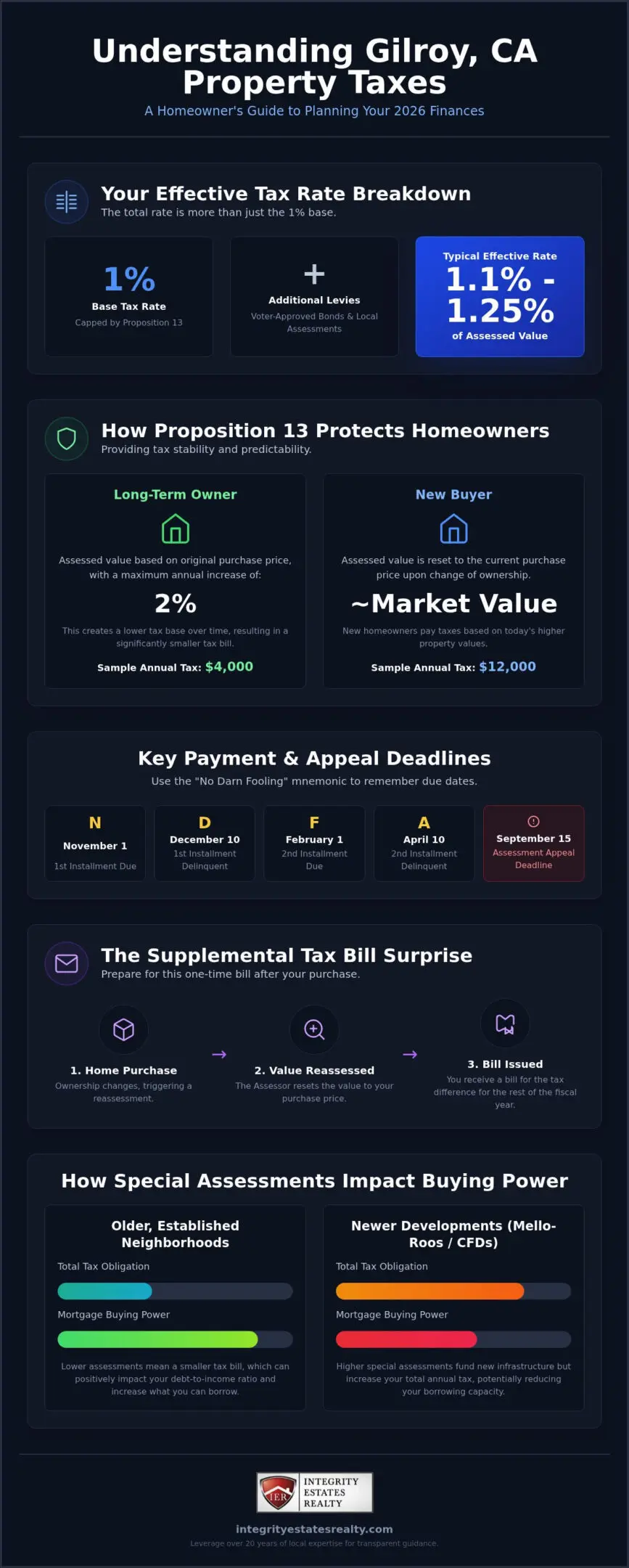
- Learn why the effective rate for property taxes gilroy ca typically ranges from 1.1% to 1.25% once voter-approved bonds and local assessments are factored in.
- Master the “No Darn Fooling” mnemonic to ensure you never miss a Santa Clara County payment deadline or incur unnecessary penalties.
- Prepare for the supplemental tax bill surprise by understanding how property reassessments work immediately following your home purchase.
- Discover how local assessments and Mello-Roos districts directly impact your debt-to-income ratio and overall mortgage borrowing power.
- Leverage over 20 years of local expertise to identify specific neighborhoods with lower special assessments before you make an offer.
Property Taxes in Gilroy, CA: Understanding the Basics for 2026
Managing your home’s finances requires a clear understanding of the entities involved in your annual obligations. The Santa Clara County Department of Tax and Collections (DTAC) serves as the primary authority for billing and receiving property taxes gilroy ca. Our local system operates on an “ad valorem” basis, which literally translates to “according to value.” This means your tax bill is calculated proportionally based on the assessed value of your real estate. For the 2026 tax year, it’s vital to distinguish between the base tax rate and the additional assessments that fund our local schools, parks, and infrastructure. While the tax collector handles the money, the Assessor’s Office determines the value that ultimately dictates your bill.
Passed by voters in 1978, Proposition 13 remains the bedrock of California’s tax structure, capping the base tax rate at 1% and limiting annual increases in assessed value to a maximum of 2%.
The 2026 assessment cycle highlights a significant disparity between long-term owners and those who have recently moved to the area. If you’ve owned your home for a decade, your assessed value is likely much lower than the current price a buyer would pay today. This creates a stable environment for families, though it means that new homeowners must prepare for a higher initial tax burden. We often see clients surprised by this gap, but it’s a predictable part of the California real estate landscape that we help you navigate. Understanding these nuances allows you to transition from a physical asset to a long-term personal dream without financial surprises.
How Proposition 13 Protects Gilroy Homeowners
The 2% annual cap on assessment increases provides a layer of protection that’s rare in other states. Even if property values in South County rise by 10% in a single year, your assessed value for tax purposes can only grow by 2%. This “save our homes” provision ensures that homeowners aren’t priced out of their own neighborhoods by rising equity. It explains why a long-time resident might pay $4,000 in annual taxes while a neighbor in an identical home pays $12,000. This system prioritizes long-term stability over short-term tax revenue, allowing you to plan your future with a high degree of certainty and peace of mind. To further protect your home and legacy, many local families work with an estate planning attorney San Jose to ensure their property tax benefits are preserved for future generations.
The Role of the Santa Clara County Assessor
The Assessor’s primary duty is to determine the taxable value of your property. It’s important to remember that the assessed value is not the same as the fair market value you see on real estate websites. A reassessment typically only occurs when there’s a change in ownership or significant new construction. When you buy a home, the Assessor resets the value to the current purchase price. This reset is a critical factor when reviewing Gilroy Real Estate Market Trends, as it directly impacts your monthly payment. By understanding the difference between what a house is worth on the open market and what it’s worth to the tax collector, you can make more informed decisions about your next investment.
Calculating Your Gilroy Tax Bill: Beyond the 1% Base Rate
While the 1% base rate is the standard across the state, your actual bill for property taxes gilroy ca will include several additional line items. Most residents in our area see an effective tax rate between 1.1% and 1.25% of their assessed value. These additional costs aren’t arbitrary. They represent the collective investment our community has made in local infrastructure and services. Understanding California’s property tax system is the first step in decoding these charges. These extra levies usually fall into two categories: ad valorem bonds, which are based on your home’s value, and direct assessments, which are often flat fees applied to every parcel in a specific district.
If you’re looking at newer developments, particularly in Northwest Gilroy, you’ll likely notice higher total bills. This is because these neighborhoods often utilize Community Facilities Districts to fund the initial construction of roads, sewers, and schools. While these neighborhoods offer modern amenities and beautifully curated streetscapes, they come with a higher annual tax obligation that must be factored into your monthly budget. We believe that transparency in these costs is essential for maintaining your long-term mortgage health and peace of mind.
Mello-Roos and Community Facilities Districts (CFDs)
Mello-Roos taxes are a common feature of California’s landscape, and Gilroy is no exception. These districts allow developers and local governments to fund public improvements by issuing bonds that are repaid by homeowners over 20 to 40 years. In Gilroy, these funds typically support fire protection services, park maintenance, and local school facilities. Before you commit to a purchase, it’s essential to verify if a property sits within a CFD. You can often find this information by reviewing the natural hazard disclosure report or the preliminary title report during your due diligence period. If you need assistance identifying these costs for a specific neighborhood, our team at Integrity Estates Realty can provide a detailed breakdown of the local tax landscape.
Local Bond Measures and School District Levies
A significant portion of your tax bill supports the Gilroy Unified School District (GUSD) through various bond measures approved by local voters. These bonds fund critical upgrades to classrooms and technology, ensuring our students have the tools they need to succeed. Additionally, you’ll see assessments for the Santa Clara Valley Water District and the Open Space Authority. These smaller levies protect our local water supply and preserve the natural beauty of the surrounding hillsides. When browsing Homes for Sale in Gilroy, CA, remember that these assessments vary slightly depending on your specific tax rate area. We believe that being informed about these local investments helps you feel more connected to the community you’re joining.
Important Deadlines and the Supplemental Tax Bill Surprise
Staying ahead of the calendar is the simplest way to protect your financial peace of mind. In California, we use a helpful mnemonic to remember the critical dates for property taxes gilroy ca: “No Darn Fooling.” This stands for November, December, February, and April. Missing these dates leads to a non-negotiable 10% penalty, a cost that adds up quickly on high-value South County homes. We want to ensure you never face that unnecessary expense. You can easily manage payments through the Santa Clara County online portal, which accepts e-checks and credit cards. If your tax bill doesn’t arrive in the mail by mid-November, don’t wait. It’s your responsibility as a homeowner to check the county’s website and ensure your account is current.
The California Property Tax Calendar: Key Dates
The tax year is split into two equal installments. While the dates are fixed, the 5 PM cutoff on delinquent days is strictly enforced by the Department of Tax and Collections. Here is your essential timeline:
- November 1st: The first installment becomes due.
- December 10th: The first installment deadline. Payments are delinquent after 5 PM.
- February 1st: The second installment becomes due.
- April 10th: The second installment deadline. Payments are delinquent after 5 PM.
Marking these dates on your calendar helps you avoid the stress of last-minute payments. If April 10th falls on a weekend or holiday, the deadline moves to the next business day. However, it’s always safer to pay early. We’ve seen many homeowners incur penalties simply because they waited until the final hour and encountered technical issues.
The Supplemental Tax Bill: What New Buyers Must Know
The most common source of sticker shock for new Gilroy residents is the supplemental tax bill. When you purchase a property, the Santa Clara County Assessor eventually updates the home’s value to your purchase price. However, the regular tax bill you receive shortly after closing often reflects the seller’s old, lower assessment. Months later, usually between six and twelve months, you’ll receive a separate bill to cover the gap between what the seller was paying and what you now owe. It’s a one-time adjustment, but it can be substantial.
A critical warning for new buyers: your mortgage escrow account almost certainly won’t cover this supplemental bill. Lenders typically only pay the standard annual bills. When that supplemental notice arrives in your mailbox, it’s your responsibility to pay it directly. We recommend setting aside a small reserve during your first year of homeownership to handle this adjustment. This proactive approach is part of the Integrity Advantage, ensuring you’re never caught off guard by the complexities of the local tax landscape.
The Impact of Property Taxes on Your Mortgage and Buying Power
Your monthly mortgage payment is more than just a repayment of borrowed capital. It’s a carefully balanced equation known as PITI, which stands for Principal, Interest, Taxes, and Insurance. When we analyze property taxes gilroy ca, we’re looking at a major component of your Debt-to-Income (DTI) ratio. Lenders use this ratio to determine exactly how much home you can afford. Because property taxes in Santa Clara County are significant, a higher tax rate in a specific neighborhood can actually lower the maximum loan amount you qualify for. For instance, a home in a Mello-Roos district with a $5,000 annual special assessment might reduce your borrowing power by $50,000 or more compared to a property without those fees.
Strategic budgeting is essential during your first year of ownership. We always advise our clients to look beyond the initial purchase price and calculate the total cost of ownership. This includes the base tax rate, voter-approved bonds, and the inevitable supplemental bill we discussed earlier. By understanding these variables before you place a bid, you protect your investment and ensure your lifestyle remains comfortable. This proactive approach is what we call the Integrity Advantage, providing you with the financial clarity needed for high-stakes transactions.
Impound Accounts: Pros and Cons for Gilroy Buyers
An impound account, often called an escrow account, is a dedicated fund managed by your lender to pay your property taxes and homeowners insurance. Each month, a portion of your mortgage payment is set aside in this account. When the tax bill comes due in December and April, the lender pays it on your behalf. The primary benefit is convenience; it’s a “set it and forget it” system that ensures you never miss a deadline or face a 10% penalty. However, some buyers prefer to manage these payments themselves to maintain control over their cash flow or earn interest on their savings. Keep in mind that many loan programs, particularly those with less than 20% down, require an impound account as a condition of the mortgage.
Financing Strategies for High-Tax Properties
Different loan products handle tax calculations in unique ways. If you’re exploring FHA Home Loans in Gilroy, your lender will use the actual projected tax rate of the property to qualify you. This is why working with experienced Mortgage Brokers in Santa Clara County is so critical. An expert broker can help you identify properties in neighborhoods with lower special assessments, potentially increasing your buying power. If you’re ready to see how these tax variables impact your specific budget, contact our experts at Integrity Estates Realty for a comprehensive total cost analysis.
The Integrity Advantage: Expert Tax and Real Estate Guidance
Jose M Hernandez brings over 20 years of dedicated experience to the South County real estate market. This deep-rooted local knowledge is your greatest asset when decoding the nuances of property taxes gilroy ca. While automated platforms provide generic estimates, they lack the granular context required to protect your long-term investment. We believe in providing a level of transparency that goes beyond the typical transaction. Our team integrates comprehensive tax analysis into your mortgage pre-approval process from the very beginning. This ensures that the numbers you see on paper reflect the reality of your future bank statements, allowing you to bid with absolute confidence.
Working with an agent who understands the intersection of Santa Clara County tax law and mortgage health is critical. It’s the difference between a successful closing and a year of financial regret. We prioritize long-term relationships over quick sales, acting as an ethical anchor in a competitive industry. Our approach bridges the gap between financial logic and your emotional aspirations. We don’t just find you a house; we curate a lifestyle that remains sustainable for years to come. This commitment to reliability is the foundation of every partnership we form.
A Partnership Built on Reliability and Trust
Since 2004, we’ve served homeowners across Gilroy, Salinas, and the greater Santa Clara County with a steadfast dedication to our core values. Having your real estate representation and mortgage brokerage under one roof offers a distinct advantage. It allows for a seamless flow of information where tax assessments are scrutinized before you even sign a contract. If you find yourself facing an assessment that seems misaligned with current market values, we provide the professional guidance needed to navigate the appeal process. We understand that your home is both a physical asset and a personal dream. We’re here to serve as your steadfast guide through every financial complexity, ensuring your peace of mind remains intact.
Next Steps: Your Personalized Market Consultation
Contact Integrity Estates Realty for a Professional Tax & Mortgage Review
Empowering Your Homeownership Journey in 2026
Understanding property taxes gilroy ca is the cornerstone of a sustainable real estate strategy. By mastering the timing of supplemental bills and leveraging the protections of Proposition 13, you transform a complex obligation into a manageable part of your financial plan. You don’t have to navigate these intricate Santa Clara County tax cycles alone. Our team at Integrity Estates Realty brings over 20 years of local expertise to every consultation, ensuring your investment is protected by a partner who understands the nuances of the South County landscape.
We offer a unique advantage through our integrated real estate and mortgage brokerage services. This allows us to calculate your total cost of ownership with precision before you even make an offer. This holistic approach ensures that your physical asset remains a source of joy rather than a financial burden. Your dream of homeownership in Gilroy deserves the highest level of ethical care and professional foresight. We’re ready to help you build a future rooted in stability and peace of mind.
Master Your Gilroy Home Investment with Integrity Estates Realty
Frequently Asked Questions
How much are property taxes in Gilroy, CA?
The median effective rate for property taxes gilroy ca is approximately 1.24% of the home’s assessed value. This figure includes the 1% base rate mandated by Proposition 13 along with various voter-approved bonds for local schools and infrastructure. While the median annual bill in the area is roughly $8,245, your specific costs depend on your home’s purchase price and any special assessments tied to your specific neighborhood.
When are property taxes due in Santa Clara County?
Secured property taxes are due in two equal installments on November 1st and February 1st. To avoid costly penalties, you must ensure the first installment is paid by December 10th and the second by April 10th. If you own unsecured property, those taxes are due August 1st and become delinquent after August 31st. We recommend marking these dates clearly on your calendar to maintain your financial peace of mind.
What is a supplemental property tax bill and why did I get one?
A supplemental bill covers the difference between the previous owner’s assessed value and your new purchase price. It typically arrives three to six months after you close on your home. Because your initial tax bill often reflects the seller’s older, lower rate, the county sends this separate notice to capture the full tax liability for the time you’ve actually owned the property since the purchase date.
Does Gilroy have Mello-Roos taxes?
Yes, many newer developments in Gilroy are subject to Mello-Roos taxes through Community Facilities Districts. These funds support essential local infrastructure like fire protection, parks, and schools. In some areas, these fees can range from $3,500 to over $8,000 annually. This can push your effective tax rate to between 1.4% and 1.8%, so it’s vital to check these costs with your agent before you make an offer.
How can I lower my property taxes in California?
You can potentially lower your tax bill by filing a formal assessment appeal or applying for specific exemptions. The deadline to file an appeal with the Santa Clara County Tax Assessor is September 15, 2026. Additionally, most residents qualify for the $7,000 Homeowners’ Exemption on their primary residence. This adjustment reduces the taxable value of your home, providing a modest but helpful annual saving on your total bill.
Are property taxes included in my mortgage payment?
Property taxes are only included in your mortgage payment if you have established an impound or escrow account with your lender. With this setup, your lender collects a portion of your taxes each month and pays the county on your behalf when installments are due. It’s important to remember that supplemental tax bills are rarely covered by these accounts. You’ll need to pay those one-time adjustments directly.
How do I pay my Gilroy property taxes online?
You can pay your taxes through the Santa Clara County Department of Tax and Collections online portal using an e-check or credit card. Paying online is the most efficient way to ensure your payment is recorded before the 5 p.m. delinquency cutoff. You’ll need your 8-digit Assessor’s Parcel Number to complete the transaction safely and verify that your account is fully up to date for the current year.
What happens if I miss the April 10th property tax deadline?
Missing the April 10th deadline triggers an immediate 10% penalty on the unpaid second installment. If the bill remains unpaid, the county may apply additional interest and collection fees over time. We always advise our clients to submit payments well before the deadline. This proactive approach avoids the stress of technical delays and protects your equity from unnecessary and non-negotiable government fines that can quickly accumulate.