
USDA Eligible Areas in Madera County: Your 2026 Guide to 0% Down Financing
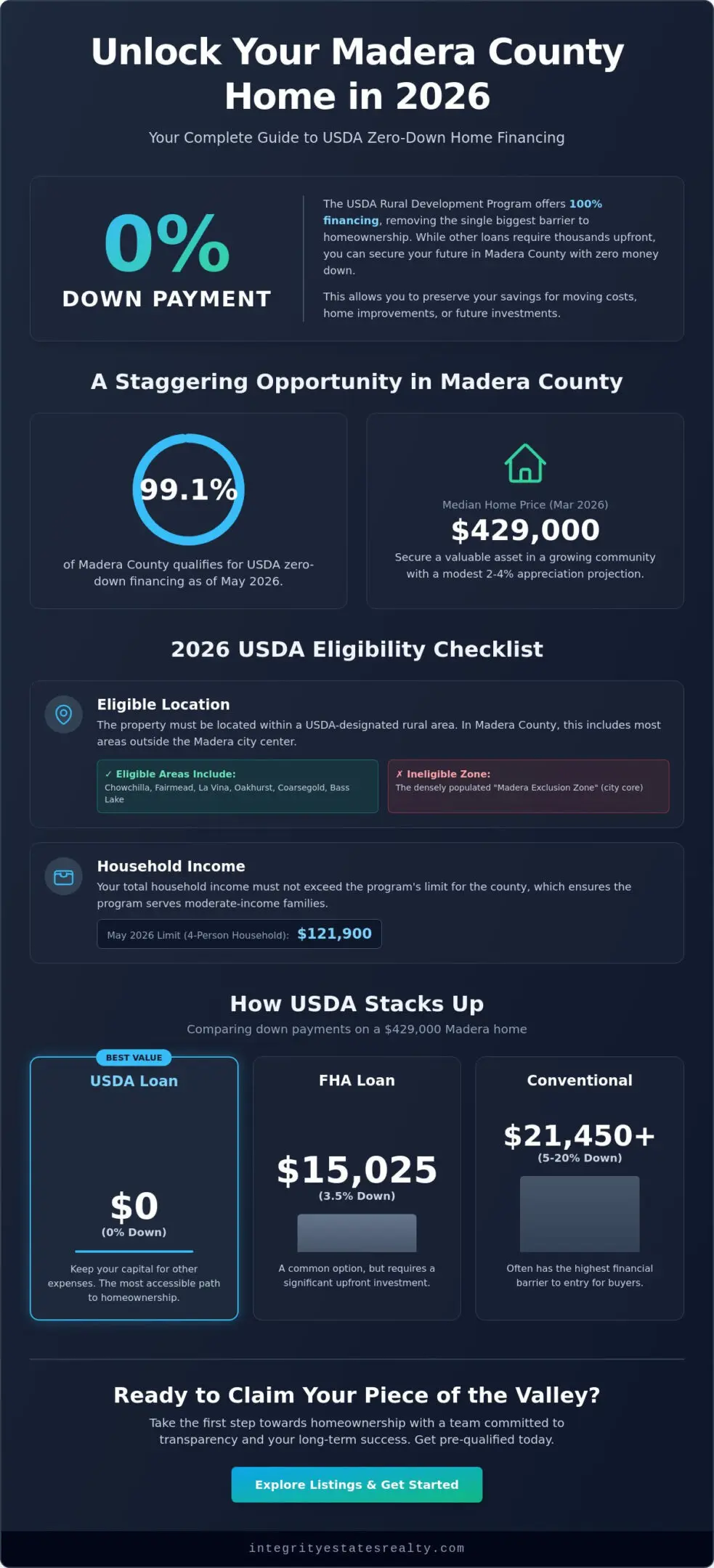
What if you could secure a modern sanctuary in California’s Central Valley without the burden of a massive down payment? While many buyers believe they’re priced out of the 2026 market, the truth is that a staggering 99.1% of the region qualifies for zero-down financing. You likely feel the weight of the $429,000 median home price in Madera County, and it’s natural to worry that “rural” financing means living miles away from modern conveniences or being disqualified because of your salary. We understand that finding an ethical partner to guide you through these complex definitions is essential for your peace of mind.
This guide identifies the specific USDA eligible areas madera county offers, including suburban pockets in Chowchilla and surrounding communities that provide a perfect backdrop for your family’s legacy. You’ll discover the updated May 2026 income limits of $121,900 for a four person household and learn how to leverage a 5.73% interest rate to transition from renter to homeowner. We’re here to show you exactly how to claim your piece of the Valley with transparency, professional expertise, and a commitment to your long-term success.
Key Takeaways
- Grasp the distinct advantages of the USDA Rural Development program and how it provides a seamless path to homeownership with no down payment.
- Navigate the precise boundaries of USDA eligible areas madera county to find a community that matches your lifestyle and commute needs.
- Determine your eligibility by examining the latest 2026 household income limits and the specific property conditions required for successful loan approval.
- Compare USDA financing against FHA and conventional options to see why this program is often the most strategic move for Madera buyers this year.
- Prepare for your home search with a methodical pre-qualification step that empowers you to act decisively when you find your ideal suburban sanctuary.
What is a USDA Loan and Why is Madera County the Ideal Target?
The USDA Rural Development Single Family Housing Guaranteed Loan Program acts as a vital bridge for families seeking a sanctuary without the immediate financial barrier of a massive down payment. Unlike conventional financing that often demands 5% to 20% upfront, the USDA program is backed by the federal government to encourage homeownership in designated regions. This makes USDA eligible areas madera county some of the most sought-after real estate in the Central Valley. As of May 2026, with 99.1% of the county qualifying for this program, the opportunity for buyers to secure a home with zero money down has never been more accessible.
This program isn’t just a financial tool; it’s a commitment to community growth. By removing the down payment hurdle, the USDA allows you to focus your resources on creating a home that reflects your values. Whether you’re a first-time buyer or looking to establish a long-term legacy, the stability of a government-backed loan provides a sense of reliability that is rare in a fluctuating market. Madera County’s unique blend of agricultural heritage and suburban expansion makes it a premier destination for those who want the best of both worlds.
The 0% Down Payment Myth
One common misconception is that “zero down” financing died out decades ago. In reality, the USDA loan remains a cornerstone of affordable housing, offering 100% financing to those who meet specific income and location criteria. When you compare this to the 3.5% minimum required for FHA home loans in Gilroy, the savings are substantial. For a $429,000 home, which is the median price in Madera as of March 2026, an FHA loan requires over $15,000 just for the down payment alone. The USDA option allows you to keep that capital in your pocket for moving costs or home improvements. Don’t let the term “rural” mislead you. Many of these eligible areas include established suburbs with paved streets, modern schools, and local shopping centers.
Madera County: A Growing Hub for Families
The 2026 real estate market shows a clear shift in how families view the Central Valley. Many professionals are migrating from the high-density Bay Area and Fresno to find a balance between professional ambition and personal peace. Madera County offers this equilibrium perfectly. It provides a seamless transition from the busy employment hubs to the quiet beauty of the Sierra Nevada foothills. With home prices showing a modest 2% to 4% appreciation projection for the coming year, acting now allows you to build equity in a community that values legacy and long-term stability. It’s about finding a place where your story can unfold in a home that belongs to you from day one.
Mapping USDA Eligible Areas in Madera County: From Chowchilla to the Foothills
Understanding exactly where you can plant your roots is just as vital as knowing how you’ll finance them. While 99.1% of the county qualifies for zero-down financing, the “Madera Exclusion Zone” consists of the densely populated city center of Madera. If your search begins within the city’s core, you’ll likely find yourself outside the program’s reach. However, just a few miles beyond those city limits, the landscape opens up into a variety of USDA eligible areas madera county offers, ranging from quiet valley suburbs to majestic mountain retreats. Finding the right pocket requires a blend of map precision and local insight to ensure your chosen property meets every federal guideline.
The Valley Floor: Chowchilla and Fairmead
Chowchilla has evolved into a premier destination for families who desire a small-town atmosphere without sacrificing modern residential developments. The community vibe is rooted in a sense of shared history and local pride, making it a perfect place to build a lasting legacy. Nearby, areas like Fairmead and La Vina provide excellent opportunities for budget-conscious buyers who want to maximize their purchasing power. Chowchilla stands as the primary target for 2026 USDA applicants seeking modern amenities and community-focused living. If you’re looking for a fresh start, exploring our current listings can help you identify properties that align with these specific geographic benefits.
The Foothills: Oakhurst, Coarsegold, and Bass Lake
For those who view their home as a personal sanctuary, the Sierra Nevada foothills offer an unparalleled lifestyle curation. Living near the gate of Yosemite in Oakhurst or Coarsegold means trading city noise for breathtaking vistas and crisp mountain air. These communities are USDA havens because their larger lot sizes naturally align with the program’s preference for non-urban settings. Coarsegold, in particular, offers the space and privacy that many modern families crave. Further into the mountains, Ahwahnee and Raymond provide a sense of seclusion and peace that is becoming increasingly rare in the California market.
The “Ranchos” and Madera Outskirts
A common point of confusion for buyers is the eligibility of the Madera Ranchos and Bonadelle Ranchos. Despite their sophisticated, suburban feel and proximity to Fresno, these areas remain fully eligible for USDA financing. This is because they sit outside the primary Metropolitan Statistical Area (MSA) boundaries that often disqualify more urbanized zones. When you’re looking at properties along the Madera-Fresno border, it’s essential to check the specific Assessor’s Parcel Number (APN) against the official USDA map. This methodical approach ensures that you don’t fall in love with a home only to find it sits on the wrong side of an invisible eligibility line.
2026 USDA Eligibility: Madera County Income and Property Requirements
Securing a home in USDA eligible areas madera county requires more than just finding the right location; you must also align with specific financial and structural criteria. The USDA program is designed for moderate-income families, ensuring that the dream of homeownership remains accessible to those who are often squeezed by rising costs. These guidelines provide a clear framework for both your household budget and the condition of the property you choose to call home. Our role is to act as your steadfast guide, helping you navigate these requirements with the precision and care your future deserves.
Income Limits for Madera County Households
Effective May 1, 2026, the income limits for Madera County are specifically tailored to the local economy. For a household of one to four people, the limit is $121,900. Larger families of five to eight people have a higher threshold of $160,950. If your gross income sits just above these numbers, don’t lose hope. The USDA allows for specific deductions, such as childcare expenses for children under 12 or medical expenses for elderly household members, which can lower your qualifying income. This accessibility is a stark contrast to the Gilroy real estate market trends, where higher entry costs often require significantly larger salaries and down payments. We prioritize these nuances to ensure your path to a new home is as seamless as possible.
USDA Property Standards: What the Home Must Look Like
The home itself must meet the “Safe, Sound, and Sanitary” standard. This means that while you don’t need a luxury estate, the property cannot be a major “fixer-upper” with structural issues, peeling lead-based paint, or hazardous electrical systems. The roof must have a reasonable remaining life, and the plumbing must be fully functional at the time of the appraisal. A common myth suggests that homes with in-ground swimming pools are ineligible, but this is no longer the case. As long as the pool is in safe, working condition, it won’t disqualify your purchase. Regarding land, the USDA generally prefers properties that are “modest for the area.” While a large commercial farm won’t qualify, a property with a few acres in the Coarsegold foothills is typically acceptable if it fits the character of the neighborhood.
Your credit profile and debt-to-income (DTI) ratio are the final pieces of the puzzle. Most lenders look for a minimum credit score of 640 to utilize the automated approval system. If your score is lower, a manual underwrite may still be possible, provided you have a strong history of reliability. Generally, the USDA prefers a total debt ratio of 41% or less, though exceptions are often made for borrowers with high credit scores or significant cash reserves. This methodical verification process is part of our commitment to transparency, ensuring you move forward with absolute confidence in your buying power.
Strategy: Why USDA is the Best Move in the 2026 Madera Market
In a market where the median home price holds at $429,000, choosing the right financing is a strategic decision that impacts your family’s financial legacy. While many buyers instinctively look at traditional loans, the USDA eligible areas madera county offers provide a unique path to equity without draining your savings. Our approach at Integrity Estates Realty focuses on identifying properties that not only meet federal standards but also provide the long-term peace of mind you deserve. By leveraging the specific geographic benefits of Madera, you can secure a home that serves as both a financial asset and a personal sanctuary.
USDA vs. FHA: The Battle for Affordability
The financial logic behind a USDA loan is compelling when compared to other government-backed options. For instance, an FHA loan requires a 1.75% upfront mortgage insurance premium and an annual fee that typically sits at 0.55%. In contrast, the USDA program features a lower 1.00% upfront fee and a 0.35% annual fee. This difference directly reduces your monthly obligation, keeping more capital in your pocket for lifestyle curation and home improvements. Choosing USDA means you don’t have to sacrifice your liquid cash just to enter the market. For those looking ahead at their long-term wealth strategy, our refinance mortgage Gilroy guide outlines how you can eventually transition into different loan products once you’ve built significant equity in your property.
Negotiating in Madera County
Success in the 2026 market requires more than just a high credit score; it requires a sophisticated negotiation strategy. One of the most powerful tools in our arsenal is the ability to ask for seller concessions. The USDA allows sellers to contribute up to 6% of the purchase price toward your closing costs. On a median-priced home of $429,000, this represents $25,740 in potential credits. This strategy can result in a true zero-dollar out-of-pocket move, allowing you to transition from renting to owning without a massive financial shock. We specialize in identifying “USDA-ready” homes that already meet strict appraisal standards, which helps you avoid the stress of unexpected repairs or closing delays. Working with an agent who understands Madera’s rural nuances ensures that your offer is structured with both precision and integrity. To begin your search for an eligible home, you can view our curated property listings today.
Start Your Madera County Home Journey with Integrity
The journey to your new front door shouldn’t be a source of stress. When you choose to work with an integrated real estate and mortgage brokerage, you eliminate the friction that often stalls traditional transactions. At Integrity Estates Realty, we provide a seamless experience by aligning your financial strategy with your property search from the very first day. Finding the perfect home within the USDA eligible areas madera county requires a guide who understands both the federal map and the nuances of local mortgage origination. This collaborative partnership ensures that your path to a 0% down home is handled with the transparency and ethical conduct you deserve.
Your journey follows a methodical, three step process designed for your peace of mind. First, we begin with an Integrity Pre-Qualification to establish your true buying power in the 2026 market. Second, we launch a targeted property search in eligible zones like Chowchilla or the Oakhurst foothills, focusing on homes that meet strict USDA standards. Finally, we guide you through a seamless closing process, where every detail is managed with precision. This holistic approach bridges the gap between a house as a financial asset and a home as a sanctuary for your family’s future.
Why a Local Expert Matters
Experience is the anchor of a successful real estate transaction. Maria Elena “Nena” Arriaga brings over 20 years of dedicated service to the Central Valley, offering a level of sophisticated market analysis that few can match. We don’t view our clients as mere transactions; we view them as long-term partners. Our philosophy is rooted in the idea of being a steadfast guide through every major life decision. Whether you’re looking for a modern suburban development or a private mountain retreat, our deep local roots mean we understand the culture and the “story” behind every neighborhood. We prioritize your legacy over a quick sale, ensuring that your investment stands the test of time.
Your Next Steps to Homeownership
The 2026 Madera market is moving quickly, but you don’t have to navigate it alone. We invite you to take advantage of our Lifestyle Curation service to find the community that perfectly aligns with your personal aspirations. You can request a custom USDA eligibility map for your specific target area to see exactly where your 0% down options are located. This data-driven approach removes the guesswork and allows you to move forward with absolute confidence. It’s time to stop wondering if you’re priced out and start planning your future in a home you love. Contact Integrity Estates Realty for a Madera County USDA consultation and let us help you write the next chapter of your story.
Your Path to a Madera County Sanctuary Starts Here
The opportunity to secure a home with zero money down in 2026 is a rare financial gift for Central Valley families. By identifying the specific USDA eligible areas madera county offers, you’ve already taken the first step toward building a lasting legacy. Whether you’re drawn to the modern developments in Chowchilla or the quiet beauty of the Coarsegold foothills, the path to homeownership is clearer than it has been in years. You now have the essential knowledge to navigate the 2026 income limits and property standards with absolute confidence.
Integrity Estates Realty provides the professional expertise and local pride needed to turn this data into a reality. With over 20 years of California real estate expertise and an integrated mortgage brokerage for faster approvals, we ensure your journey is both efficient and transparent. We’re deeply rooted in Madera and Fresno communities, and we treat your purchase as the start of a lifelong partnership. It’s time to stop dreaming of a sanctuary and start living in one. Find Your USDA-Eligible Dream Home in Madera County and let us guide you home with the reliability and integrity you deserve.
Frequently Asked Questions
Is the city of Madera eligible for a USDA loan?
The core city limits of Madera are currently ineligible for this program. However, 99.1% of the surrounding region remains qualified, making USDA eligible areas madera county incredibly diverse for buyers who look just outside the city center. This includes the outskirts and rural pockets that provide a suburban feel with the benefit of zero-down financing.
What are the income limits for USDA loans in Madera County for 2026?
For 2026, the household income limit for a family of one to four people is $121,900. Larger households with five to eight people have a limit of $160,950. These figures are higher than the national standard of $119,850 to account for the specific economic landscape of California’s Central Valley, ensuring more local families can qualify for a sanctuary of their own.
Can I buy a mobile or manufactured home with a USDA loan in Madera?
Yes, you can purchase a manufactured home if it’s a new unit and placed on a permanent foundation. The USDA also has specific pilot programs that may allow for the purchase of existing manufactured homes if they meet strict age and structural requirements. We’ll help you verify if a specific property meets these federal standards before you commit to an offer.
How much are the closing costs on a USDA loan in California?
Closing costs typically range from 3% to 5% of the total purchase price. On a $429,000 home, this represents approximately $12,870 to $21,450. One major advantage of the USDA program is that sellers can contribute up to 6% of the purchase price toward these costs, which often allows our clients to move in with no out-of-pocket expenses at the closing table.
Do I have to be a first-time homebuyer to use a USDA loan?
No, the USDA loan is available to both first-time and repeat homebuyers. While 89% of active USDA-backed loans in Madera County are held by first-time buyers, the program is open to anyone who meets the income and location requirements. You must use the home as your primary residence and you cannot currently own another “adequate” home in the local area.
What credit score do I need for a USDA loan in Madera County?
Most lenders require a minimum credit score of 640 to qualify for the USDA’s automated underwriting system. If your score is slightly lower, we can sometimes pursue a manual underwrite, provided you have a reliable payment history and stable income. Maintaining a score of 640 or higher generally ensures a smoother, more predictable path to approval and a seamless closing experience.
How long does the USDA appraisal process take in the Central Valley?
The appraisal itself usually takes 7 to 14 days to complete once it’s ordered. The entire loan process, from the initial application to the day you receive your keys, typically spans 30 to 45 days. Our integrated brokerage model helps expedite this timeline by ensuring all financial documentation is meticulously prepared before the property search even begins.
Can I use a USDA loan to buy land and build a house in Oakhurst?
Yes, the USDA offers a “Single-Close” Construction-to-Permanent loan that allows you to finance the lot purchase and the construction costs simultaneously. This is a popular option in the Oakhurst and Coarsegold foothills, where families often want to build a custom legacy home. You’ll need to work with a USDA-approved builder to ensure the project meets all federal safety and quality guidelines.